

What’s Driving the Blaze Credit Union Merger?
For many decades, credit unions had a reputation for being friendly, small, workplace-based organizations where people could get car loans and other financial services. Members often knew the people handling their paperwork and finances, so they didn’t feel like a number being processed through a large system.
St. Paul-based Hiway Credit Union got its start in 1931 within that type of environment. It sprang up during the Great Depression to serve Minnesota Highway Department employees.
On Jan. 1, Hiway will merge into the Spire Credit Union with the resulting credit union managing assets of nearly $4 billion, serving about 250,000 members, and employing about 650 people.
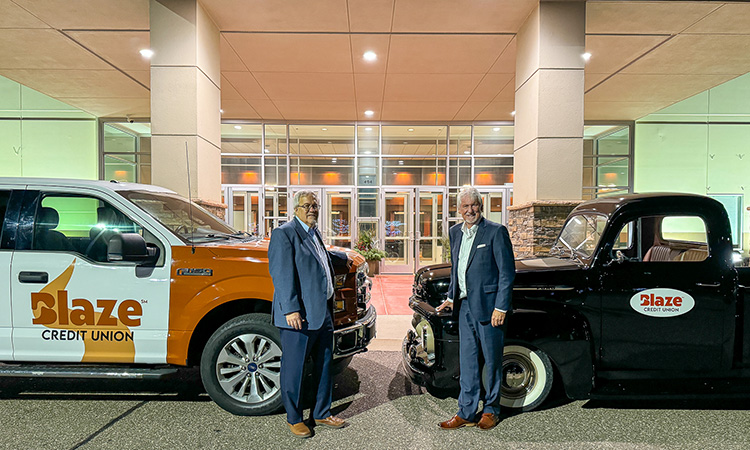
The combined entity will be called Blaze Credit Union, becoming the fourth-largest credit union in Minnesota. It will be headquartered in Falcon Heights at 2025 Larpenteur Ave. W., which is near the Minnesota State Fairgrounds. Dan Stoltz, Spire president and CEO, will serve as the Blaze CEO, while Dave Boden, Hiway president and CEO, will become Blaze president.
“Everybody was supportive, even from the first time we talked about it, because we approached it purely as a merger of equals,” Boden said, during a joint interview with Stoltz at Spire’s longtime offices in Falcon Heights.
“The consolidation in the credit union market and community bank market is going quickly,” Stoltz said. Nationally, there were 5,376 credit unions at the end of 2018, but that number had fallen to 4,686 by June of this year, according to the National Credit Union Administration.
Minnesota lost about one-fifth of its credit unions over that time frame—dropping from 107 to 87. Yet numbers provided by the Minnesota Credit Union Network show the surviving credit unions are the beneficiaries of growth in members and assets.
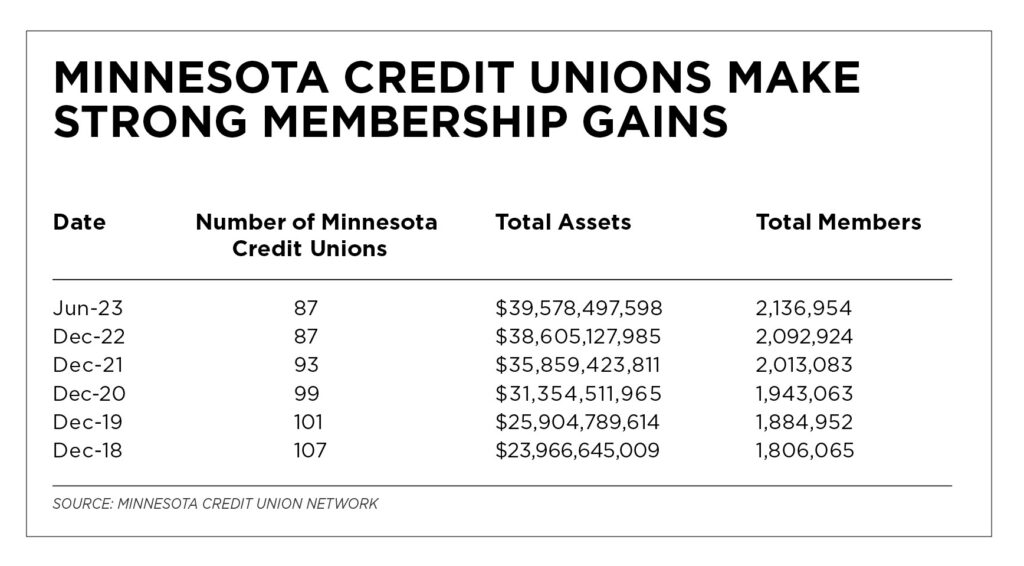
The number of people who belong to Minnesota credit unions has risen from about 1.8 million in 2018 to more than 2.1 million in 2023. Simultaneously, the asset base of Minnesota credit unions has jumped from nearly $24 billion to almost $40 billion over the same period.
Across the United States, there are multiple factors driving the decisions to merge credit unions into larger organizations. “I would say regulatory compliance overload, technology, innovation, and I just think that customer demand and competition is stronger,” Stoltz said. “They are demanding more, so you need more resources and stronger talent.”
The Filene Research Institute, based in Madison, Wisconsin, is tracking the restructuring that’s unfolding in the credit union sector. Taylor Nelms, who studies cooperative finance at Filene, expects credit union consolidation to continue. “Growing competitive pressures, member expectations about technology, and shrinking margins all mean that it is critical for credit unions to find and leverage opportunities to grow and scale through collaboration,” Nelms wrote in a 2022 analysis article.
Spire and Hiway were both sound financial operations as independent organizations. But Boden said there’s intense competition for employees and members, who have increased service expectations for branches and digital offerings. “We felt there’s a point where we would need to scale our resources,” Boden said. He anticipated that Hiway would need to make a “bold move,” not simply to serve customers for the next three to five years, but for its future 10 to 20 years from now.
‘High touch and high tech’ member benefits
When Delta and Northwest airlines announced their proposed merger in 2008, the combined carrier was expected to benefit from Northwest’s technical expertise and reliable operations and Delta’s reputation for friendly customer service.
In the marriage of Spire and Hiway, Spire is bringing a large network of branch offices to the union and Hiway is providing strong technology elements.
“Spire had a much larger branch network,” Boden said. “They had 22 going in and we had four, so that was a way for our members to see a much larger branch network throughout Minnesota.”
Meanwhile, Stoltz said, “[Hiway] had a technology platform that we wanted to go to that they just did.” In addition to the operating systems that Hiway offered, it also had experience with using Interactive Teller Machines (ITMs). “We want to be known for the greatest service in the marketplace,” Stoltz said, emphasizing the need for Blaze to provide “high touch and high tech” customer service.
Stoltz and Boden emphasized that they and their governing boards don’t want to lose the personal touch they’ve been providing in their customer service. “We call people by name,” Stoltz said, and he wants that facet of Spire maintained after the combined organization is much larger.
Boden anticipates that Hiway customers will have even more opportunities for face-to-face service after the merger. “As you grow and expand your branch network, you are actually making it easier to facilitate providing local service and have somebody there that you know and can walk in and talk to,” he said.
As the merger is implemented, Stoltz and Boden anticipate there will be financial benefits for Blaze Credit Union members. Their goal is to be the best credit union in the state of Minnesota.
In preparation for the merger, Spire and Hiway compared their customer fee structures. “Whoever had the lowest fees, we adopted that,” Stoltz said. Over time, he also predicted that members would see more favorable interest rates, because the larger credit union will derive some financial benefits through operational efficiencies.
In leading a not-for-profit financial cooperative, Stoltz and Boden will be aiming for a 1% return on assets for Blaze’s income. On an asset base of about $4 billion, the 1% would be $40 million, which would then be allocated to member givebacks, investments in the organization, and a reserve fund.
Finding a compatible merger partner
In early 2020, three major Twin Cities law firms executed mergers that were part of a national consolidation trend. In some cases, the search for the right merger partner took years as well as outside consultant help.
In the case of Spire’s Stoltz and Hiway’s Boden, their path to a merger was much more low-key and neighborly. They have both been based in Ramsey County and each has chaired the Minnesota Credit Union Network.
In May 2022, Spire and Hiway were among the four credit unions that formed United Financials Capital LLC, which provided them the ability to make larger commercial loans.
In addition, Spire and Hiway have been making charitable contributions to many of the same community organizations. “We do it because it’s the right thing to do,” Stoltz said. “I would go to an event and who is in the booth next to me? Hiway. I’d be at another event, and Dave would have a table at a gala next to me. We’d be running into each other all the time on all of this community give back, which we both believe in.”
Both credit unions are longtime supporters of Gillette Children’s Hospital, food and shelter nonprofits, veterans and military organizations, and youth education and job experience programs. They also offer presentations and programs on financial literacy and wellness.
The Stoltz-Boden relationship was a foundation for the ultimate merger discussions at the board level. “We just get together now and again and talk about how things are going,” Boden said, and they would sometimes mention that they might consider a merger.
“That just evolved into the last couple of years where it was a little more serious discussion,” he said. “Dan had some thoughts specifically about how this might work. Then I took it to our board as well.”
They each used the same PowerPoint presentation when they spoke to their boards about the rationale and benefits of a merger. “We both started with the values and vision,” Stoltz said. “The values of our cultures and the values of what we place in the community were exactly the same and our vision was the same. We needed to see growth, and we wanted to be impactful in the community.”
Through a combination, Stoltz said that Spire and Hiway could offer their members more products. “We’re confident that there will be better pricing through the scale,” he said, meaning better interest rates for members.
In mid-September, Hiway announced that more than 80% of voting Hiway members had approved the merger.
Growing the credit union, enhancing employee benefits
When the merger was reviewed this summer by the National Credit Union Administration, Spire had about $2.1 billion in assets and more than 157,000 members, while Hiway had about $1.7 billion in assets and more than 90,000 members.
“If you live, work, worship, volunteer, attend school, or do business in 31 counties in Minnesota and Wisconsin, you qualify for membership in Blaze Credit Union,” according to Casey Carlson, Spire’s chief marketing officer.
“This includes all Minnesota metro counties and counties ranging as far north as Itasca and St. Louis, as far south as Blue Earth and Waseca, as far west as Stearns and Morrison, and as far east as St. Croix in Wisconsin,” Carlson said.
If Minnesota and Wisconsin residents live outside that 31-county region, they will still be able to join the Blaze Credit Union. In that case, the person can join after making a $10 donation to the credit union’s foundation, he said.
Spire’s geography has grown into different Minnesota regions because small credit unions have been merging into the Twin Cities-based financial organization.
Before forming a partnership with Hiway, Spire did 10 mergers in the last nine years, Stoltz said. “None of them were predatory in nature,” he said. “They were very much passive, where people have come to us.”
As Spire and Hiway embark on their merger, Stoltz says their mission is simply to “improve lives.” They are striving to do so by the type of financial products offered to members as well as how they are accessed—digitally or at branch locations.
Stoltz envisions a three-legged stool when he defines the growth strategy of Blaze. The credit union’s leadership will be discussing an “aggressive expansion” strategy with the Blaze board, which will consist of the current Spire and Hiway board members.
The first part of the strategy is to attract new members, while the second element is educating existing members about the different products the credit union offers.
Part three of the strategy is doing some small mergers. It’s unlikely that another merger of equals is on the horizon, Stoltz and Boden said.
“We just want to be attractive to other organizations,” Boden said. “There are a lot of credit unions with assets of $250 million, $500 million to $1 billion. Realistically, these organizations need scale to offer all of the same things.”
Among the many choices for financial services, Stoltz and Boden want Blaze to be top of mind for consumers. “Our vision is pretty bold,” Stoltz said. “We want to be Minnesota’s best” credit union. That doesn’t necessarily mean the largest in the state, but he maintains that the best service will drive growth.
Blaze’s leaders also want their credit union to be well-regarded by current and potential employees. Since they made the merger deal, they’ve boosted some pay rates and assembled a better employee benefits package.
They’ve established a minimum base pay of $20 an hour for Blaze employees. Both said their starting pay for tellers had been slightly under that figure.
Through the combination of the two organizations, they also said it will create more opportunities for advancement and increased compensation as employees are promoted within the bigger credit union.
With the desire to be “the best organization for employees in Minnesota,” Boden said that Spire and Hiway leaders have been comparing their employee benefits and selecting the best benefits for the Blaze package.
“Spire offered an extra percent on 401 (k), so we went to that,” Boden said. “We had a paid leave program. We put that out to the whole [Blaze] organization.”
Blaze is avoiding layoffs and all of the branches operated by the two credit unions will remain open.
Becoming and governing Blaze
While the merged credit union will carry the new name Blaze, Boden said the organization is built on the Midwestern values of hard work and trust that were present at Spire and Hiway. “But Blaze was partly conceived to also indicate that progressive, moving forward attitude,” Boden said. “We’re there for stuff down the road, and we want to be there for you.”
After starting the process with about 100 names, the two organizations ultimately ended up with Blaze, which is linked to blazing a trail and providing guidance and navigation.
“You know people aren’t going to like a name change,” Boden said. “Your core members may not love it.” In part, that’s because generations of families have been members of the two credit unions.
But the leaders said they’re pleased that the Blaze name tested well with people in all demographic groups.
“It is blazing trails and being trailblazers,” Stoltz said. “So, it’s helping people on blazing their own trail.”
One trail that Stoltz and Boden will be traveling is the 15-minute drive between Stoltz’s headquarters in Falcon Heights and Boden’s headquarters in St. Paul. While the credit union will technically be based in Falcon Heights, they plan to retain the buildings they own at their respective headquarters.
But the men also want to have a presence at both facilities where they have employees in key positions.
“Office buildings are priced at a ridiculous low right now because of vacancies,” Stoltz said. “So we plan to keep the administrative offices for the short term. That could be two to three years.”
As CEO, Stoltz will be reporting to a 17-member board of directors. That will consist of all nine current Hiway board members and eight current Spire board members. Stoltz served on the Spire board, and his resignation from the board takes effect Dec. 31.
It might take three to five years to get back to a more normal-sized board, Stoltz said. Because credit union members have such a personal investment in their board service, Stoltz understands why he will be working with a large board.
“We thought for year one and year two, everybody wants ownership,” Stoltz said. “Everybody wants to see that what we said we were going to do does happen.”