

Walgreens Opens Micro-Fulfillment Center in Brooklyn Park
Walgreens is continuing its national rollout of micro-fulfillment centers—or, facilities that use automation to fill prescriptions. Its first in Minnesota opened Tuesday.
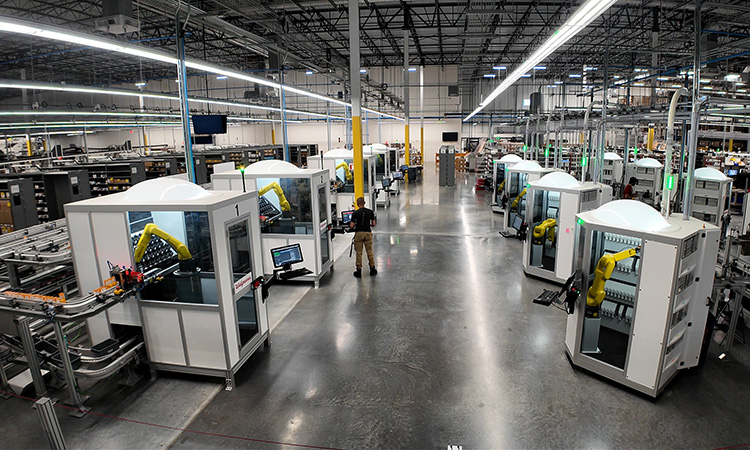
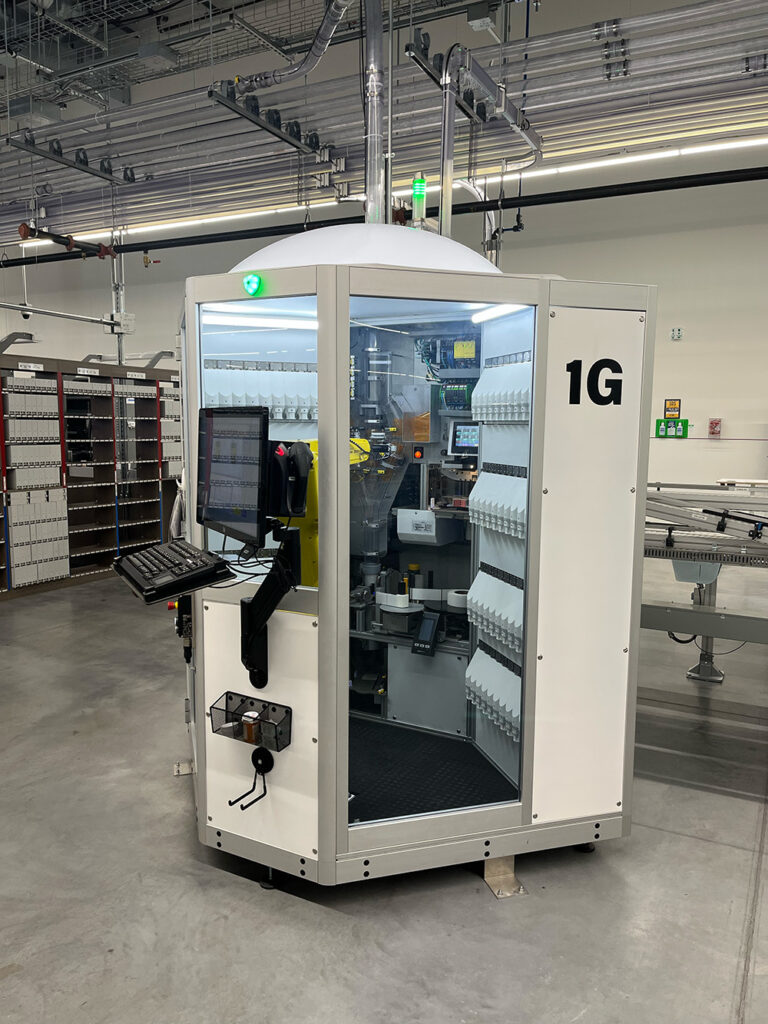
In a Brooklyn Park business center off Highway 169, pneumatic tubes, robotic arms, and conveyor belts are set to fill, cap, and bag millions of prescriptions a year for shipping out to 145 Walgreens retail stores across the state, along with 55 stores throughout the Midwest. The goal: free up in-store pharmacists, so they can focus more on patient care and less on routine refills.
“That’s allowing the pharmacist to operate at the top of their education and do what they’re trained to do,” says Kayla Heffington, vice president of Walgreens’ pharmacy operating model, “which is to talk to you about your medication and your therapy and your counseling, and explain to you why immunization might be really critical.”
Walgreens began opening these facilities in 2021. With the Brooklyn Park location, it operates 12 micro-fulfillment centers nationally, which support more than 5,000 stores. (The closest to Brooklyn Park’s center are in Bolingbrook, Illinois, and Liberty, Missouri.)
Minnesota’s 53,000-square-foot plant is expected to process 12.7 million prescriptions a year. For scale, Walgreens’ micro-fulfillment centers are on pace this year to fill 180 million prescriptions total. In store, that amounts to about 40% of prescription volume, according to Walgreens.
To help open the center, the state awarded the city nearly $3 million, per Brooklyn Park reporting, tapping $2 million through the Minnesota Job Creation Fund and $775,000 through the Minnesota Investment Fund. At the ribbon cutting Tuesday, Brooklyn Park business development coordinator Malcolm Hicks described the facility as an investment “in the future of health care, logistics, and the people of Brooklyn Park.”
The center is expected to create more than 175 local jobs, a mix of full-time and part-time, according to Walgreens. Most will be pharmacy technicians running machines, Heffington says. Matt Cook, vice president of central fulfillment operations, characterizes work at the center as 85% automated and 15% manual.
The center is also expected to take phone calls out of stores, reduce inventory waste, and centralize data entry. Patients will be able to track prescriptions in real time. “[Prescriptions are] scanned when they go into the tote [for shipping],” Heffington says. “They’re scanned when the tote leaves the facility. We have constant tracking of where the prescription is.”
This way, patients can check the timing of prescriptions’ arrival in stores from the center. Heffington says most will be able to reach their destination within 24 hours. “If you were to say, ‘No, that doesn’t work for me—I need it now,’ we would say, ‘No problem—we’ll fill it locally.’”
Partly because it’s in a high-volume region, Minnesota has been high on Walgreens’ list for a micro-fulfillment center. “Twenty-five of [Walgreens’] top 100 stores in the country, from a volume perspective, will be serviced by this facility,” Heffington says.
Brooklyn Park makes sense geographically, adds Rick Gates, chief pharmacy officer for Walgreens. “This [center] covers stores in South Dakota, some stores in Iowa, some in Wisconsin, and in Michigan. It just gives us a really good geography to get out to those stores, as well.”
The Brooklyn Park center opens amid significant changes for Walgreens. In March, Walgreens Boots Alliance (of which Walgreens is a subsidiary) entered a definitive agreement to be sold to a private equity firm, Sycamore Partners, which would end its nearly 100-year run as a publicly traded company.
The center also debuts during a turnaround for Walgreens. Lower reimbursement rates for prescriptions have troubled the drugstore industry, and pharmacies have faced understaffing, worker protests, and online competition (from Amazon, for example, whose prescription delivery service launched in 2020). In other hard news, the pharmacy giant last month agreed to pay up to $350 million in a settlement related to unlawful opioid prescriptions. And in late 2024, the company announced it would close about 1,200 stores over the next three years.
For stores in the Midwest, Brooklyn Park’s micro-fulfillment center represents a potential boost to Walgreens’ service “ecosystem,” as Gates describes it. “We find that most customers still want to engage at the local level,” he says. “We’re building an ecosystem where, however you want to engage us for your pharmacy needs, we’re here for you.”