

Sustainable Aviation Fuel Facility Coming to Rosemount
A new sustainable aviation fuel facility in Rosemount is expected to be completed by the end of next year, a group of Minnesota business leaders announced at a press conference at Minneapolis-St. Paul International Airport on Tuesday.
It’s being built at Flint Hills Resources’ existing Pine Bend refinery in Rosemount. The company, which is owned by Koch Industries, is working with Delta Air Lines to develop the facility.
Officials described the still to-be-built project as a “blending facility,” meaning it will combine sustainable aviation fuel (aka SAF) with traditional jet fuel and then provide it to airlines at MSP Airport.
British oil and gas producer Shell plc will provide so-called “neat” SAF at the facility – that is, pure, unblended sustainable fuel. SAF needs to be blended with traditional aviation fuel before it goes into planes, leaders said. The Rosemount facility is expected to accommodate 30 million gallons of SAF each year. That will then be blended with 30 million gallons of traditional fuel, providing a total of 60 million gallons of fuel a year to MSP Airport.
Notably, that’s just a fraction of all the jet fuel needed at the airport each year; Delta Air Lines, which handles over 70% of flights at MSP, guzzles more than 250 million gallons alone each year. In total, all airlines at MSP Airport used over 330 million gallons of fuel last year. Still, groups behind the project say they’re making a pivotal first step toward more sustainable air travel.
“SAF is a transformational direction in reducing carbon emissions for the nearly 40 million travelers” at MSP Airport each year, said Dana Nelson, director of governmental affairs at the Metropolitan Airports Commission, which owns the Twin Cities airport. “We think the availability of SAF is going to be a growing consideration for our airlines as they talk about new service and new routes, and we want MSP to be in their view.”
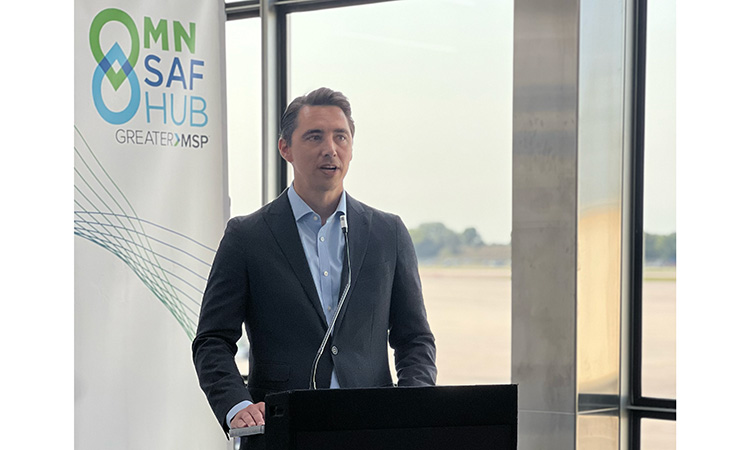
Tuesday’s press conference was a highly choreographed event, featuring a dizzying array of speakers from organizations working on the wider sustainable aviation fuel hub project. Local dignitaries like Lt. Gov. Peggy Flanagan, Ecolab chairman and CEO Christophe Beck, and others spoke glowingly of the future of SAF in Minnesota. Beck said that the new facility is an example of turning challenges into opportunities.
Peter Frosch, CEO of local economic development group Greater MSP Partnership, said the new Rosemount facility sends a signal that the “Minnesota SAF economy is open for business.” Greater MSP is leading the larger SAF hub project.
And yet, by many leaders’ own admission, large-scale production of SAF is still a long ways off. A news release issued by SAF hub coalition members on Tuesday said that the “first large-scale, in-state production of SAF” won’t take place until at least 2028. Before that happens, the main goal is to “get SAF flowing to MSP Airport” over the next three years, according to the release.
Peter Carter, Delta Air Line’s executive VP of external affairs, said that his company’s goal is to use 10% SAF in all flights by 2030. He described it as an “audacious aspiration,” mirroring similar language he used at a sustainability panel in Minneapolis earlier this year.
SAF can be produced through a number of organic materials, such as feedstocks, agricultural biomass, woody biomass, and used cooking oils, according to Greater MSP. With a donation from Cargill, the University of Minnesota is studying the use of two oilseed crops in low-carbon transportation fuels.
The SAF blending facility marks another high-profile development for the city of Rosemount. In March, Facebook parent company Meta Platforms Inc. announced plans to build a new data center there. At the time, mayor Jeffery Weisensel said he aims to transform his city into a “hub of emerging technology.”