

St. Paul Could Convert 10 Office Properties to Housing
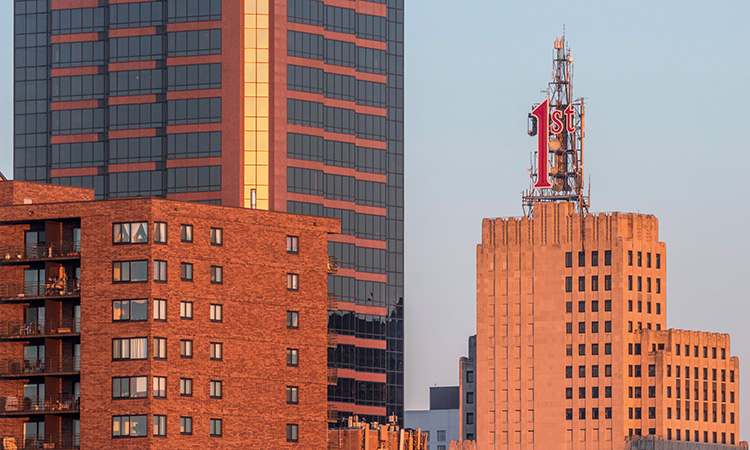
The First National Bank Building, once a prestige office location in the Upper Midwest, is the most compatible property for conversion to housing in downtown St. Paul.
That’s the conclusion of a new study released Wednesday by the Saint Paul Downtown Alliance, which hired architectural and design firm Gensler to assess which office buildings could readily be renovated for housing.
The Downtown Alliance provided Gensler with 20 properties to examine at a time when vacancy rates are high, and St. Paul’s urban core has been hurt by the pandemic’s work-from-home trend. Gensler gave 10 of the 20 properties “category 1” scores, which the firm defined as “good candidates for conversion, success likely.”
If all 10 properties were renovated for housing, Gensler estimates it would create 3,951 new housing units. Downtown St. Paul has 10,572 residents, according to the latest population tally reported by the Downtown Alliance.
Four sections of the First National Bank property were evaluated for their potential as housing spaces. One section—floors eight to 27 in First National’s building one at 332 Minnesota St.—achieved a 95% compatibility rating as “potentially suitable for conversion to residential.” It was the highest score given among the St. Paul properties that were studied.
Gensler looked at five factors when assessing the properties, including the floor plate and the building’s form. Other considerations were services, such as parking and loading access, as well as walkability and proximity to transit. Criteria five, listed as building envelope, consisted of sight lines and the distance between adjacent buildings.
The First National Bank Building, constructed in 1915, is a Madison Equities property that was owned by Jim Crockarell. Following his January death, First National and several other Madison Equities buildings were put up for sale this past spring.
“This stacked building has an articulated façade in the middle section of the building increasing daylight to the building interior,” the Gensler report said of the First National Bank Building. “Units would likely be focused on the east, south, and west sides of the building to maximize daylighting. The floor plate will likely yield close to ideal market size units.”
Two other properties broke the 90% mark in Gensler’s rating system. Those strong candidates for housing units are U.S. Bank Center, floors six through 26, at 101 Fifth St. E., and Park Square Court, 400 Sibley St.
Seven additional properties and a second First National Bank building earned category 1 ratings, meaning they scored well enough in Gensler’s study to merit more detailed feasibility studies.
They are: 375 Jackson building, 375 Jackson St.; Alliance Center, 55 Fifth St. E.; Empire Building, 360 Robert St. N.; First National Bank, building two, 105 Fourth St. E.; Gallery Professional Building, 17 Exchange St. W.; Great Northern Building, 180 Fifth St. E.; InterContinental, 11 Kellogg Blvd. E.; Town Square Tower 1-UBS Plaza, 444 Cedar St.; and Town Square Tower 2, 445 Minnesota St.
“The results of this preliminary office-to-residential study are encouraging and demonstrate the unique potential we have in downtown St. Paul,” Joe Spencer, president of the Saint Paul Downtown Alliance, said in a Wednesday news release.
“Downtown is poised for one of the greatest transformations in the city’s history,” Spencer said. “This conversion study gives the market a data-based head start to begin conversations around the key role housing can play in reinvigorating downtown.”
The alliance noted that two office-to-residential conversions are underway at the former Ecolab University and Landmark Tower buildings.
Seeking state, federal financial support
In an October Twin Cities Business article, Mayor Melvin Carter and council member Rebecca Noecker talked about the need for government incentives to spur housing redevelopment projects. They were joined in that perspective by B Kyle, president and CEO of the St. Paul Area Chamber.
During the 2024 Minnesota legislative session, St. Paul city and business leaders sought a proposed tax credit that could equal up to 30% of the costs of conversion. This provision wasn’t limited to St. Paul, and it was described as converting underutilized buildings.
St. Paul downtown advocates will return to the State Capitol in early 2025 to make their case for the tax credit. They will face a split Minnesota Legislature and DFL Gov. Tim Walz. The House is evenly divided 67-67, and Democrats hold a one-seat 34 to 33 advantage over Republicans in the Senate.
In response to TCB questions, Spencer provided email comments about how he and other St. Paul leaders are reacting to the current political climate as well as where they’ll be discussing the potential for housing redevelopment in downtown St. Paul.
“We believe that supporting strong downtowns is a bipartisan issue,” Spencer wrote in the email. “The most recent election results clearly tell us that the economy matters, and our downtowns are the economic engine for the entire state. Job growth is still occurring most in strong and vibrant downtowns across the country.”
Spencer serves on the board of the International Downtown Association, which is based in Washington, D.C. In that capacity, he’s contacted members of Minnesota’s congressional delegation to support the Revitalizing Downtowns and Main Streets Act, which has bipartisan sponsors.
Twenty-two people serve on the board of directors of the Saint Paul Downtown Alliance, which is a coalition of business, government, and nonprofit leaders. The Gensler report, which was dated Nov. 8, was released to the news media Wednesday.
Spencer said the report hasn’t been presented to the full board, but it has been shared with the Downtown Investment Strategy working group that focuses on downtown real estate. The working group is co-chaired by council member Noecker and Chris Hilger, CEO of Securian Financial.
The office vacancy rate in St. Paul’s central business district was 31% in the third quarter of this year, according to a report from Cushman & Wakefield. The comparable figure was 33.5% for the Minneapolis central business district.
“We are providing this [Gensler] report to the market via our website to help stimulate interest in downtown buildings,” Spencer wrote in the email. “I am presenting to the Minnesota Commercial Real Estate Women next week, and I will be reaching out to developers to share the report.”