


Some Data Centers Are Good
People really hate data centers. There’s no sugarcoating it – they’ve become one of the most politically toxic issues in the midterm elections, with the governors of previously data center-friendly states like Texas and Pennsylvania lining up as the latest to show their opposition. But if we build them right, there is an opportunity here that Minnesota should embrace.
There has been a lot of discussion about why, but the reasons mostly boil down to concerns about the facilities themselves, from water and electricity usage to noise, and bigger issues with the rapid advance of artificial intelligence and the people that control it, many of whom seem to care very little about potential job losses and societal upheaval. As someone that believes AI will lead to many exciting things for our society, I regret how much the arrogance of some Silicon Valley elites has paved the way for critics to paint their mission in an extremely negative light.
Closer to home, we are not having a full, balanced conversation about the benefits and the drawbacks, and this election season threatens to plunge Minnesota into a place where we never will.
There are important discussions about a couple key areas that are worth looking at individually: water, energy, community benefits, taxes, and construction.
The current state of play in the Twin Cities
The Twin Cities already has 73 data centers, most of which predate the existence of OpenAI, Anthropic, and the current discourse around data centers. This is important to remember because people have begun to conflate “data centers” with the AI tech behemoths, when many data centers are actually servicing old school software companies with very benign products.
Downtown Minneapolis already had nine data centers when the deal to sell the Star Tribune printing plant to a data center developer was announced. Looking at that sale demonstrates how the loudest voices are mostly off-the-mark – the North Loop has some of the most valuable real estate in the entire state, and building the worst type of data center there would be bad for the neighborhood. But in a city with a dwindling tax base driven by a collapse of the commercial real estate market, we need all of the developments that we can get. Every dollar of increased value is a dollar that homeowners won’t have to pay in property taxes. The developer has promised housing and retail (features that the current site does not have), and as an added bonus, a lucrative land sale might be an important way to buoy the newspaper’s finances. A deal structured to benefit the city is a good one, and one the city really needs right now.
The water-and-electricity situation has changed
While many proponents of data centers hand-wave at the water concerns of the facilities, it’s important to take them seriously because they sit at the heart of the opposition. Earlier generations of data centers used “air cooling”, where water is misted into the data center and collectively cooling the entire thing at once. It uses a lot of water, and many of the scary stats about water usage come from this earlier generation of the facilities.
But two new types of cooling have the potential to curtail water usage – “direct-to-chip cooling”, which concentrates cooling at the chip level and massively reduces overall usage, and immersion cooling, a technology pioneered by Rochester-based LiquidCool Solutions which plunges entire servers into a lubricant that virtually eliminates water usage all together. This is a technical problem with a technological solution, but it’s fundamentally solvable. Water does not need to be a reason to ban data centers.
One of the other major concerns people have about the facilities relates to their electricity usage. Research from the Electric Power Research Institute (EPRI) and Tyler Norris at Duke University have pointed out an exciting opportunity, which is that under the right conditions, data centers could actually reduce electricity prices. Those conditions – building needed grid upgrades by themselves without passing costs on to utility customers, and curtailing their power usage at moments the grid is under stress – could be preconditions to building data centers. One idea that’s surfaced for this is a “Large Load Surcharge”, where people looking to bring a really large energy load like a data center onto the grid would pay an extra fee that would go back into upgrading the grid.
This is not an argument that data centers DO lower electricity costs – in fact, looking at what’s happening with utility rates and load growth right now, it looks like they do not. But it is an argument that they could, if built right.
This illustrates why water and energy have become such a big problem for data center proponents – they way that many of these have been done in the past will not work in the future, and arguments about what they could do moving forward need to reflect that fact that many of these have been done irresponsibly in the past.
Taxes and community benefits
If you haven’t noticed, property taxes are exploding pretty much everywhere in Minnesota. Property taxes are up in Minnesota, and with dropping commercial property values, increases are hitting homeowners especially hard. Minneapolis is considering an 11.3% property tax increase. Dakota County is considering a 21% hike. St. Louis County is seeing a 6.3% increase, Carver County is facing a 7.5% increase. This pattern is repeating across the state.
Looking at the places that have been proactive about building data centers, you can see how much communities can benefit from the one type of construction that’s actually growing (more on that below).
An Indiana utility has proposed a rate cut for an area that’s brought lots of data centers onto its grid. Officials in West Virginia have proposed eliminating their income tax and replacing it with data center income. Loudon County, which hosts more than 200 data centers, has cut property taxes by more than 30% over the past decade. Fredrick County, Maryland has negotiated a $110 million package of community benefits. All of these things are possible with the right structures and policies.
Construction
Data center construction continues to expand. At the same time, construction for everything that’s not a data center. This stunning chart from the Wall Street Journal was making the rounds last week:
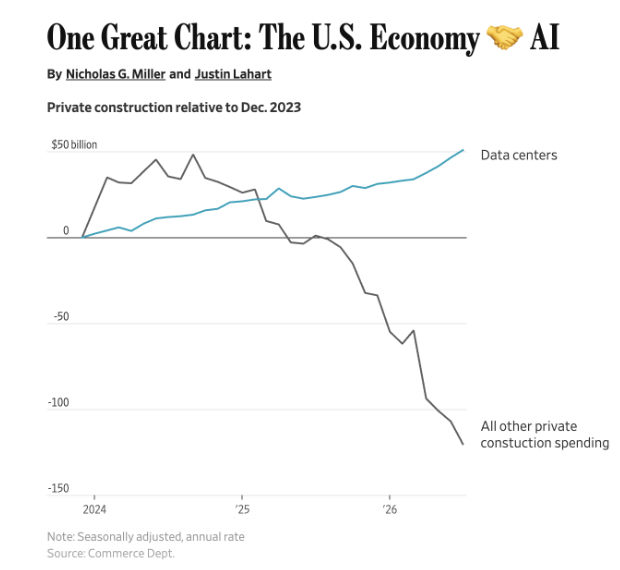
As construction of housing, commercial properties, and more face a contraction, we are facing a situation that is going to put increased pressure on the entire construction industry. If Minnesota follows along with the states pursuing moratoriums or bans, we might lock out the one industry that seems ready to keep a large number of people working in trades employed as the economy wobbles.

Where to put them
A Washington Post columnist proposed an interesting solution last month, which was data centers on brownfields or Superfund sites. Minnesota has 98 sites on the Minnesota Permanent List of Priorities (PLP) Superfund list – what if we cut a deal to force cleanup of contaminated groundwater or remediation of other harmful impacts in exchange for building data centers?
When done wrong, you get facilities like the grotesque Collosus facility, which is built right on a state line in Memphis, dodges sensible restrictions on grid capacity by locating gas turbines across the border in Mississippi, and uses a tremendous amount of electricity and water. Proponents of data centers do themselves no favors by treating abusive developments like these as healthy and viable projects.
Saying yes to every data center under any condition is not only bad policy, it is now politically impossible. But saying yes to some data centers under some conditions could allow Minnesota to jump ahead of the queue in building things in the right ways and under the right conditions that can maximize the benefits for our state and local communities. There’s a way to win here, and it’s not by going the route of the moratoriums. We need to start by agreeing that some data centers are good.