

Is the Amtrak Borealis Train Really Profitable?
On May 21, Amtrak debuted a second train in the St. Paul–Chicago market. Initial ridership was encouraging, prompting a wave of media attention turning all sorts of supposition into fact, including that the train was profitable, had stolen a substantial portion of the air travel market, and would quickly lead to a third and even fourth Amtrak service in the corridor. I’ve been covering rail transportation in the region since the 1990s and the drumbeat of nonsense got so thick on social and mainstream media that I decided to do some of my own ciphering. Here goes:
Some History: Twin Cities–Chicago used to be the most competitive rail corridor in the nation. For much of the 20th century, three to six railroads competed, operating over 20 trains a day in each direction, some traversing the route in under seven hours. Jet travel and interstate highways killed long-distance passenger rail in America, and by the advent of Amtrak in 1971, the route was down to just a couple railroads and fewer than five trains. Amtrak pared it to one, the Empire Builder, which runs Chicago to Seattle/Portland over parts of the old Milwaukee Road and Great Northern (now CPKC and BNSF Railroads). Amtrak briefly funded a second train in the corridor from 1978-1981, an overnight Chicago–Duluth service via St. Paul. Otherwise, it’s been status quo for most of the last 53 years.
What Created Borealis: The history of efforts to improve service in the corridor is too convoluted for this article, but a few years ago states were given responsibility for funding and marketing Amtrak services under 750 miles. (Initially the federal government pays 90% of the cost of those services, but over time the states became increasingly responsible for deficits.) Minnesota, Illinois, and Wisconsin began working to create a second daily Twin Cities-Chicago train. This effort had certain advantages over other regional “wish list” startups that Biden-era funding has encouraged: There was an existing route which already had passenger service, so stations and most of the infrastructure was in place. There was a host railroad, CPKC, that had a good relationship with Amtrak, and a reputation for handling its trains efficiently, which can’t be said for most American railroads. And CPKC was looking for federal approval for its merger, which incentivized it not to fight the multi-state effort. CPKC even agreed to start running the train before certain agreed-on infrastructure improvements were made to its railroad. The process took several years, without clear timelines, but suddenly it was announced in early May that the service would begin in 10 days.
What Is Borealis? Borealis is not technically a new train from Amtrak’s perspective. This is important. It’s an extension of one of Amtrak’s seven daily Chicago-Milwaukee “Hiawathas.” Amtrak operates several higher-frequency regional corridors out of Chicago Union Station serving routes of 250 miles or less. Amtrak is a tenant in that corridor of Metra, which runs Chicago’s network of suburban commuter trains, and then CPKC Railway for the rest of the route. Using the existing Chicago-Milwaukee “slot,” meant fitting the train into the dense Chicago commuter network was simple.
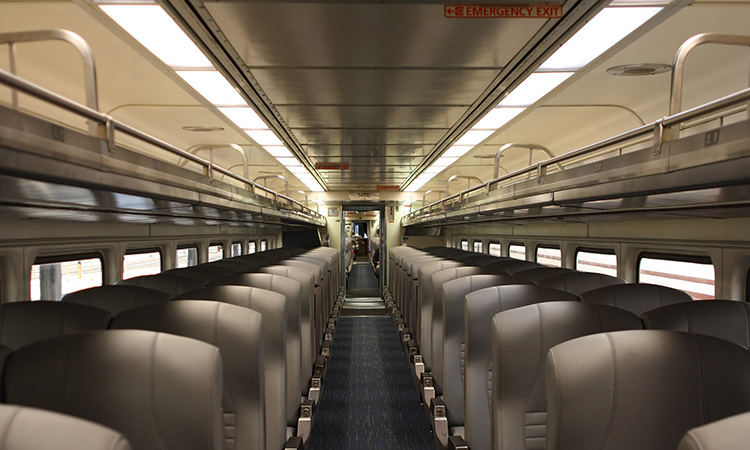
While the Empire Builder is a long-distance, federally supported double-decker train, with dining car, sleeping rooms, sightseer lounge with glass roof, and roomy coaches, Borealis is quite different. It operates with a modified commuter car design known as “Horizon.” Seating is more comfortable than airline or bus, but denser than most Amtrak services of seven-plus hours. The only amenity is a snack car, of a different 1970s Amtrak design, offering a rather rudimentary array of frozen and packaged snacks. Wi-Fi is promised, but reports are it’s non-existent. Amtrak spokesman Marc Magliari says the route operates off cellular services and will be negatively impacted when the train is in areas with little to no coverage. Amtrak is equipment-constrained due to a years-long backlog of cars awaiting repair and maintenance as the railroad faces shortages of qualified technicians to put them in good working order. It also has lots of new corridor equipment on order, but it will likely be several years before it shows up on Borealis, as other corridors are ahead of it in need and priority, says Magliari.
Ridership: Many of the articles touting the route’s amazing success based it on the first ten days of ridership. The hype made it all the way up the media food chain to Fast Company. Looking at the train’s first full month, June, from data released by Wisconsin Association of Railroad Passengers—aka WisARP, a Wisconsin passenger rail advocacy group—and provided by Wisconsin DOT, Borealis averaged 330 riders westbound and 288 riders eastbound. (The disparity is probably due to the fact that the westbound Borealis traverses Chicago-Milwaukee in a low-demand time of day, while the eastbound runs through at peak hours.). Amtrak does not break out point-to-point ridership data for competitive reasons, says Magliari. So we don’t know how many Borealis riders are new to Amtrak and how many were historic Empire Builder riders. The new service can’t be deemed successful unless it expands existing ridership in the corridor, rather than simply sharing what exists. Magliari also pointed out that Amtrak would never draw conclusions about the success of a train with such little data. He noted that summer is MSP-Chicago’s busiest season, and the early data was expected to be robust.
The Milwaukee factor: Then there’s the issue of Chicago–Milwaukee ridership. Remember, Borealis is an existing train in that corridor. Amtrak would not provide data about how many of Borealis’s riders rode only that portion of the route, but WisARP released WisDOT data in May noting 38.5% of Borealis May ridership was Chicago–Milwaukee, meaning fewer than 200 of the train’s roughly 300 daily riders were using the “new” train. In June 2023, Chicago–Milwaukee service averaged 144 riders per train. Extrapolating the data, it’s possible nearly half of Borealis ridership is existing Hiawatha riders. And a portion inevitably have switched off the Empire Builder, which arrives in St. Paul from Seattle several hours late many days. Magliari says Amtrak would prefer that Chicago-Twin Cities riders use Borealis allowing it to sell more Empire Builder tickets to passengers traveling to St. Cloud or Minot or Glacier Park, who often couldn’t get a reservation because of peak loads on the Chicago-Twin Cities portion. (Amtrak can use pricing to dissuade local riders from using the Builder. The two trains are scheduled only three hours apart in each direction.)
Plane slayer: To the supposition that Borealis had “stolen” or generated, nearly overnight, 10%-20% of the ridership of the Chicago-MSP air corridor, well, let’s dig into that. On an average summer Friday, there are 26 nonstop flights between MSP and Chicago’s two airports, 27 on the Fridays Sun Country operates a flight. These services range from 70-seat regional jets to nearly 200-seat Boeing 737Max jets. Using an average capacity of 125 seats, that’s roughly 3,300 seats each way in the air corridor. Based on the above data, it appears Borealis has taken the equivalent of a single mainline jet flight, or maybe 5% of the daily air passengers.
Profitability: Most media covering the Borealis boomlet relied on advocates touting stats from Amtrak’s May 2024 route performance data, which showed the train with $100,000 in operating income, making it one of only two profitable Amtrak routes (the DC-Florida Auto Train is the other). The problem is that’s wrong on multiple levels. First, explains Magliari, Amtrak’s data only measures direct costs like crew and fuel and microwave pizza. It doesn’t include indirect costs shared by Borealis and the Builder and items like debt service and depreciation, etc. Secondarily, even a casual reading of the single line of financial data Amtrak shows $300,000 in gross ticket revenue but $600,000 in operating revenue. That other $300,000 constitutes state subsidies to the train. Without them, Borealis would have lost $200,000, or an average of $10,000 per trip. (I don’t mean to suggest the train, as a public service, isn’t justified—it just ain’t making money.)
Prospects for a third train: Rail advocates and journalists alike fell all over themselves to proclaim the immediate justification for a third service on the route. Once Borealis’ consortium of states is able to parse exactly how many new riders it has attracted to the corridor, it can get about the task of thinking about the future. Amtrak’s fiscal year ends Sept. 30 and Magliari says autumn would be a reasonable time to dig into the data, which would be best-case-scenario, because it would only cover peak ridership months. And a third train would require an agreement with CPKC, if not Metra. No such agreement exists, says Magliari. (MnDOT appeared to pour water on the prospects for a third train in this just published article.)
Whither Madison? One of the great missed opportunities of Borealis is Madison. The University of Wisconsin’s main campus and State Capitol attract thousands of trips from the Chicago and Twin Cities area each day. Madison’s geographic position, on an isthmus oriented SW to NE, historically made it circuitous to serve from a NW to SE oriented train, and now most of Madison’s rail links have been cut. Amtrak’s closest stop is Columbus, Wisconsin, a 40-minute drive to the northeast. Despite Borealis’ advent, there remains no connecting shuttle bus service from Columbus timed to serve Twin Cities-bound or originating trains, disenfranchising dozens of potential daily riders. Madison continues to remain a bridge too far for Amtrak.
Bottom line: Best-case scenario, Borealis is generating around 150 new riders per trip outside the Chicago-Milwaukee corridor. But it’s impossible to know without endpoint data from the Empire Builder if all 150, or 100, or just 50 are new riders on the route. That data is key to judging the train’s success. And any way you cut it, Borealis will need hundreds more riders to turn a profit and justify a third service and new equipment, which is at best, years off.