

Clean Energy Accelerator Grid Catalyst Unveils 2025 Cohort
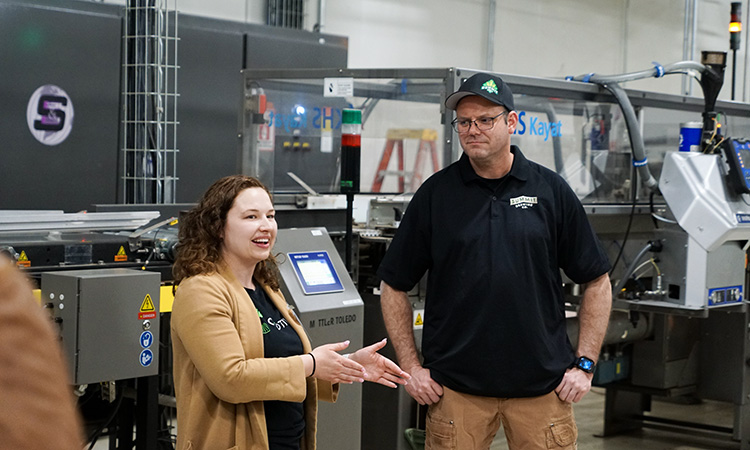
At Summit Brewing Co.’s canning facility in St. Paul, a conveyor belt springs to life at the push of a button. Cans of beer would usually run along the belt, but not today; this is just for demonstration. The conveyor belt is now powered by a new type of motor technology that promises greater efficiency and lower environmental impact.
Summit is one of five organizations that’s been matched up with five startups in Grid Catalyst’s annual clean energy accelerator program. The St. Paul brewer is testing out an electrostatic motor developed by Middleton, Wisconsin-based C-Motive Technologies. The main draw of C-Motive’s motor, company officials say, is that it is more efficient than traditional motors and can be produced domestically. It also requires far less copper than a typical motor, and requires no rare earth materials at all.
“We have a completely domestic supply chain,” said Brandi Kochera, C-Motive’s director of business development, at a demonstration on Wednesday. “We like to say we’re now a tariff-proof motor.”
Though electrostatic motor technology hasn’t been widely adopted in the modern era, the concept itself is not entirely novel; Benjamin Franklin developed his own such generator in the 1700s. In fall, C-Motive earned a nod in the Wall Street Journal for its application of the technology.
Grid Catalyst’s accelerator pairs startups working on various clean energy technologies with bigger industry partners willing to test them out. The organization this week unveiled the five companies in its 2025 cohort. Aside from C-Motive, the other cohort members and their demo partners are:
- Flow Environmental Systems, a Rogers-based company that’s developed a CO2 heat pump; it’s demoing its technology at the Local 455 Pipefitters/Steamfitters union’s St. Paul training facility
- LiquidCool Solutions, a Rochester-based company that’s developed “immersive cooling for data centers;” it’s partnering with St. Cloud-based data center operations company Vaultas
- Enspi, a Minneapolis-based startup that’s developed “AI-enabled software for utility management;” it’s partnering with Grand Rapids Public Utilities
- EcoSnap, a Centennial, Colorado-based startup that manufactures ductless, mini-split heat pumps; it’s partnering with Minneapolis-based architecture firm Precipitate Architecture.
Each company will receive between around $100,000 and $125,000 in funding from Grid Catalyst to help stage their demonstrations, said Nina Axelson, Grid Catalyst’s founder and president. Though it’s been around since 2021, the accelerator received a big boost when the Minnesota Legislature allocated $3 million for it in 2023.
Axelson said her group has enough funding to continue on with another cohort in 2026.
It’s less clear what will happen after that. With the return of Donald Trump to the White House and changing dynamics in the state legislature, the future of clean energy initiatives is an open question. The returning president has vowed, more than once, to give fossil fuel producers free reign to “drill, baby, drill.”
Axelson noted that her program has never depended on federal dollars, though she acknowledged there could be “ripple effects” from federal policy changes.
“There is an effort in progress to see if we can extend some of that funding through the state,” she said. “We think we have a good value proposition.”
Gregg Mast, executive director of clean energy advocacy group Clean Energy Economy Minnesota, maintains that external market forces are already driving a push away from fossil fuels.
“Whether encouraged or merely tolerated by the federal government, clean energy is poised to define the next era of U.S. economic growth and leadership on the global stage,” wrote Mast and Clean Grid Alliance executive director Beth Soholt in a Star Tribune op-ed published shortly after the 2024 election. “The White House might influence the pace, but the destination is inevitable.”