


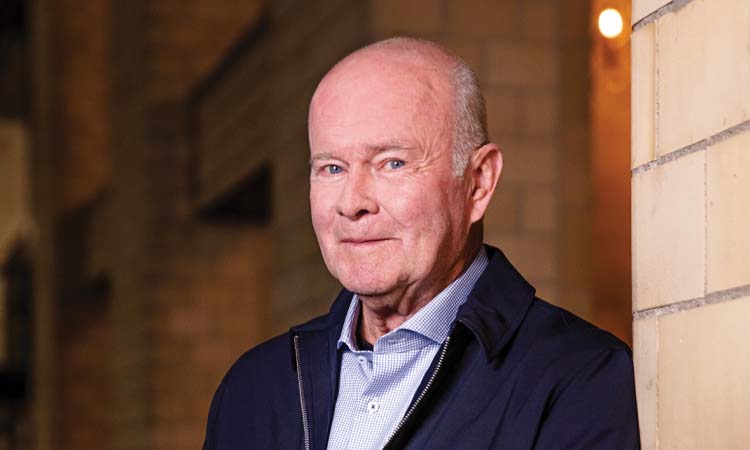
David Shea
David Shea doesn’t . . .
Design houses. Sit for long meetings. Have a résumé. Or employ engineers.
But he does sketch. He loves to sketch. “David can enter a space completely filled with boxes, and he can instantly envision how a space will lay out, how it needs to work as a restaurant, lobby, workplace, [or] store,” says Shea principal and partner Tanya Spaulding. “Then he sketches it out almost immediately.”
Shea founded his namesake firm in 1978 and still owns 100% of the business. To call it an architecture firm is not wrong, but it’s not quite accurate. “I’ve always loved interiors. How they connect with people,” he explains. Shea’s niche is “developing approachable spaces that are closer to people and how they live their lives.”
Architecture is a vast and prestigious field, which has won popular acclaim through the handful of household names who have left their stamp on the Twin Cities: Frank Lloyd Wright, Cesar Pelli, Philip Johnson, Eero Saarinen, Frank Gehry, and Minoru Yamasaki, to name a few. But only Wright devoted much attention to interiors, the lived spaces in his majestic designs.
Interiors are what energize David Shea. “It was an outlier niche. I tried to change the paradigm of what commercial architecture was, in a way. Interiors were afterthoughts. This made us different.” If your idea of commercial interiors is beige, utilitarian spaces designed for cubicles or racks of clothes, Shea sees it differently. “I love materiality, I wanted something artistic,” he recalls. Shea became the first registered architect/interior designer in the region.
Architects can be difficult, even intransigent, but although Shea has a definite aesthetic, he mostly follows his clients’ lead. “Architects are mostly idealists,” he notes, using their art form to make statements about how people might better live or function. “I’m a pragmatist, and I celebrate the success of my client.”
That Shea has found so much success in the chaotic and often dysfunctional restaurant business speaks to this quality. “David has an innate ability to understand creatives,” explains restaurateur Gavin Kaysen. “He feels egoless. He knows what I like and he knows what I don’t like.” Shea designed Kaysen’s Spoon & Stable in 2014, following it up with several more projects, including Bellecour, which opened last year in the North Loop.
David Shea grew up in Boston’s South End, the son of a lineman for New England Telephone— “a typical Irish family,” he says. (Shea says Bostonians don’t recognize his distinctive accent as local, but maybe they’re being difficult.) He came to Minneapolis in 1967 to attend a five-year architecture program at the University of Minnesota. He got bored after a few months, went back to Boston, came back to Minnesota a year later, and went to work for architect Ed Baker around 1969, where he worked on the early sketches for the IDS Center, skyways, and offices.
“I tried to change the paradigm of what commercial architecture was … interiors were afterthoughts. This made us different.”
—David Shea
Six Memorable David Shea Commissions*
*Out of 3,748 unique projects for 800-plus clients
1973–74: IDS Center Crystal Court spaces
1978: Foshay Tower (National Historic Register work)
1984: Fitger’s Brewery (Duluth)
1984: Leeann Chin at the Union Depot
2001: The Milwaukee Road Depot
2018: The Armory
“You needed a 10-year apprenticeship to become a registered architect. I tested out of all that stuff,” Shea chuckles. He left Baker to start his own firm (with four colleagues) in 1978.
Forty-eight years later, Shea has about 50 employees and has broadened the firm’s scope, adding interior design, graphics, artisanship, and branding/marketing services. Spaulding thinks Shea has had some role, large or small, in almost every downtown Minneapolis building.
A particular specialty is historic preservation. Shea’s influence is evident in the Milwaukee Road Depot, Fitger’s in Duluth, and St. Paul Union Depot, among others; he introduced developer Ned Abdul to the long-languishing Minneapolis Armory. Abdul and Shea joined forces to resurrect the amazing art deco space that once again fills with young men many days each week (though none with bayonets).
“I love the complexity of historic preservation,” Shea says, “the need to respect the past while focused on the future. [Our] mission is to make those spaces impactful, create experiences.”
Shea can often be found traveling, meeting potential clients, checking out spaces, having dinner at the bar. “I’ve got 3.5 million miles in airplanes,” he says. “I travel, I see, I explore.”
In the late 1990s, Shea added a New York office and began to work on national rollouts for clients like Morton’s and the Palm Steakhouses, Cole Haan, Toys R Us, and Macy’s. Head count peaked around 75 as the firm diversified into retail, hotels, workplace, and financial institutions. The New York lease was history after 9/11, but Shea continued to expand, creating an in-house artisanship practice (Shea Makes) and diversifying into health care design. The firm, will turn 50 in two years.
David Shea still lives and works in downtown Minneapolis and is at once hopeful, and pained by its atrophy—the sense other places may be lapping us. “I’ve seen cycles, of course. This one is particularly complicated,” he says. “Time will make a difference. People still want to gather. Look at the North Loop.”
It’s hard to imagine what it’s like to walk outside and see your work around every corner, but architecture, unlike restaurants, endures. “I’m not going to live forever,” Shea observes, “but the principles will.”