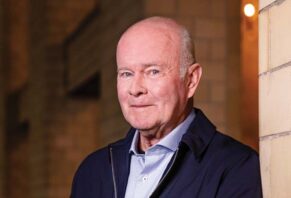



Tim Murnane
Tim Murnane remembers all the signs that he should work at Opus. They were literal signs advertising the company, then known as Rauenhorst Construction Company and today based in Minnetonka, after it had launched in the founder’s Minneapolis home. The signs were posted around the frontage of I-494 in the south suburbs, where founder Gerry Rauenhorst had bought some 2,000 acres for development.
Murnane was in his early 20s. He was working for Federal Land Co., an Eagan-based developer, managing five shopping centers, hiring snowplows for parking lots, learning about development financing, leasing spaces to a florist, a Chinese restaurant. It was the early 1980s, and it was exciting. “The freeways were coming through, and Eagan was just taking off,” Murnane recalls. Soon, a headhunter contacted him with an offer. “It was a really good company,” Murnane says. But he told the recruiter no; he wanted Rauenhorst.
Rauenhorst founded his company in 1953 and helped pioneer the “design-build” model, integrating development, design, and construction. Murnane had heard about Gerry, whose professionalism and integrity set the gold standard in the breakneck world of commercial real estate.
About a month later, Murnane got another call. Rauenhorst Construction had become Opus Corp. in 1982—and it wanted him. “I was a St. Paul kid. They needed somebody with St. Paul connections,” he reasons. Plus, he knew Eagan. He joined as a junior developer in 1984 but was promoted to lead developer that year.
Right away, he was developing two buildings, about 100,000 square feet each. “They gave you a lot of rope to go out and, you know, either swing or hang yourself.”
He compares the role of lead developer to the quarterback on the team. One person calls the shots, “but without that team working in close connection, the projects fail.”
Since then, Murnane has been lead developer for more than 30 million square feet of office, industrial, and retail projects. His Twin Cities legacy takes clearest shape in the Arbor Lakes lifestyle center in Maple Grove, in the 1.6-million-square-foot Best Buy campus in Richfield, and in downtown Minneapolis’ American Express Financial Advisors headquarters.
In 2010, two years after the financial crash, Murnane took over as CEO. It was a very different Opus: shrunk by half and in distress like its peers. He became the second CEO who wasn’t a member of the Rauenhorst family, but he held close to Gerry’s two core values: respect and integrity. And he embraced the challenge. “I like complicated projects,” he says, recalling those days from a small armchair in his office at the Minnetonka headquarters, which overlooks undeveloped land.
After 16 years as CEO, he retires at the end of this year. Matt Rauenhorst—Opus president, CEO of the company’s development subsidiary, and Gerry’s grandson—is set to become the third Rauenhorst CEO.
“I’m still as passionate about this business as I was at 21. I love it.”
—Tim Murnane
Hard and Soft
Murnane, the oldest of six, grew up in a family of the law. His great-grandfather was St. Paul’s chief of police under Prohibition. His grandfather and great-uncle started a St. Paul law firm in 1940. But he says his father, a trial attorney, never pushed. “My dad and I were really close. … He always just said, ‘Whatever you want to do, just make sure you’re the best at it and that you love what you’re doing.’ ”
What makes the industry appealing? As Murnane tells it, there’s the thrill of working with brokers, engineers, and city staffers, of finding land and outlasting, maneuvering, or riding market conditions, of multitasking and making fast decisions, so that now, decades later, he can drive past the Best Buy corporate buildings, shaped like suburban cruise liners, and think—after the $50 million in tax-increment financing, the negotiations with the Federal Highway Administration, and a Supreme Court case on eminent domain—“They still look pretty good.”
Danny Queenan has known Murnane since childhood. As a young adult who wanted to break into real estate development, he had hesitated to contact Murnane; he didn’t want to strain the relationship. But then he ran into Murnane by chance and mentioned his interest. Before long, he was hired.
The two worked together for over a decade, with Queenan rising from junior developer to CEO of Opus’ independent operating company in Chicago, before Queenan moved on from Opus in 2009. He treasures Murnane’s gentle but firm mentorship, another hallmark of his leadership. Lacking early-career mentors, Murnane wanted to be that for others. “He has an extremely high EQ,” Queenan says.
For everything to hang together, a developer needs soft skills, too. “Building buildings is exhilarating but finite,” Murnane says. “Building relationships is personal and infinite.”
Murnane comes across as direct, authentic, and intimidating only by accident. His ease with connection, he says, comes from empathy. “I was raised that way.” He attributes it to his mom. “She was probably the most selfless person I ever met.”
Notable Developments Led by Tim Murnane
1996: The Eagan Promenade, Eagan, 242,000 sq ft
2000: American Express Financial Advisors HQ, Minneapolis, 1.18 million sq ft
2003: Best Buy corporate campus, Richfield, 1.6 million sq ft
2003: Shoppes at Arbor Lakes lifestyle center, Maple Grove, 1.1 million sq ft
2005: Woodbury Lakes lifestyle center, Woodbury, 330,000 sq ft
Constant Development
Murnane’s best-known venture is likely the Shoppes at Arbor Lakes.
It started as a gravel pit, scouted by a broker in the early ’90s. Three retailers—Kohl’s, Barnes & Noble, and The Gap—wanted space in the northwest metro. Led by Murnane, Opus made a 300,000-square-foot development out of it. It was so successful that, a decade later, the project had grown into a roughly 2-million-square-foot retail and entertainment center. He calls it the first open-air lifestyle center north of Chicago.
Murnane convinced Maple Grove to let in big-box retailers to draw foot traffic that would support smaller stores and attract high-end retailers, too. “We didn’t need an anchor tenant,” he says—nor multimillion-dollar subsidies. “There was a huge growth of retail,” he says, recalling the flush ’90s and early 2000s. “We probably overbuilt as a country.”
That growth came to a screeching halt in 2008. The Great Recession “crushed everyone in our business.” Seeing that “there weren’t going to be enough opportunities for everybody” as the company atrophied, Murnane left Opus in 2009 as senior vice president and general manager. He consulted, then opened a Minneapolis office for a national developer. The following year, Opus asked if Murnane would come back as CEO.
He approached the company as though it were a development. “We had to get all the stakeholders together. We had to create the vision.” He met with East Coast capital partners, reestablished ties with brokers nationally. The projects became lower risk. Before, Opus had mostly developed on its balance sheet—using “all of our own money,” he explains. Today, he counts more than a dozen joint-venture partners involved in industrial and multifamily projects, two of the company’s biggest focuses.
Opus got off the ground again with the Stadium Village Flats student housing, the Nic on 5th luxury apartments, and Xcel Energy’s headquarters, all in Minneapolis. It pulled through.
The development business never quite lets you go, Murnane says. Why? “I think you have the love of the deal.” The relationships, it seems, won’t go cold. He’s been invited on boards. Friends have offered deals.
“I’m still as passionate about this business as I was when I started at age 21,” he says. “I love it.”