


Inside the Legislature’s Agreement to Improve ‘Oregon Trail’-era IT for Safety-net Programs
 As the Minnesota Legislature staggers to the finish line, one accomplishment lawmakers can point to is money put toward improving information technology counties use to run social services programs.
The wonky issue made an unlikely center stage appearance this session as counties furiously lobbied for better IT and lawmakers linked bad computer systems to an inability to detect Medicaid fraud.
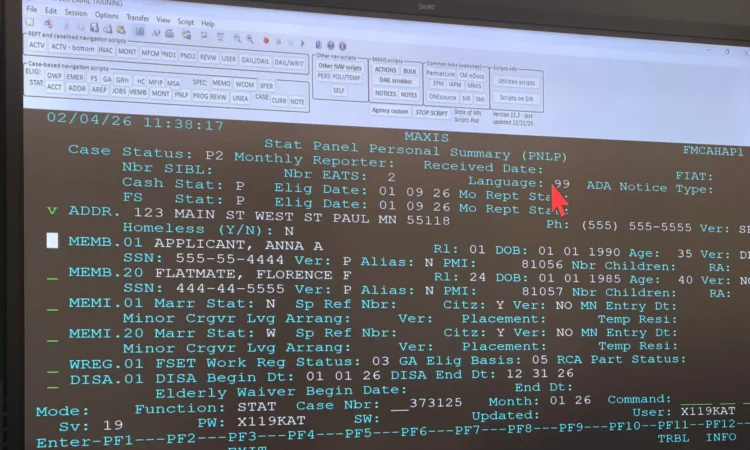
“In a session where there weren’t many lanes of agreement, it was a huge lane of agreement,” said Matthew Hilgart, director of government relations at the Minnesota Association of Counties. “I think the image of a county worker operating on a DOS-based screen resonated with the public.”
The details are still being worked out. A final bill will not reach the House and Senate floor until Sunday, the final day of the session.
But, as of Saturday afternoon, there was bipartisan agreement on a bill that would put $90 million toward rehabbing, and eventually replacing, the MAXIS mainframe computer system that Minnesota created 37 years ago to run the Supplement Nutrition Assistance Program (SNAP) before a mouse became a fixture for computers.
The payout is also intended to revamp the METS system that is used for Medicaid and MinnesotaCare, health insurance programs for the poor, elderly and disabled.
“We have a great number of social workers living in my district who have been asking for modernization for quite some time,” said Rep. Ginny Klevorn, DFL-Plymouth. “This will really make the employees’ jobs much more efficient and much more enjoyable.”
It is also supposed to be easier for recipients to apply for these programs. And $15 million in the bill will go toward providing technology for the new Office of Inspector General, which will, in theory, stop people who try to defraud the social safety net.
“The OIG is going to need new technology, too, of course,” said Rep. Paul Torkelson, R-Hanska, the author of the legislation set to pass. “We want to set that up as quickly as possible so that when the OIG gets into office they can hit the ground running.”
Significant role for counties
Minnesota is one of a handful of states in which county governments are entrusted to administer eligibility and benefits for Medicaid and SNAP, otherwise known as food stamps, both of which are sprawling federal-state programs.
Throughout the session, Torkelson and Sen. Melissa Wiklund, DFL-Bloomington, who are both retiring, have worked with Gov. Tim Walz’s office on an information technology modernization bill.
In Walz’s budget deal reached with legislative leaders Wednesday night, $75 million will go to IT modernization this year and $15 million the next year, though a new governor and Legislature would have to approve that $15 million.
As Walz trumpeted this agreement, Torkelson, co-chair of the House Ways and Means Committee, worked at translating it into a bill.
The 15-page measure, which passed out of the House Ways and Means Committee last Thursday, focuses on the creation of a “modernization advisory council” that consists of representatives from the departments of Human Services; Children, Youth and Families; and Information Technology Services. It additionally includes four representatives from counties. This council is supposed to have its first meeting by September.
Meanwhile, the state’s commissioner of Information Technology Services (currently Jon Eichten) must lay out “a multiyear modernization plan” for social services systems by March.
The bill also calls for specific changes like adding an artificial intelligence chatbot for SNAP applications and replacing MAXIS’s dreaded “green screens.”
The Torkelson bill calls for $50 million in a human services systems account that can be periodically replenished.
Wiklund’s office said Saturday that they are operating from the Torkelson bill but expect an additional $40 million to be added into the bill for specific modernization projects requested by counties.
The IT services commissioner is expected to approve counties’ individual monetary requests for projects.
Wiklund, who is chair of the Health and Human Services Committee, said she was satisfied with the bill’s outcome after months of negotiations.
“I am very happy with the agreement,” she said. “It represents a serious response to the urgent needs of counties and the people who depend on these services and work in county offices.”
This article first appeared on MinnPost and is republished here under a Creative Commons license.