

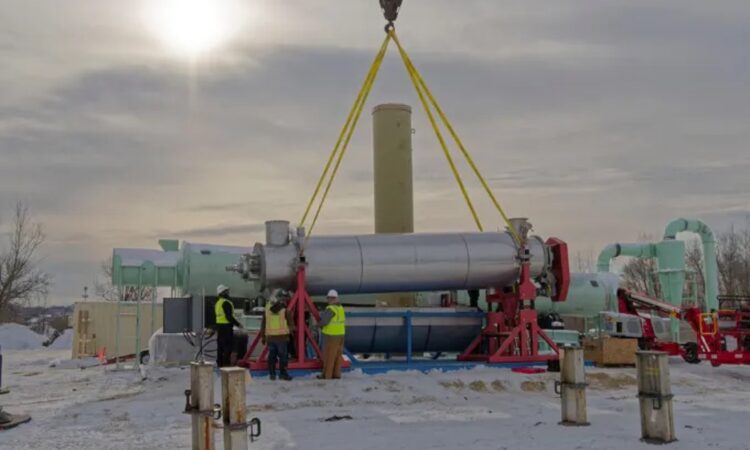
Carba Brings First-of-Its-Kind Technology to Burnsville Facility
Carba, a Minnesota company in the growing biochar industry, installed a one-of-a-kind reactor in its Burnsville facility in December that will help grow the state’s pioneering role in the industry.
The company’s technology has taken an innovative approach that’s set it apart from the rest of the market. To talk about the technology, we first have to do a quick debrief about photosynthesis and salt.
At its most simple form, the photosynthesis that trees use to convert sunlight into energy involves plants chewing up and absorbing carbon from the atmosphere. Plants take carbon, water, and energy from the sun and use them to produce the sugar that they need to grow. Trees act as major carbon sinks by eating and storing carbon as part of this process. If trees burn or decompose, their carbon is released back into the atmosphere. That’s where biochar steps in.
The key to biochar is heating up organic material without burning it. Too hot, the material burns and the stored carbon is released. Too cold, and you don’t stop the decomposition process.
Imagine a pile of salt, heated to a violent temperature until it’s liquefied. That liquefied salt serves as a perfect heating mechanism, providing a consistent temperature that can be used to convert the biomass (think old wood and organic matter) into biochar through pyrolysis, a process that breaks down organic matter. That process traps the carbon stored inside of the trees.
Molten salt has a long history in the energy world and has been used in solar and nuclear projects for years. It involves taking salt heated to 500 to 800 degrees Celsius. Carba’s technology runs at a lower level than most of the industry, operating at 400 to 500 degrees Celsius, which makes the biochar especially porous.
Carba founder Andrew Jones explained that it’s the consistency provided by the salt that makes it a better technology than what’s currently on the market. Most other people burn them and run hot gases over or around a reactor or heat a reactor with fire under metal. The molten salt allows them to get more throughput in a smaller system and maintain temperature.
“Molten salt is basically a thermal battery,” Jones said. “Because it’s a liquid with no vapor pressure, you can pump it around and move huge amounts of heat exactly where you want it. Most other systems are using air or direct fire, which creates massive temperature gradients and hot spots.”
Those hot spots lead to less consistent results. That’s a big problem for an industry that relies on bankable volume that can be sold to buyers through carbon credits.
Advantages of a Minnesota business launch
Key attributes in Minnesota support Carba’s business model. Minnesota has some of the cleanest landfills in the country—and some of the most expensive—because of strict regulations. The Burnsville landfill, where Carba operations are taking place, is one of the cleanest in the country, Jones said.
The biochar industry’s roots in Minnesota go much deeper than Carba. Jones cites the University of Minnesota’s pioneering research at the school’s Natural Resources Research Institute in Hermantown as a major driver behind its success. Just last year, the city of Minneapolis also launched the first municipal biochar facility in the country, some of which the city is using to manage runoff from streets into boulevard gardens.
The majority of its feedstock comes from vegetation management companies that do utility line clearing. Minnesota also has an abundance of wood waste because of the emerald ash borer that’s swept through the state’s trees. That wood waste often gets burned or composted, which re-releases carbon back into the atmosphere.
“There is so much wood waste in Minnesota that there simply isn’t space for it anymore,” Jones explained. “We don’t have to buy it, so the feedstock is free, and in some cases, we get paid to take it.” This first reactor will be able to process about 10,000 tons a year, and Carba is planning to build three more reactors on the same site. As a point of comparison, St. Paul’s District Energy system burns 250,000 to 300,000 tons a year and uses it to provide heating to the city’s downtown. But it is now at capacity.
How Carba differentiates itself
Carba has found a niche to differentiate itself from the rest of the biochar industry by avoiding agriculture markets, which can have volatile swings. About 85% of biochar companies are putting it into soil. In contrast, Carba is using biochar to clean up landfills and plug it into industrial systems—an approach that hasn’t yet been employed elsewhere.
Landfills have an untapped potential. In Minnesota, there are requirements to cover landfills with about six inches of soil. The biochar can mix in with that soil as part of the additive layers. Jones estimates that more than 20 U.S. states mandate some type of soil cover for their landfills, which could be a major growth area for the company in the coming years.
Revenue driven by the carbon credits market
So, who is paying for all of this? Right now, Carba’s primary revenue source is selling carbon credits, which companies purchase to offset their use of carbon elsewhere. Companies, including Microsoft—Carba’s biggest carbon credits customer—make climate pledges. Then they buy credits to offset the carbon-heavy parts of their businesses. The other public buyer is Terraset, which is a carbon credits marketplace that institutional investors use to buy and sell credits.
Carbon credits are a voluntary market, so the gutting of the Inflation Reduction Act passed by Congress in 2022 hasn’t hurt them as much as it has other companies in the climate tech space. The market has grown in the past year, with more buying activity than the last five years combined. “The concern now isn’t demand—it’s whether supply can actually deliver,” Jones said.
The company recently closed on a $6 million funding round from a variety of investors, including local investors such as Demos and Groove Capital. Carba previously has received an investment from the Minnesota Climate Innovation Finance Authority. It’s a public fund similar to a “green bank” that funds climate and energy companies. The Minnesota Legislature approved creation of the fund in 2023.