


Open Letter: Is It 1929 Yet?
To: Mr. Andrew Ross Sorkin
The New York Times
620 Eighth Ave.
New York, NY 10018
Dear Mr. Sorkin:
History records epochal moments by reference to dates; 1066, 1776, 1914, 1929, Dec. 7, 1941, and simply 9/11. You are a highly respected business columnist for The New York Times, a co-anchor for CNBC, and a frequent participant at Davos. Now you have chosen to apply your narrative skills to that pivotal year in capitalist markets by writing 1929. The book is already a bestseller, and no doubt will enjoy an orgy of gift-giving at the end of the year. People should buy this book.
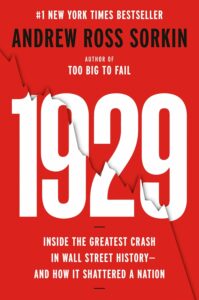
1929 is the yardstick against which we measure all market declines and is usually seen as the beginning of the Great Depression. Your grandmother’s collection of newspaper discount coupons or her admonition to shut the refrigerator door comes from the frugality bred into that generation by the scarcity of the Great Depression. The decade was known as the “Roaring ’20s” or simply the Jazz Age; it was chronicled in fictional form by St. Paul’s own F. Scott Fitzgerald.
And the stock market indeed roared in the ’20s, gaining over 500 percent from 1921 to its high in 1929. After Black Thursday (Oct. 24, 1929), the Dow Jones Industrial Average would not return to its previous high until 1954. The Great Gatsby was no more.
The narrative core of 1929 is the meticulously detailed actions of “Sunshine Charlie” Mitchell, chairman and CEO of National City Co. and National City Bank (today’s Citibank). The efforts of bankers to inflate their stock and manipulate stock prices while encouraging ordinary Americans (and depositors) to invest in the market is laid out in almost daily detail (82 pages of notes!).
Winston Churchill makes a number of appearances in this narrative: first as a journalist, later as a speculator, and later still as a frequent social guest of a small circle of bankers controlling the market. (He, too, suffers a huge financial loss.)
The book contains interesting tidbits in every chapter: Charles Mitchell’s wife, Elizabeth, was dancing with George Gershwin when Gershwin asked her advice on whether he should work on a new idea or stay in New York. She told him that he should work on the new idea in Paris, which he did (and wrote “An American in Paris”).
Ultimately, after the market crash, the public came to view bankers, and particularly Charles Mitchell, as the cause of their misery, leading to inevitable criminal trials and congressional hearings. The trial of Charles Mitchell is detailed in the book, although to any criminal defense reader the ultimate verdict will not be a surprise. The congressional hearings, and particularly those involving Sen. Carter Glass, are less predictable. Glass is one of the most important political figures in the 20th century; he was the co-author and principal architect of both the Federal Reserve Act of 1913 and the Glass-Steagall Act of 1932. Both monumental legislative enactments have shaped banking regulation for the past 100 years. Sorkin brings Glass to life with this detailed narrative.
The Great Depression marked a dramatic pivot in the American economy. Prior to 1929, business and the market ruled; when German reparations needed to be renegotiated, America’s representatives were bankers, not diplomats. But with the Depression, government action in the form of regulatory agencies became the focus. One of these agencies was the Securities and Exchange Commission, chaired by William O. Douglas (later a member of the U.S. Supreme Court, which rubber-stamped most of FDR’s New Deal agencies).
Many who read this book will look for parallels to today. Sorkin, in a series of interviews, has said that he sees parallels in stock manipulation and unregulated 1929-style stock pools and today’s cryptocurrency and mining of meme coins. In the book, Sorkin maintains that no regulation by itself will prevent another 1929—it’s a tale of human nature.
Today, investors are concerned that we are in a “This can’t continue” market environment. The local newspaper has had a whole business section devoted to exactly that question. Articles in The Wall Street Journal talk about the artificial intelligence spending surge that cannot continue. A recent front page in the WSJ contained an article about Sotheby’s accepting bids for an artist-created toilet sculpted out of 223 pounds of gold; maybe Gatsby isn’t dead after all. But more likely, these are indications that despite market speculators who will yell, as they always have, that this time is different, this cannot continue. The same feeling many of us had in 1999, and again in 2008, has started to dominate our thoughts today.
In the future, I almost expect to see a Sorkin book 2029: What Could Possibly Go Wrong?
Sincerely yours,
Vance K. Opperman