

New Minnesota Orchestra CEO on the Business of Running a Symphony
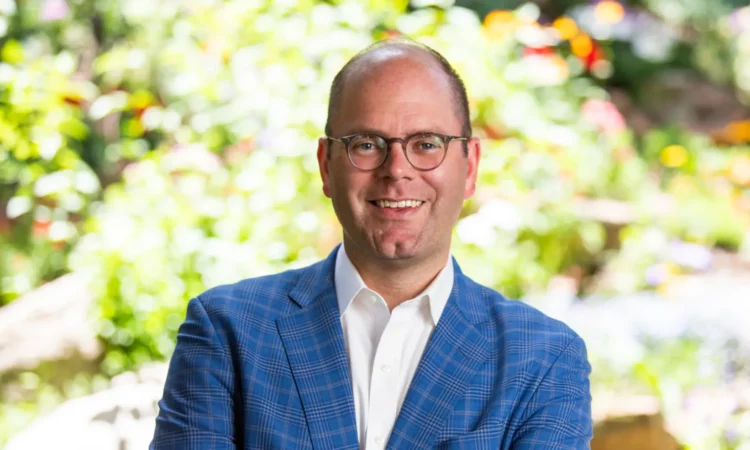
Isaac Thompson was a serious violinist. He played in the Minnesota Youth Symphony and earned a master’s in violin performance from the University of Texas at Austin. But the Shoreview native apparently lacked—something. “A mentor of mine kind of gave me a dose of reality,” he recalls, sitting in his small white office in downtown Minneapolis’ Orchestra Hall: “‘You know, you’re a decent violinist,’” the mentor said, “‘but perhaps you should explore this other track.’” He moved into management, and he’s been exceptional at it.
Thompson started as president and CEO of the Minnesota Orchestra last month. His administrative career has taken him through an impressive roster of symphonies: director of artistic administration for the Cincinnati Symphony Orchestra; managing director of the New York Philharmonic; and, most recently, president and CEO of the Oregon Symphony.
Minnesota’s orchestra is in the same league, Thompson says. “This is one of the top orchestras in America—period, hands down.”
But by the numbers, it has not fully returned from pandemic-era deficits. Traffic last season trended 9% lower than pre-Covid levels.
Even so, last season also notched record highs for the orchestra, across earned revenue and donations. A new music director—the charismatic and likable Thomas Søndergård—likely spurred ticket sales. Earned revenue, at $11.6 million, rose year-over-year by 22%. To explain the record donations, interim president and CEO Brent Assink said the orchestra’s board of directors showed “tremendous generosity.”
The organization nonetheless incurred an operating loss of $3.8 million. Total revenues amounted to $38.7 million, outstripped by total operating costs of $42.6 million. The orchestra explained that, for the first time since 2020, it wasn’t getting a boost from pandemic-era grants. In a way, that means the Minnesota Orchestra is officially post-pandemic.
And Thompson sounds up to the task. “The opportunity to come back to a vibrant community, which has a tradition of great cultural institutions, to lead one of the anchor arts organizations, was a thrilling opportunity.”
Note his choice of words: “community,” “anchor,” “cultural institutions.” Thompson assesses where orchestras fit, culturally and economically. These are nonprofits, but they’re also ticket sellers, operating in some ways as businesses.
The major challenge for orchestras right now, he says, is rising costs. “Expenses, like any business, continue to go up with inflation.” Revenues—both ticket sales and philanthropy—must grow with that. “As cost structures continue to go up, we have to be as innovative as possible in terms of focusing on diversified revenue streams.” The organization has more than 150 employees.
To describe orchestra economics, Thompson reaches for an analogy now close at hand: “Let’s take the Vikings. The Vikings could not exist just on ticket sales. Like, that would not sustain an NFL team. So, you think about the media rights and all the revenue that comes in from that—and sponsorships. An orchestra is similar. Though, we don’t have media rights. We don’t have a CBS or a Fox contract. Our media rights [are], really, private philanthropy. It’s investment from individuals.”
Philanthropy accounts for about two-thirds of the orchestra’s annual revenue, according to an orchestra spokesperson, including endowments. One-third comes from earned revenue, including ticket sales, venue rentals, and food and beverage concessions.
Thompson describes public backing as minor in the United States. “Government funding has gone down. The National Endowment for the Arts has gone down. So, we really rely on private philanthropy.” The National Endowment for the Arts has never been a lot, he adds. For years, the Minnesota Orchestra has been picking up $40,000 annually.
The Twin Cities philanthropy scene is “phenomenal,” Thompson says—but more philanthropy appears to be needed.
As far as strategy goes, he also stresses that every orchestra is different. New York City was “the world’s cultural capital.” Thompson could, as managing director, count on major donations. He was there during the pandemic and noticed how, from an outward-looking, worldly scope, the Philharmonic contracted into the five boroughs. He helped organize pop-up concerts performed in the back of a pickup truck. “I learned a lot during the pandemic,” he says, “about the imperative of orchestras focusing on what its value proposition is to its local community.”
In Portland, sports fandom came into play. He introduced and co-chaired a coalition bridging downtown entertainment scenes—namely, sports and the arts. Their venues funnel into the same pool: urban economic activity, which is theoretically easy to lobby the city to support. Group members have promoted one another’s events and advocated for improvement in public-owned facilities, events funding, and the urban environment. Collaboration, he says, has grown as an industry trend over the past couple decades.
That spirit may have special relevance post-pandemic. “Many people aren’t staying [downtown] after work,” he says. “They’re not going to restaurants or bars. So, I think spectator events … are going to be absolutely critical to cities moving forward.”
Minneapolis is like Portland in the amount of handwringing over its downtown. Is it safe? Is it dead? Is it coming back? Meet Minneapolis, the city’s marketing organization, describes the orchestra as “an important piece” of regular downtown activity. “I think [the orchestra] attracts economic development,” Thompson says. “It certainly is a factor in attracting and retaining talent.” Full-time, salaried musicians multiply their impact by teaching, too. “The tentacles of a major orchestra are immense.”
He wants to pursue more tie-ups, to increase that urban activity. “We’ve already looked at opportunities to align ourselves with some of the other downtown entities,” he says. Whether they’re in sports, the arts, whatever—his goal is for other cultural institutions to view the orchestra as “a top-level partner in helping to bolster their work.”
The orchestra’s most notable new partnership, under Thompson’s brief leadership so far, will be with First Avenue.
These two downtown juggernauts are set to operate a new, 8,000-capacity outdoor concert venue. Construction on the Community Performing Arts Center (CPAC) began this fall, and it’s expected to open in 2027. Part of the 48-acre, Northside-boosting Upper Harbor Terminal redevelopment project, this amphitheater will be publicly owned but privately managed by the orchestra and First Avenue, together known as Port of Minneapolis LLC.
“There are a lot of details to sort out,” Thompson says. “Of course, [First Avenue] brings a skill set to venue operations that we don’t have as much experience in. We have great connections with phenomenal musicians, and booking artists. So, I think it’s going to be a really symbiotic relationship, in a joint-venture setting.”
Dayna Frank, president and CEO of First Avenue Productions, expresses appreciation for Thompson: “He’s a big thinker—an extremely useful tool when approaching a new endeavor like the partnership we have formed for the Community Performing Arts Center.”
CPAC ticket sales will open a new revenue stream for the orchestra, with the center set to host about 50 ticketed events a year and employ more than 250 for operations. Ticket proceeds will also go toward Northside social initiatives. The orchestra is expected to play here, too.
The venue “tells a greater story about how essential a major orchestra like the Minnesota Orchestra is to the entire cultural fabric of the Twin Cities,” Thompson says. The farther into the metro the orchestra extends, the more value it may have to potential funders.
Until its opening, though, Thompson has time to reacquaint himself with Minneapolis after more than 20 years away. He says he’s “excited to continue these conversations with the city, with the community, about how the orchestra can really be a civic pillar to downtown Minneapolis.”
And while he has described the new job as a homecoming, he’s likely leaving the violin in its case. “There’s not a lot of time these days to keep practicing and keep my chops up.”