

Minnesota Chamber Report: Immigrants Drive Economic, Population Gains
Plenty of Americans have cheered on President Donald Trump’s vow to deport millions of undocumented immigrants. But business advocacy groups around the nation have taken a more nuanced position.
For better or worse, immigrants – legal or not – play a key role in the American workforce, often taking on unskilled, high-demand jobs that many in the native-born population don’t want. But many immigrants have also gone on to become entrepreneurs who employ others.
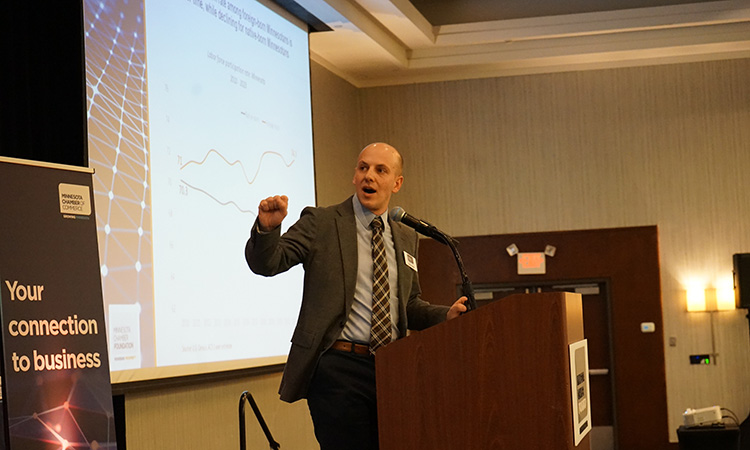
As a whole, immigration has played an essential role in sustaining population levels as birth rates stagnate – in Minnesota and around the nation. Those were a few takeaways from a Minnesota Chamber of Commerce workforce summit held in Brooklyn Park on Wednesday.
At the summit, the chamber shared more details about its recent report touting the many “economic contributions of New Americans in Minnesota.”
In its opening pages, the report notes that the “national discourse and policy debates on immigration have shifted considerably” over the last 16 years.
“The economic realities remain unchanged: immigration is an essential ingredient of Minnesota’s long-term economic success. New Americans contribute to the economy as entrepreneurs, consumers, taxpayers, and workers, often filling high-demand roles that businesses struggle to staff,” the report stated.
The report is one of many issued on the topic by the Minnesota Chamber over the last 15 years.
According to the report, 94% of Minnesota’s net population growth between 2020 and 2024 was attributable to international immigration. The report also noted that Minnesota’s foreign-born population growth “has occurred primarily through legal immigration over the past decade.”
“From 2012 to 2022, the state’s foreign-born population increased by 26%, while its estimated undocumented population remained flat, despite fluctuations throughout the period,” the report said. “This suggests that concerns about border security and immigration enforcement should not be conflated with Minnesota’s longer term immigration trends, which have provided a clear boost to the state’s economy.”
What’s more, almost 60% of Minnesota’s total labor force and employment growth came from foreign-born workers between 2019 and 2023, according to the report. Immigration has also helped “mitigate historic workforce shortages in the post-pandemic period,” the report said.
“As we deal with people leaving the workforce through retirement and aging out of the workforce, immigration is helping pick up some of that slack,” said Sean O’Neil, director of economic development and research with the Minnesota Chamber, at Wednesday’s meeting.
Entrepreneurship among Minnesotan immigrants, meanwhile, has also risen in the last decade. In 2014, the rate of self-employment among Minnesota’s foreign-born population was 3.4%; fast-forward to 2022, and it increased to 5.5%. That’s higher than the rate of self-employment among native-born Minnesotans.
Still, Minnesota’s foreign-born self-employment rate was among the lowest in the nation, coming in 49th place. The national average is 8.2%
For what it’s worth, compared to the national average, Minnesota is not even an “especially high immigration state,” O’Neil noted. Over 14% of the U.S. population is foreign born, while just 8.6% of Minnesota’s is foreign born. “Without immigration, our overall population picture–even though it’s been strained–would be a lot more strained than it is today,” O’Neil said.