


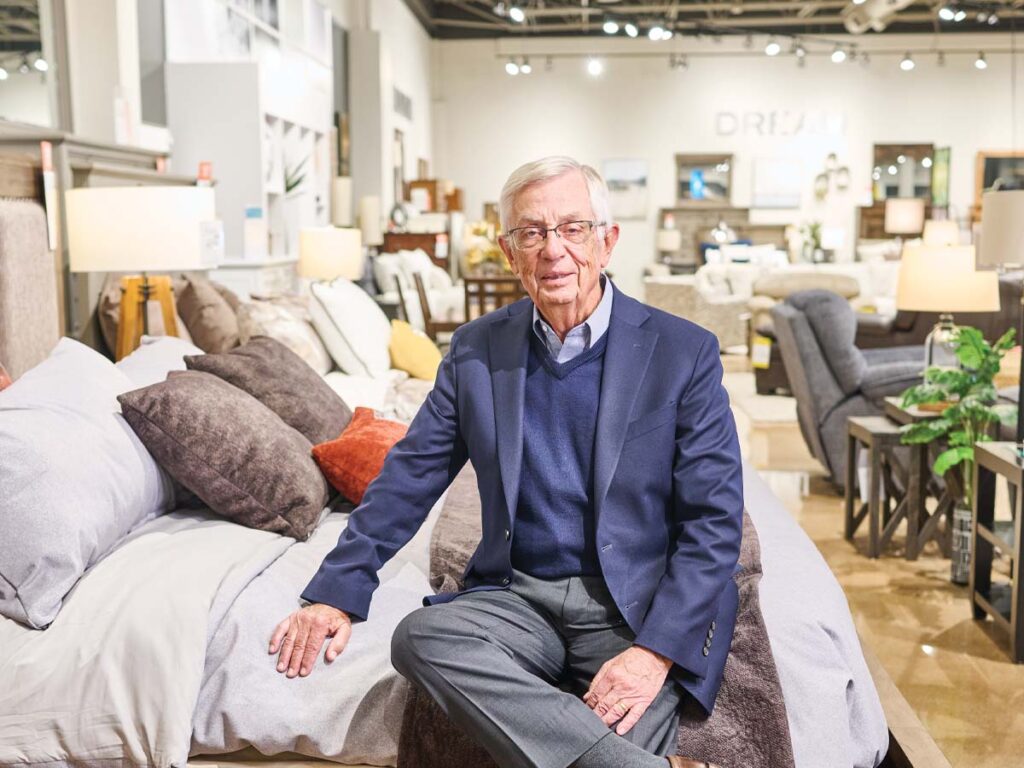
Ken Larson
More than four decades before you could get a king-size mattress delivered to your door in a compact box, Ken Larson disrupted the business of sleep.
It was the late 1960s, and the options to buy a mattress were extremely limited. “Dayton’s was the leader. Or you went to Levitz,” Larson recalls. While working in the furniture business, Larson spotted the unfilled niche. “The idea was to create sleep shops—small stores in strip centers. If the customer was treated well, given good information, and you made a good attempt at helping them understand that sleep could make a difference, I thought we’d have a shot.”
The first Slumberland store opened in Richfield in 1967. Larson was just 25 years old but had an instinct for connecting with customers, both on the sales floor and through marketing. “Newspaper color inserts were the thing that set us apart,” he says. “Our opening price point was just above cost. Then we’d upsell customers on a better mattress.”
Rather than treating mattresses like a basic commodity, Larson packaged them as “sleep sets,” complete with box spring, headboard, sheets, blanket—21 pieces in all, starting at just $299.
“That was unheard of,” he says.
Today, Slumberland Furniture is a full-service furniture retailer, with e-commerce and 122 stores in 12 states, 72 of them franchise operations. The company, still owned by Larson and his family, estimates annual revenue north of $400 million. But that’s just the retail business. Even more valuable than furniture sales in Slumberland stores are the buildings that house them. In all, the Larson family real estate portfolio includes 3 million square feet under ownership and management.
It’s one of several strategic decisions Larson made early on that set up Slumberland for enduring success, even as the options to buy mattresses proliferated.
“He understands the big picture—he’s very deliberate.”
—John Fitzgerald, Attorney, Lathrop GPM
Recline mode
“I’ve always been hooked on data,” Larson says. He started measuring three things: how many people visited a Slumberland store, how many of those shoppers made a purchase, and the average price of a purchase. Mattresses are not a frequent purchase, so it didn’t take long for Larson to realize that, to grow, he would need to offer more kinds of products.
Within a few years of launching Slumberland as a mattress shop, Larson started broadening his assortment, and he went for a major brand name: La-Z-Boy recliners. “Having brand names is critical—you can ride on the reputation of that brand,” he says. Today, Slumberland Furniture is La-Z-Boy’s top independent dealer, and the line continues to be a draw (much to the chagrin of many wives, Larson jokes in his mild-mannered way). He lets the product change their minds, he says, as he kicks back in a recliner at the newly remodeled Eagan store. He’s been known to send recliners to friends recuperating from illness or surgery. “This chair can be the most comfortable place they sleep.”
Other category additions—upholstered furniture, leather goods—took the company further away from “slumber,” but Larson continued surveying shoppers and found that nearly 20% believed Slumberland was a full furniture store before it actually became one. In the 1990s, they updated the name to Slumberland Furniture and never looked back.
Measured expansion
Slumberland began growing beyond the Twin Cities in the mid 1970s, but even then, it didn’t go too far—St. Cloud, for starters. “It always sounds exciting to say you’re national,” says Larson, who invested in local TV commercials as well as newspaper ads. “But the smarter approach is to think about crossover with marketing and advertising.”
That same philosophy guided Larson’s early decision to grow through franchising at a time when it wasn’t common. “It allowed us to go into smaller communities,” Larson says. It also helped the company build a dedicated team of small-business owners. Several franchise owners were store managers first.
“It’s important that the company culture doesn’t change in different cities,” says Larson, who redefined Slumberland’s mission as the company opened stores in neighboring states. “We rolled out a mission statement when we started growing outside of the Twin Cities that focused on exceeding the expectations of customers. Our core values are the same today as they were 35 years ago: integrity in everything, treat each other—customers and stakeholders—with love, dignity, and respect.”
A tangible representation of that philosophy is 40 Winks by Slumberland, a foundation that works with local nonprofits to donate beds to children in need. Since 1991, 40 Winks has provided more than 50,000 beds.
“Ken is really one of the best people leaders you’ll find,” says his son Kenny, who became president of Slumberland Furniture in 2008, and then CEO, but only after a formal search process. “I learned everything from him. When you’re in a family business, a lot of it is watching and seeing how he’s doing it. I learned a lot by the way my father carries himself, communicates with people, and treats each person with love, dignity, and respect.”
Next-generation growth
In 2016, Slumberland Furniture bought the 122-acre former Imation headquarters in Oakdale and renamed it 4 Front Campus. Slumberland’s corporate offices occupy just part of the 550,000-square-foot original building, and the company leases space to other businesses. Plans are in the works to develop more office and industrial space, retail, and a medical building. The deal was led by Kenny Larson and his brother Michael, who oversees Slumberland’s real estate holdings. But their father laid the groundwork for this, the company’s largest development deal to date, many years earlier when he first started buying rather than leasing the storefronts Slumberland occupied, and then the strip centers around them.
Slumberland Furniture
Founded: 1967
Employees: More than 1,000
Stores: 122, plus e-commerce
Reach: 12 states
Annual retail revenue: $400 million
Real estate holdings: 3 million square feet
“He understands the big picture—he’s very deliberate,” says John Fitzgerald of Lathrop GPM, who has handled real estate deals for Slumberland for more than 20 years. In addition to being a lucrative investment, owning strip centers has given Slumberland stores the ability to choose their neighbors. “They can make the Slumberland store the anchor,” Fitzgerald says, “and then lease out to noncompeting brands.”
Owning its stores saved Slumberland during the pandemic and allowed the company to invest in e-commerce, which grew to seven times its pre-pandemic levels. Ultimately, that led the company back to brick and mortar. “If people have the ability to buy online, they need an even better store experience to support it,” Kenny Larson says. After a pause in store openings, Slumberland is now focused on adding franchise locations.
As for the founder of the enterprise, Ken Larson likes to stay involved in real estate decisions. When he and wife Barb are not spending time with their five children, 19 grandchildren, and three great-grandchildren, they devote themselves to philanthropic work through the Evangelical Free Church of America, where Larson is a past board chair; the Evangelical Council for Financial Accountability, where he’s a current board member; and other charitable organizations. The couple founded God’s Ancient Library, donating Torahs they buy in Jerusalem to seminaries and museums for teaching, research, and public engagement. Larson often delivers the Torahs in person. He recently was in Missouri to give one to a seminary.
There’s no slowing down Larson, who fondly recalls traveling across the world to cheer on Olympic gold-medal skier Jessie Diggins. Her father was a 40-year Slumberland employee; her mom owned the Red Wing franchise store for many years.
“Years before she won the gold, I traveled with her to Russia and saw her at the finish line, falling over, gasping for breath. I asked her, ‘Are you just out of gas, Jessie?’ And she told me, ‘Mr. Larson, if I finish a race with anything left, then I’ve had a bad race.’”
Larson pauses and leans in as he tells the story. “I’ve tried to apply that to my life. My personal mission is to finish strong.”
See the other 2024 Minnesota Business Hall of Fame inductees.