

Niron Magnetics Picks Alabama for New $1.8 Billion, 10,000 Ton Facility
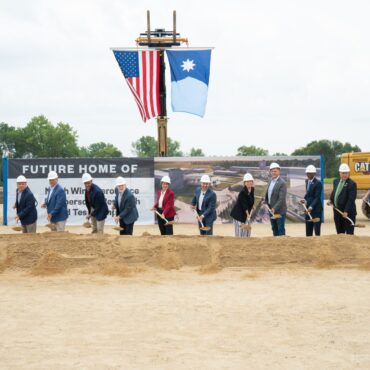
Niron Magnetics is a darling of Minnesota’s corporate community for a reason. The company was birthed by University of Minnesota research, brought to life through the university’s technology commercialization ecosystem, has its headquarters in Minneapolis, and is building its first manufacturing facility in Sartell, which is scheduled to come online in 2027.
If you don’t already know, Niron makes a high-performance rare-earth free magnet. They’re currently producing around 1,000 magnets every day in Northeast Minneapolis, and have begun plotting their global ambitions that will allow them to scale up extensively beyond that. The company’s CEO, Jonathan Rowntree, was featured in the first ever interview on The Twin Cities Business Show this spring, where he laid out some of their growth plans.
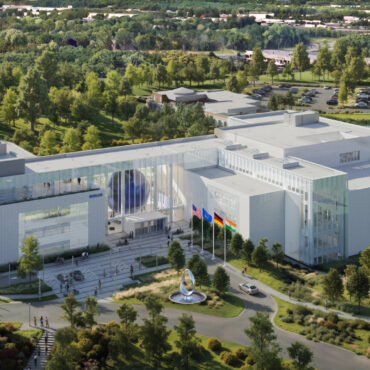
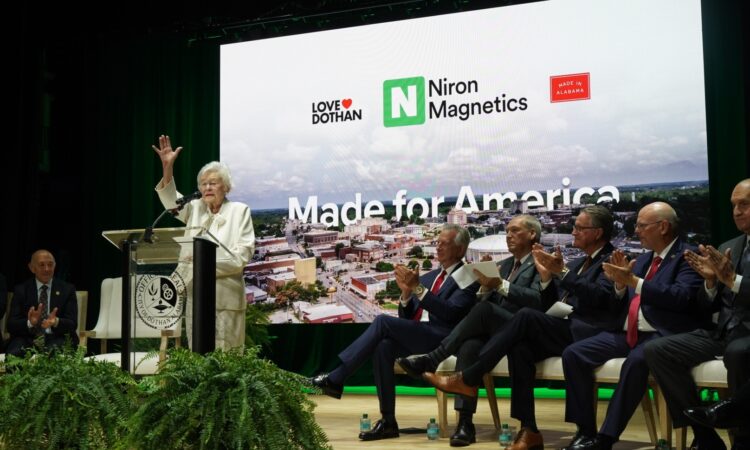
On November 20th, an announcement from Alabama’s Governor’s office unveiled that the state had been selected for a $1.8 billion investment and Niron’s second facility – which they are calling “Plant Two.” Plant One in Sartell is expected to produce 1,500 tons of magnets per day, while Plant Two will produce closer to 10,000 tons. As context, the U.S. uses about 50,000 tons every day, the world uses about 300,000 tons, and the global demand for magnets is expected to triple in the next decade.
There are some ways in which this should be seen as an indictment of Minnesota’s economic development environment and some ways in which the thinking goes well beyond the state’s tax policy. In a series of interviews with Rowntree dating back to this spring, he shared his view on how the site selection process was playing out and where Minnesota sat in their decision making.
Where Minnesota could have done better
In an interview in mid-October, Rowntree mentioned that Minnesota was a finalist for the facility, but hinted that the state was unlikely to be selected. He mentioned a confluence of factors.
Rowntree made clear that it would be more expensive to build the plant in Minnesota, and that the incentives required to make it cost competitive with other states would likely be too large to close the gap.
“We’re down to five states, five sites. We still got Minnesota in the mix, but they’re struggling to be competitive on incentive packages, and we’ve still got some challenges on power,” Rowntree said.
His explicit mention of site-readiness and access to available electricity are worth paying special attention to. “We need several hundred megawatts of power. So it’s not data center level, but it’s not a small chunk of power.” There are not a ton of available sites out there that have that type of capacity ready to go off the shelf, and he implied that other states were better-positioned to provide them the scale of electricity that they needed as quickly as they will need it.
There are also logistical benefits to the Alabama site that were mentioned in the announcement. It will have direct CSX rail access, and the site was prepared by the state of Alabama to be ready to build immediately.
The scale of the project is really large, and with that, the incentive package will likely be large to match it. Once we get the final numbers on the Alabama deal, I would expect to see a large public subsidy to lure the company to the state: “This is more than a billion-dollar kind of project. And so that’s why we need support to help with cost-effective loans, especially in this current environment where interest rates have come up,” added Rowntree.
This was always part of the plan
Two weeks ago, Niron opened a new Experience Center in Northeast Minneapolis that features their magnets in an electric motorcycle, high-end speakers, motors, and an e-bikes. At the announcement, Rowntree went out of his way to highlight their Minnesota connections and over-emphasize how happy he was to have the company’s home here.
“Niron’s home is Minnesota. Our headquarters is Minnesota.” Looking back, it seems clear that there was a hint here that while the company would be expanding elsewhere, their main offices will continue to live here.
In our interview this spring, Rowntree already had his sites set on other states, and a bigger vision to build towards international expansion: “The sky’s the limit, to be honest, with our technology. We have plans to build a number of high-volume manufacturing plants… We may build more plants here in the US, but we’ll also have a very heavy export business. So we are also considering future plants both in Europe and in Southeast Asia.”
Where the company goes from here
Niron’s ambitions are enormous, and this is an important step in their journey. Plant One was built with an eye towards having a replicable industrial facility that they could use as a model to put in at a second location, third location, and more.
“There’s no more scaling after Plant One. It’s really copy and paste. So we take the largest line in Plant One and just copy that multiple times and paste it in Plant Two.”
Back in April, Rowntree mentioned on The Twin Cities Business Show that they have plans to build towards ten plants or more in the years to come: ““We’re really focused right now on plant one and plant two, but fully intend that we’re going to hopefully build that through plant one through ten.”
This new plant will raise their output considerably: “Plant Two is 10,000 tons, where we move the needle on reliably supplying the U.S. market.,” said Rowntree.
But this is just the start. A win for Minnesota as one of our homegrown businesses expands, and a loss for Minnesota in the sense that it’s happening elsewhere.
But if you’ve been listening to Rowntree, nothing about this announcement should be much of a surprise.