

First Take: Vertical Endeavors’ New Owners
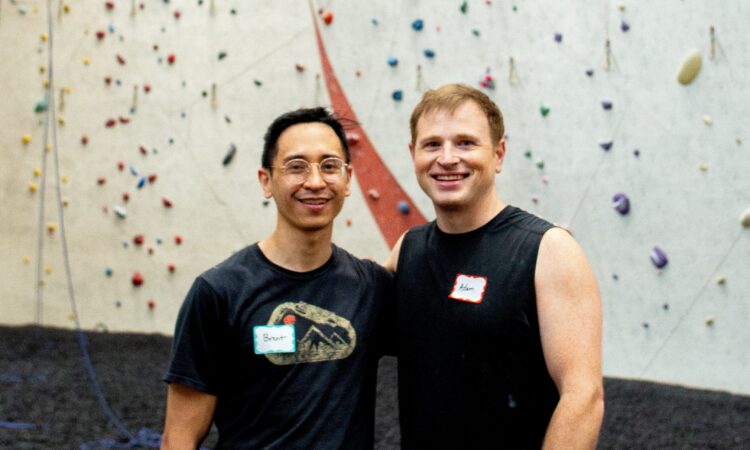
Last month, Twin Cities-based indoor climbing business Vertical Endeavors welcomed husbands and avid rock climbers Adam Arling and Brent Sugay as its new owners following the retirement of owner-founders Nate and Pam Postma. What started as an early date spot for the couple evolved into an integral part of their lives, and now, it’s a place they find themselves spending even more days of the week.
The duo brings several years of experience in business leadership, finance, management consulting, and technology to Vertical Endeavors. For the past 12 years, Arling has worked for Minneapolis-headquartered engagement agency BI Worldwide, where he focuses on game mechanics, a role he continues alongside his work as the climbing business’s president.
Sugay, who serves as its CEO and CFO, was a management consultant for global professional services company Accenture before working in finance and business planning strategy for large healthcare companies, including Blue Cross Blue Shield and its subsidiaries. He had been working as an independent contractor for the past couple years to finish a 10-year climbing project in Kentucky’s Red River Gorge, an expert-rated roped route.
In 1972, the Postmas opened the first Vertical Endeavors location in St. Paul, during a time in which indoor climbing was just beginning to take off, according to a statement the couple shared to announce their departure. “If you look at the history of climbing in Minnesota and nationally, Nate and Pam Postma are trailblazers,” says Arling, adding that his predecessors founded the sole national trade association representing the industry, Climbing Wall Association.
Arling and Sugay have inherited the six gyms built by the Postmas over the course of their 34-year leadership: four in the Twin Cities, one in Duluth, and another in Glendale Heights, Illinois. The two say they have a lot to learn from Vertical Endeavors’ founders but bring with them similar values of accessibility, community, and experience seeking.
“We’ve always been adventurers of sorts,” says Arling. About eight years ago, the couple made the decision to sell their house and convert a Mercedes-Benz Sprinter to go rock climbing across the country. “We just did it because life’s too short and we’ve always encouraged each other to do the things that we want to do.”
They recently sold their van and afterward looked for their next venture—this time, not too far from home.
This interview has been edited and condensed. Arling responded by video call; Sugay, by email.
How did you get into climbing?
Brent Sugay (BS): I started climbing in 2009 when I took a class in college. I wasn’t very good when I started, but I loved the mental and physical challenge. When I first moved to Minneapolis in 2010, I would take the bus every weekend from Loring Park to climb at the Vertical Endeavors in St. Paul when it was the only climbing gym [in the metro]. Climbing quickly became an obsession and my favorite way to unwind after class or work.
Adam Arling (AA): Brent brought me to Vertical Endeavors in St. Paul on an early date. I’ve always been very afraid of heights, so I was reluctant, but with exposure over time, I’ve gotten better at it and less afraid. … He built this really cool friend network from a queer climbing group years ago with people across the country, and now, together, we will meet up in Kentucky or Colorado or Utah seasonally to go climbing together. I love the social aspect.
You mention that you considered moving out of state—if it came to that—to purchase a climbing gym. What is it about a climbing gym that you both were drawn to as a business endeavor?
AA: We’ve always talked about being entrepreneurs or going into business together because we have these skills that complement each other and are both problem solvers. Brent had this itch to build a gym from scratch … but it was a challenge that we were up for because climbing is a lifelong passion of ours, and at the end of the day, it’s a place where we already spend a lot of our time.
That’s how it started, but then when we found out that Vertical Endeavors’ owners wanted to retire, we were like “This is perfect! We already hang out there, and we don’t have to move!” This is our family, so why not invest our time in this space where we could unleash more of its potential?
How have your professional backgrounds shaped your approach to owning and operating a climbing gym?
AA: I work in a gamification division [at BI Worldwide], so I’m always thinking about the psychology and social aspect of what motivates people and how to get them involved. I’ve also managed a couple of local political campaigns, which I’d liken to being an entrepreneur: building a team from the ground up, raising money, having a budget, and marketing a product or cause.
Before that, I worked at a nonprofit called the Citizens League in St. Paul, which had a community-organizing approach of including people impacted by a problem in solving that problem because it creates more sustainable change. … Coming to this company, I see a lot of opportunities for that. We’re building the capacity of facility managers to own and make decisions around their budgets instead of being really top-down.
BS: While I spent much of my career launching and growing businesses for Fortune 500 companies, I was always inspired to run my own business. I feel very lucky to combine my professional skills with my passion in climbing with the support of my husband.
What are some of your goals and aspirations for this first year as owners?
AA: The previous owners built six gyms over the last 34 years, and some of them are a bit older than others and could benefit from some reinvestment in the facilities themselves and the equipment. … The other part is reinvigorating the brand. Some retail businesses like this have been very “paid membership, come in, leave,” but we treat the gym like a third place. We want to make the gym more comfortable for people who want to study afterwards or work remotely there and for families who are going to watch and hang out while their kids climb.
BS: We want to invite more people into the sport and show them there’s a fun challenge no matter their skill level and a community out there that’s happy to show you the ropes.
What’s your strategy for converting newcomers into members? How do you get people to keep coming back?
BS: Climbing can be intimidating at first, so we have a great staff to teach the basic skills to get newcomers comfortable to tackle the wall. … We reset our routes weekly, so there’s always a new climb to try. … We also support member-led groups—such as Up Ending Parkinsons, Adaptive Ascents, Out Climb, BIPOC Beta—to bring in new folks to try it out and find their own community.
What’s your advice for someone looking to go climbing for the first time?
BS: Focus on your legs. Your strongest muscles are in your legs, and if you can build up your feet as you climb, you’ll rely less on your arms.
AA: You have to figure out where you’re at, start there, and just work on it. You’re not going to be good the first time. It’s going to hurt a little bit the day after, but if you stick it out for a couple of sessions and find a community of people you enjoy, you’ll push past that initial barrier.