

 What’s this?
Building Skills for What Comes Next
Minnesota’s corrections industries date back to the 1870s, when incarcerated people (IPs) produced hay-baling twine and the “Minnesota” line of farm machinery. Today, IPs at six Minnesota correctional facilities are building life-changing skills in MINNCOR Industries shops.
Guided by a mission to “Transform Lives for a Safer Minnesota,” MINNCOR staff teach job skills and model strong workplace habits in classrooms and workshops, preparing IPs for meaningful employment when they return to their communities.
Across MINNCOR’s half-dozen facilities, work opportunities range from packaging and shipping to graphic design, printing, and furniture and textile manufacturing, with products designed for offices, libraries, schools, and more. And because this is the Land of 10,000 Lakes, dock and pier assembly is among the training options offered through MINNCOR.
From the Inside Out
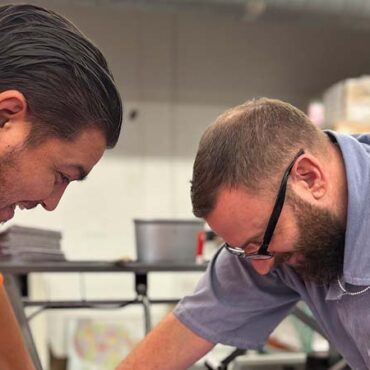
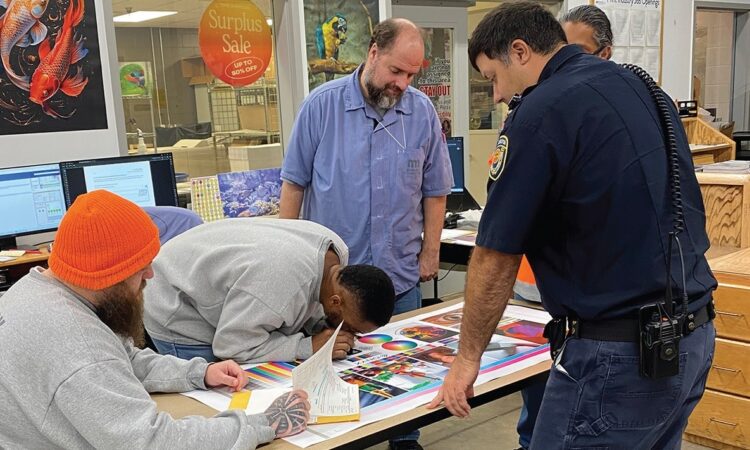
Corrections Manufacturing Specialist Debra Woitalla has been training IPs for 18 years in the print shop at the Moose Lake facility. She has helped numerous IPs gain hands-on commercial printing experience, producing everything from those little red “I Voted” stickers to DNR maps and brochures.
Networking with printing industry contacts gave her insight into what IPs need to demonstrate to prospective employers after release. From there, she adapted a training curriculum developed by an industry group into a 20-week course on operating the facility’s older offset press.
“It’s really [about] believing in second chances,” Woitalla says. “I wanted to see what I could do to build some hope for these guys.”
Training also covers design, collating, color theory, and mixing ink and toner. MINNCOR tracks participants’ hours and proficiency on each piece of equipment, and provides a certificate that can be shared with prospective employers.
“It’s a very skilled trade, and we are one of the few places left in the country that’s teaching this,” she says. “It’s so easy to find employment for these IPs when they are close to being released.”
Along with certification, she also helps IPs build their confidence, prepare a resume, and recognize their own value. “I have seen the biggest change in these guys. They handle stress in a more constructive way,” she says. “They start learning to be accountable and make good decisions, build character and confidence.”
Stitching Together a Successful Future
Michael Crego is a production supervisor at Shakopee, Minnesota’s only correctional facility for women, where he oversees the work of 100-120 IPs across three workshops. They do everything from basic assembly and packaging to making uniforms, utility belts, and sandbags used to secure roadwork signs.
“In our simplest assembly shop, people say, ‘They’re just folding balloons,’” he says. “In reality, those folks are learning about raw products coming in and finished goods leaving. You can take that anywhere. People are leaving here with really defined job skills in assembly, production and warehousing.”
With the vast majority of incarcerated people eventually returning to their communities, Crego sees employment as an important part of a successful transition. Research supports its importance, alongside stable housing, supportive relationships, and access to needed services.
“You have to have a plan when you leave prison,” he says. “When you do, you give yourself the best chance to succeed.”
Learn more at MINNCOR.com