

Minnesota’s Bowling Businesses Continue to Reinvent Themselves
Decades after its heyday, bowling has remained popular in Minnesota, reflected in the 172 bowling centers scattered throughout the state. But while the sport and entertainment option has maintained its core identity—the distinctive rental shoes, the often-retro scoring system, the loud crash as the ball knocks down the pins—its economics have undergone a drastic transformation.
Throughout the 1970s and ’80s, organized league bowling was the lifeblood of bowling alleys here and across the country, but starting in the ’90s, league participation saw a sharp decline. (Why? There’s no definitive answer, but author Robert Putnam described a turn in U.S. lifestyles away from community in his famous 2000 book Bowling Alone: The Collapse and Revival of American Community.) Many alleys began to pivot from traditional league play to bowling as a more-casual recreational activity.
As bowling centers started looking for other ways to sustain their businesses, some changed their revenue models entirely. Under the impression that they needed more than bowling alone to drive business, they transitioned their centers into multi-attraction venues with offerings like laser tag, arcades, and active play sets. The family entertainment center (FEC) model resembled a small-scale amusement park and became the basis for Minnesota bowling centers in the 21st century.
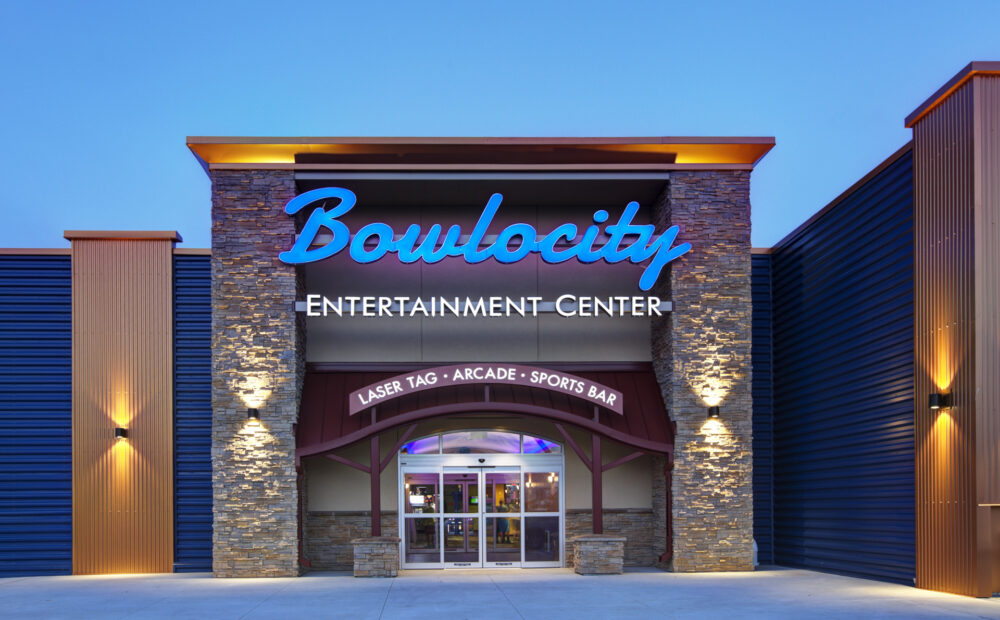
In Rochester, Bowlocity Entertainment Center was on this curve. During co-owner Erin Glorvigen’s final year at Saint Mary’s University, where he was finishing up his entrepreneurship degree on the school’s Winona campus, he conducted a study that evaluated the feasibility of turning then-Recreation Lanes into an entertainment center. When he returned home after graduating in 2011 to help his father, Gene Glorvigen, run the business that the family has owned since 1989, they began to more seriously consider the FEC idea.
“We had ongoing conversations even before Destination Medical Center was announced,” Erin Glorvigen says. “We knew Rochester was growing. We knew we could handle [the expanded business] as far as revenue.”
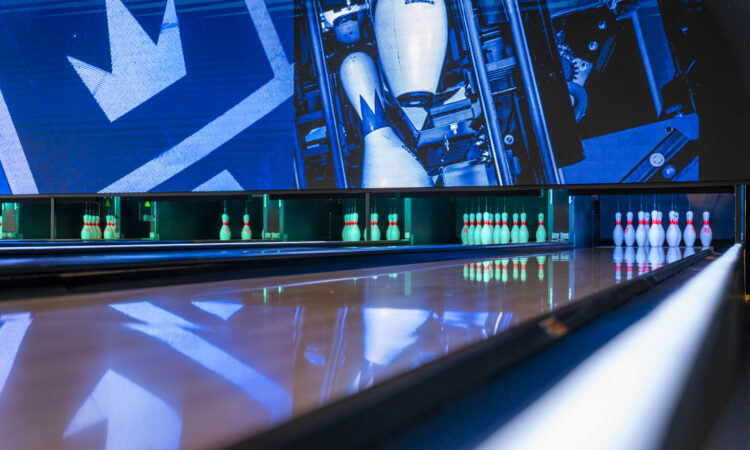
In 2014, the center reopened under a new name and doubled in size, with the addition of a laser tag area, arcade, and eight suite-style lanes.
The bowling-alley-to-FEC strategy has taken off. In 2024, Bowlocity expanded a second time, adding four lanes of duckpin bowling and a high-tech, interactive darts game while also upgrading amenities. The renovation of the now-40,000-square-foot facility totaled around $2 million.
“If you have just a bowling center with a bar, you can really only get so many sales in a year,” Glorvigen says. “The market has shown over the last decade or two that in order to truly survive, you have to read the room.”
Social appeal
In 2011, I began bowling in one of the Saturday morning youth leagues at Bowlocity, where I continued to practice and compete until moving away for college. During my interview with Glorvigen, I recalled the construction and tarp around the building during its first expansion and the confusion I felt then as to why a rebrand was necessary. My family vied for seats each week to cheer on their kids and other families’ kids, catching up with parents and occasionally sticking around to share a pizza. It had a small-town feel.
When Bowlocity reopened in spring 2014, the original 16 lanes sat next to a bustling arcade filled with children, and many regulars commented that it felt like an entirely different establishment. Bowling wasn’t the main attraction anymore. League bowling sees many of the same people year after year, so there was still a sense of community, but for some, the connection to the center was severed with the expansion.
A small-town feel does not necessarily provide a solid business model, but bowling centers have recognized it may be worth trying to preserve in some form.
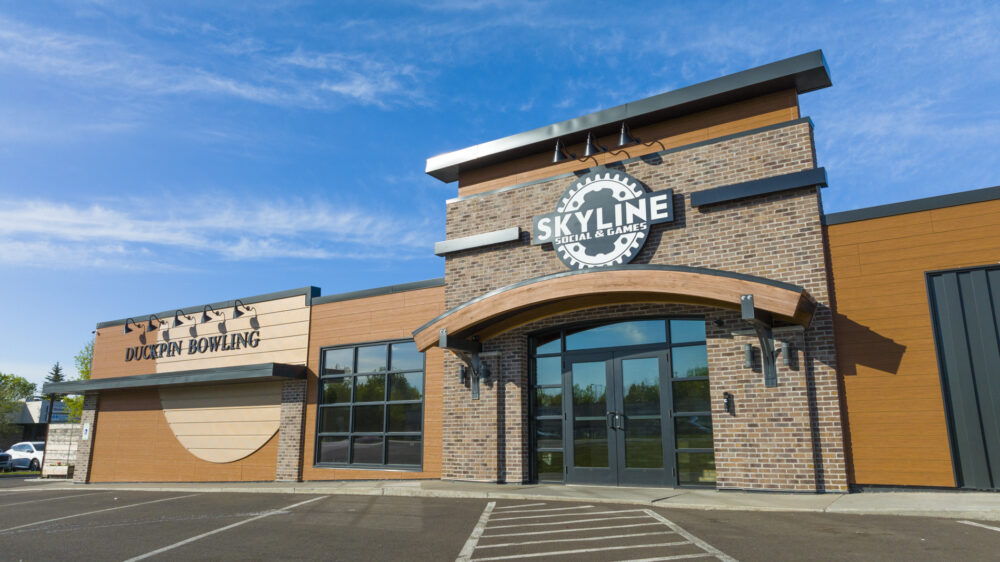
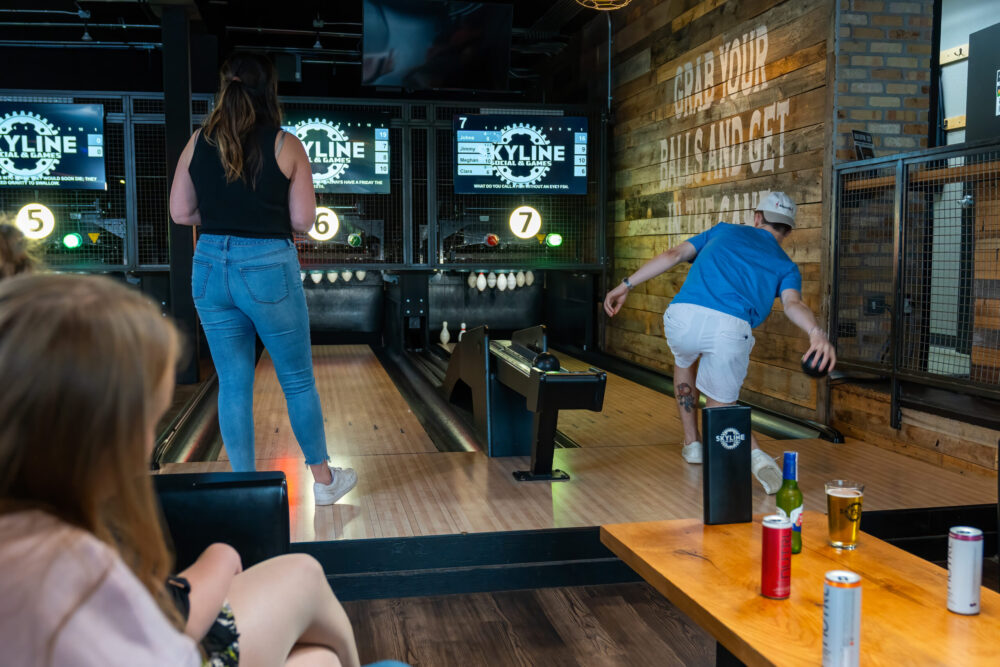
In Hermantown, a Duluth suburb, the owner of Skyline Lanes knew the bowling alley’s league-based model couldn’t last. “Traditional bowling leagues, where people show up at your facility and bowl for 30-plus weeks [and in] the winter months, were just not going to happen,” says Corey Kolquist, third-generation owner of what is now Skyline Social & Games. “I just saw that league bowling was coming to an end unless you reinvented yourself.”
The business transformed similarly to Bowlocity. For 70 years, Skyline has been family-owned, and Kolquist first got involved in 2010. Five years later, he took over and spent a few years studying the FEC model to ultimately revamp the business in 2019. The full remodel was completed in 2023: expanded arcade, triple-sized restaurant, duckpin bowling, axe throwing. That expansion set the precedent for Skyline’s second location in Apple Valley, which opened in late July. Both locations also focus on outdoor entertainment options like volleyball, cornhole, and bocce.
Kolquist says some operators have smartly catered to families and corporate groups, as recreational play has overtaken the leagues.
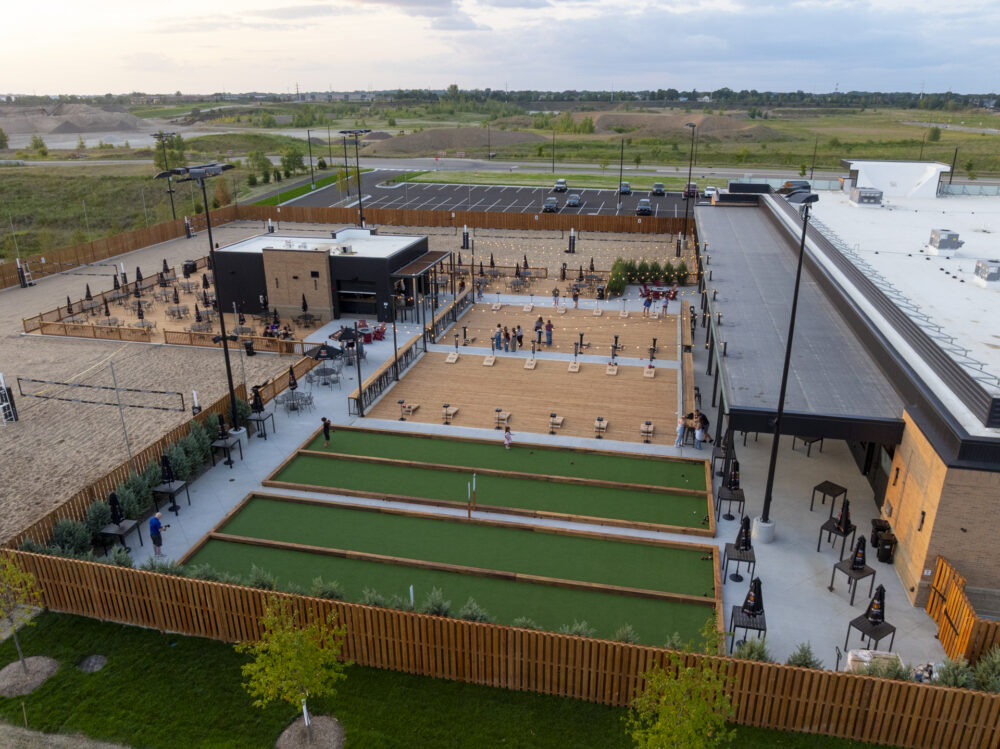
Skyline runs only a few traditional leagues at its Hermantown location and none in Apple Valley. But it offers “social” bowling leagues that instead meet every other week for 12- to 14-week periods, an option that Kolquist believes more closely aligns with the experience people want. (Skyline offers social leagues for other activities, too.)
The social leagues are a legacy of Covid-19. Post-pandemic, Kolquist noticed greater desire among customers to be around other people despite busy schedules.
“It’s a time to put on the calendar to get together with friends and socialize,” Kolquist says. “There’s just more things competing for people’s attention nowadays … so this prioritizes making that time.”
Bowlocity, too, has introduced a handful of social leagues that have proven to be popular, says Glorvigen. The center still hosts several weekly leagues that draw the same crowd of more-serious bowlers, but social leagues bring in more people, who might not be considered league bowlers in the traditional sense but still care about having a regular outing.
For the love of bowling
While FECs are on the rise, the traditional bowling alley is by no means non-existent. Southway Bowl in St. Cloud, for example, would be more profitable if it were an entertainment center, says owner Jason Hanson, but money isn’t everything to him.
He is one of four owners who purchased the business in 2021 with the hope of reviving the center after years of mismanagement. “The writing was on the wall that this might be another bowling center closing, and we leveraged all of that into an attractive enough price to make us pull the trigger,” Hanson says. “We came in with new blood and new ideas.”
For the owners, who each came in with at least two decades’ experience owning bowling alleys or shops for bowling equipment and services, that meant going all in on bowling. As four individuals who bowl competitively, they knew the kind of establishment where they prefer to bowl, so they dedicated the next five years to turning Southway into that spot.
They spent at least $250,000 to repair all 24 lanes of the center, bring in new oiling machines, improve the building’s appearance, and renovate the kitchen, Hanson says.
He says he cares about promoting bowling itself through a well-maintained facility and a greater emphasis on leagues and tournaments. What were four- to six-team leagues when he took over became eight- to 14-team leagues. In 2010, another St. Cloud bowling center, Granite Bowl, merged with and moved into Southway. With the move, Southway revived Granite Bowl’s annual tournament, which had been on a years-long hiatus.
“The reason we stick with bowling is [that] we bought a bowling center, and we’re bowlers,” Hanson says, referring to the ownership group. “We’re invested in the sport of bowling continuing to thrive.”
The owners don’t have much desire to add other entertainment, although Hanson says they could at the expense of some lanes. Even cosmic bowling—the variation with black lights and party music—is off the table, he says, because it inhibits a bowler’s abilities. (As someone who has been practicing at a center when it turns off the lights for cosmic bowling, I concur.)
Hanson views FECs as operating in a separate market from his business. What he does see as a potential threat, however, are corporate bowling centers.
“The larger they get, the harder it is for them to focus on the individual bowler, and the more they only look at the bottom line,” Hanson says. Yet, he understands that they play an important role in bringing bigger tournaments to Minnesota, like the World Series of Bowling, which came to the Twin Cities this past spring.
Currently, 20 of the state’s 172 bowling centers can be categorized as corporate-run or chain businesses, including two located inside casinos, according to Bowling Proprietors Association of Minnesota executive director Josh Hodney.
At what cost?
Since Hanson and his co-owners took over Southway, revenue has been up by 15-20%, but he says that the remodel expenses continue to weigh on the business. At the same time, ownership has been trying to navigate inflation, raising prices for league participation and open bowling by 25-50% (although Hanson says that when he took over, rates were much lower than they should have been).
“The things that are affecting us aren’t any different than the things affecting the restaurant down the street,” Glorvigen says. But Bowlocity and Skyline have prospered because of their many offerings. Bowlocity’s annual revenue is split equally among bowling, other entertainment, and the restaurant. Of Skyline’s revenue, entertainment, food, and beverage are one-third each. When one part of the business suffers, they can usually make up for it in another.
Looking ahead, Glorvigen and Kolquist believe their businesses will continue to grow thanks to their early investments in the FEC model. They suggest that more bowling alleys will follow suit.
“But in any industry, there’s always great operators with different business models that make it work,” Kolquist says. “There’s going to be great traditional league houses … but it’ll be far and few between.”
While Hanson agrees that Minnesota’s bowling scene makeup will increasingly lean FEC, he believes chain centers will also become more common as corporations continue to buy mid-size centers that can’t find succeeding owners. (He brings up the 2019 acquisition of nine local bowling centers by a New Jersey-based equity partner of Triple Shift Entertainment, which Finance & Commerce covered at the time.) However those changes play out, he wants centers to remember their roots.
“Some [businesses], to stay afloat, are going to gear towards the family entertainment center [model]—maybe not so much in our region, where we’re a lot of 8- or 10-lane centers that don’t have room to add arcades or laser tag, but in the metro area, you’ll see more of that,” Hanson says. “I just hope we can continue to grow the sport enough to where it’s still going to need the family-run centers that maintain bowling as the priority.”