


Is It Time to Tear Down Empty Skyscrapers?
Say you own a consistently vacant but otherwise perfectly serviceable building. Maybe it’s downtown, part of a defining post-pandemic real estate problem that has left more than a quarter of Twin Cities offices vacant, with work-from-home to blame. Experts say a marketing push or residential conversion won’t work, or would be exceptionally difficult, for many of these skyscrapers. So, some observers have been discussing a third path: demolition.
Local demolition contractors say the option has been coming up in conversation over the past year. Building owners are “in a panic,” says Andy Ristrom, vice president of Bolander, a St. Paul-based contractor that offers demolition services. “Their vacancy rate is so high … their property taxes keep going up … energy prices, both natural gas and electric, keep going up,” even as property values continue to fall.
“One thing that’s really forcing this conversation is debt maturity,” says Chad Rempe, vice president of preconstruction services at the Kraus-Anderson construction company in Minneapolis. (Notably, the Dayton’s Project and a Normandale Lake Office tower recently fell into foreclosure.)
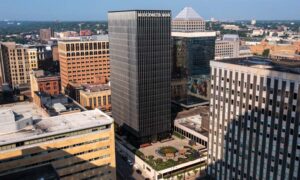
The downtowns contain plenty of omens, such as the largely vacant 51-story City Center complex in downtown Minneapolis; Target paid almost $110 million to end its lease there about five years early. Then there’s the Wells Fargo Center, the 57-story building that in 2024 reportedly sold for about a fourth of its pre-pandemic value. Last year, the St. Paul Downtown Development Corp., a redevelopment nonprofit, bought downtown’s 16-story Alliance Bank Center, after owner Madison Equities abandoned it.
In the past year, Ristrom says, Bolander has priced half a dozen large buildings for demolition, some of them skyscrapers, all in the downtowns. (Ristrom can’t disclose names.)
Erik Hansen understands the dread, as director of Minneapolis’ Department of Community Planning and Economic Development, which provides demolition permits. “All tools need to be on the table,” he says, “even ones that might have, in recent times, been taboo.”
Replacement strategies center on mixed-use redevelopment, but financials remain an issue. “I don’t know how much traction you’d get converting these former office buildings into residential apartment buildings if you can’t [even] get people to build new ones,” Ristrom says.
So, what’s involved in taking down a massive steel-frame tower? It has to come down a floor at a time, top to bottom—basically construction in reverse. It’s imperative to contain the debris, ensure public safety, and protect neighboring buildings. Las Vegas-style implosion is almost certainly off the table.
“All tools need to be on the table, even ones that might have, in recent times, been taboo.”
—Erik Hansen, director, Minneapolis CPED
What would it cost? With so many considerations, the estimates vary and contractors struggle to generalize. One places it at roughly $1 million per floor. Another says $3–4 per cubic foot. Others speak in the tens of millions of dollars for buildings in the 25- to 50-story range. Variables include materials, height (more height = more mitigation), whether there’s space around the building to place equipment, etc.
The building may require asbestos abatement, certainly if it went up before the mid-1970s. This phase can add millions to tear-down costs.
Demolition leaves the owner with an empty site downtown. If they’ve paid millions for the empty building, then tens of millions to bring it down—what’s next? Spend tens of millions more to construct apartments? Developers still have a rough go penciling out multifamily projects on vacant suburban lots thanks to high interest rates, skyrocketing materials costs, and labor inflation. Ristrom says multifamily developers are “either divesting from the downtown core or not going to build here anymore,” period, because of what they see as unmanageable codes and regulations.
Where demolition does make economic sense, there’s clear and lucrative use for the land. That’s why implosions bloom along the Vegas Strip, as in 2024, when the Tropicana made way for a new baseball stadium—“because they have a business plan that makes money,” Ristrom says. Fifty million dollars in demolition costs is a pittance in a $2 billion ballpark plan, but it’s a deal-breaker for a $35 million apartment building.
There is one notable, much-discussed exception where demolition might pencil out.
Some in the media have batted around the idea of razing City Center and the former Multifoods Tower for a T-wolves/Lynx arena. Minneapolis Mayor Jacob Frey told the Star Tribune in April he supports the idea, although he’s opposed to subsidizing it. Team ownership intends to privately finance a new arena but will likely seek tax and fee abatements. (Redeveloping the City Center block also would require taking down a 585-room Marriott and a 687-stall parking ramp, adding further millions to project costs.)
Read more from this issue

An analogue: Milwaukee’s Fiserv Forum, home to the NBA Bucks, was finished in 2018 for $524 million downtown. A decade later, a Minneapolis equivalent would cost at least $750 million. That makes demolition maybe 10% of the total investment, perhaps equivalent to land acquisition at alternative sites elsewhere in town.
Summing up, Ristrom predicts some building owners will go bankrupt and some buildings will go for dirt-cheap—but they’ll still sell, and they’re generally safe from the wrecking ball.