

What’s Behind Minnesota’s Shifting Hospital Systems?
The Minnesota Hospital Association says we have a problem. More than 30 nonprofit hospitals in the state are out of cash to make payroll.
The Hennepin County Medical Center (HCMC) was trending toward that scary position recently. Leadership had claimed all of this year that the state’s flagship safety-net hospital would close in June if it did not receive financial assistance from the Minnesota Legislature.
That changed Sunday night. The state’s approved bill would send more than $200 million in direct stabilization funding to HCMC. The legislation also includes a new reserve account of up to $500 million that HCMC, and possibly other hospitals, could draw from until 2031. The deal now awaits Gov. Tim Walz’s signature.
HCMC was running out of money for several reasons, but spotty insurance reimbursements and the hospital’s mission to accept all patients regardless of their ability to pay especially set it back in recent years.
“The cost spiral has been going on for a while,” adds Mike Opat, a former member of the Hennepin County board of commissioners, where he oversaw governance changes at HCMC.
Opat now works as North Memorial Health’s first chief business development and community relations officer, a role he’s held since 2022.
North Memorial Health has had its own financial difficulties, as it announced this month it would merge with Sioux Falls, South Dakota-based hospital system Sanford Health.
The Role Labor Costs Play
Labor costs are the No. 1 cost for any health system. According to the American Hospital Association (AHA), employee wages, benefits, and contract labor typically account for 50–60% of a hospital’s total operating expenses. “It’s a people-intensive industry,” says Tim Sielaff, executive fellow at the University of St. Thomas Opus College of Business. Sielaff previously served as chief medical officer of Allina Health for five years.
During the Covid-19 pandemic, hospital labor costs inflated, as did costs generally.
“The inflation in the cost of doing business was not supported by the insurance reimbursement structure,” Sielaff explains. “That is a substantial challenge. A safety-net hospital has a different set of challenges than other health systems.” Namely, safety-net hospitals such as HCMC tend to rely heavily on Medicaid and Medicare.
A hospital system generally loses money on Medicaid patients, according to the AHA. Meanwhile, a health system typically breaks even or makes minimal profit on Medicare. Private commercial insurance—health coverage obtained through the likes of UnitedHealthcare, Cigna, or Blue Cross Blue Shield—reliably provide hospitals with profit.
In 2025, about 40% of Hennepin Healthcare’s payors used a Medicaid system, 29% relied on Medicare, and 18% used commercial insurance.

The Insurance Fiasco
There’s a lot of conjecture when it comes to Medicaid cuts right now, Opat says.
In 2025, President Trump’s “One Big Beautiful Bill Act” brought sweeping changes to Medicaid, including additional program eligibility requirements. The first changes won’t take effect until fall.
Even before then, Minnesota had seen a reduction in Medicaid enrollment across the state because Congress had mandated states return to pre-pandemic eligibility processing. In 2024, 1.2 million Minnesotans were covered by Medicaid, down 10.3% from its 2023 peak. “Medicaid rates are awful, never get better, and never cover the costs,” Opat says. “Those with commercial insurance are being asked to subsidize the Medicaid population.”
Medicaid has played a critical role in the financial viability and operational stability of hospital systems. Medicaid accounted for 19% of all spending on hospital care in 2023, according to KFF, a national health-policy organization. The other major payers for hospital care are Medicare (25%) and private health insurance (37%).
Consistent revenue from Medicaid helps to reduce the burden of uncompensated care, which the AHA links to two primary sources: charity care (free or discounted care for low-income patients) and bad debt (unpaid bills from uninsured or underinsured patients).
Nonprofit hospitals like HCMC are often required to offer charity care based on their mission and tax-exempt status.
Another piece of the insurance-problem pie has to do with diagnostic relative groups (DRGs). Insurers determine how much to pay for hospital services using DRGs, which are a type of patient classification. DRGs categorize hospital stays by clinical conditions and expected resource use. Instead of paying hospitals for every service provided to an individual, insurers use DRGs to pay a fixed rate for that individual’s entire hospital stay.
“If you have a ruptured appendix, typically that DRG pays the hospital $500 in one night, but it can take the hospital four nights until the patient leaves,” Opat says. “The hospital takes a risk for that. For four nights, your costs are $200, and you get reimbursed $50. This is what troubles [HCMC]. People are just sicker [there]. Sometimes insurance companies make an allowance for it, but many times it’s not enough.”
Minnesota Legislature Grants HCMC’s Request
The health and human services finance and policy bill that passed the state legislature on Sunday allocates $205 million to HCMC and creates an additional pool of $500 million that other hospitals contending with financial distress due to uncompensated care could draw from until 2031.
In the past, Hennepin County funded HCMC for the uncompensated care it provided due to its mission to serve all as a nonprofit, safety-net hospital and Level I trauma center.
HCMC would deliver about $20 million in uncompensated care per year about 10 years ago, Opat explains. “That number has been jacked up to $38 million for people uninsured and who can’t get enrolled in Medicaid, had a combination of bad debt, or couldn’t pay their co-pays.”
Uncompensated care totals have increased each year at HCMC since 2020. In 2024, HCMC provided $104 million in uncompensated care, with $24 million of that provided to patients who live outside Hennepin County. According to Hennepin Healthcare, HCMC accounts for 20% of all uncompensated care in Minnesota.
“People believe hospitals have a lot of money because they are big,” Opat explains. “They have a lot of money but spend more money.”
One of the ways HCMC makes up for that loss is through Medicaid “directed payments” fees. Hospitals pay these special taxes to the state to unlock much larger federal Medicaid reimbursements. “HCMC gets $120 million a year in Medicaid directed-payments fees. These work for hospitals with a lot of Medicaid,” Opat says.
Directed payments were a topic of national conversation last year, but legislation to expand this cashflow ultimately died at the finish line because the federal government curtailed the rapid growth of these payments in the “Big Beautiful Bill.”
“[Directed payments] are a massive amount of help,” Opat adds. “Hennepin’s the only hospital in the state to get it.”
Pending changes to the current federal budget will put further stress on HCMC’s mission to deliver health care. “If you take that system that is barely breaking even, or losing money, and reduce funding further, that will lead to difficult decisions [at HCMC],” Opat explains.
Opat wanted North Memorial Health to get in the mix of Medicaid directed-payments fees, but the federal government in January said there will be no more such arrangements in any state. However, Hennepin County’s remains.
Why North Memorial Health Had to Merge
North Memorial Health, with major hospitals in Robbinsdale and Maple Grove, and South Dakota-based Sanford Health announced earlier this month it signed an agreement to merge into a single nonprofit health system.
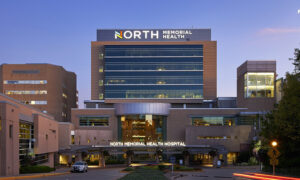
The proposed merger—subject to governmental review—came as North Memorial recorded a 2025 operating loss and sought subsidy funding from the Minnesota Legislature. CEO Trevor Sawallish says the Robbinsdale hospital lost $50 million in 2025.
In 2024, North Memorial Health closed its mental health services and the neonatal intensive care unit in Robbinsdale. The health system laid off more than 100 hospital employees. Another major hospital system, Minneapolis-based Allina Health, laid off nearly 350 people in 2023.
“For North, [the move was] purely survival,” Opat admits. “It’s being taken over by a bigger system. That system is willing to take on the losses that happen, primarily at Robbinsdale, or try to make the business plan work better at Robbinsdale. Maple Grove [hospital] makes some money and can expand, and the payer mix is better up there, but the folks felt it was never going to get sustainable at Robbinsdale.”
Other mergers, such as Allina with Sutter, were also defensive in general, he adds. “What they are doing is taking systems that are financially stressed and putting them into larger systems. You can get economies of scale in your shared services—marketing, HR, benefits-buying power, volume discounts, all the things to feed hospitals and clinics. That’s what drives the consolidations.”
In a nation watching hospitals merge and close at what can feel like a once-a-week rate, dominant health care systems are beginning to take over the industry.
“We, as community members and voters, really need to assess the value that our health systems have in our community,” Sielaff stresses. “If, by merging, you’re keeping the facility open, that’s really important. But what happens is that it doesn’t end up reducing insurance premiums. It increases the cost of care.”