

New Generation of Entrepreneurs Poised to Build Duluth’s Future
Many urban downtowns continue to struggle with post-Covid 19 challenges, and Duluth is certainly no exception.
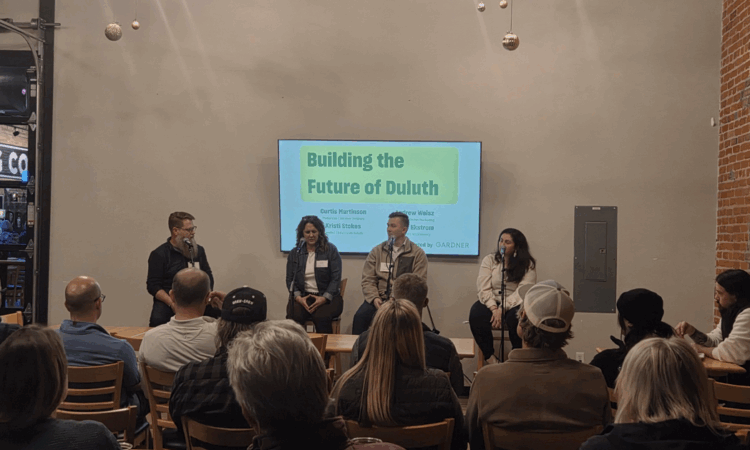
But the energized, mostly younger crowd that gathered Jan. 8 for the “Building the Future of Duluth” panel discussion expressed cautious confidence about where the central city is heading. Indeed, many of those attendees are helping to construct that future.
The gathering sponsored by Gardner Builders took place in the event room of Blacklist Brewery, itself an example of downtown entrepreneurship. Located on East Superior Street, the brewery and its taproom once occupied the former location of the Last Place on Earth, a notorious venue for synthetic drugs that was closed a decade ago.
When Blacklist moved to larger quarters a block away in 2021, the old Last Place space was taken over by another entrepreneurial endeavor, Duluth’s Best Bread.
The event’s panelists were:
- Curtis Martinson, operations lead for the Duluth office of Gardner Builders and the panel’s moderator
- Kristi Stokes, president and COO of Downtown Duluth, a private nonprofit that promotes and supports central city development and safety
- Andrew Weisz, CEO of Finden Marketing, a full-service Duluth-headquartered agency focusing on regional clients
- Emily Ekstrom, owner of Superior Street gift shop Hucklebeary
Ekstrom’s story is a notably inspiring one. She opened Hucklebeary as a pop-up shop in 2017. It became a permanent business in 2022 and now employs 10. Ekstrom also was able to buy the building on Superior Street that houses her shop.
Much of this success Ekstrom credited to the help she received from other businesses and from local lenders. In many ways, Duluth is “a big small town,” where neighbors look out for each other.
For Ekstrom, that included a neighboring business accepting deliveries while she was away from her pop-up shop. Once Hucklebeary became a permanent fixture on Superior Street, other downtown retailers and the city police department helped her develop anti-shoplifting strategies.
Like the other panelists, Ekstrom acknowledged downtown Duluth’s challenges. Superior Street businesses were hurt not only by Covid-19 and more work-from-home employees but also the four-year street reconstruction project that concluded in 2021. Many street frontages remain vacant.
The recently completed Essentia Health complex has yet to generate much additional street traffic. Even without the problematic presence of the Last Place on Earth, many residents believe that downtown has a crime problem.
Though statistics show a trend of declining violent crime, drug-related offenses and the increased presence of homeless people have fueled residents’ belief that outside of Canal Park, the central city has significant safety issues.
As the head of downtown Duluth’s biggest booster organization, Kristi Stokes summarized the many plans both her organization and City Hall are putting together to “reimagine downtown.”
Proposed ideas include finding ways to make use of underutilized larger buildings, perhaps by dividing them into smaller spaces for retailers and other types of entrepreneurial businesses. Stokes and event attendees conjured up visions of business incubators, coworking spaces, and a food hall.
The city also needs to manage safety concerns, in part by providing help to its unhoused population and those battling mental health challenges.
Duluth would also like to encourage redevelopment of new and existing buildings into housing. Stokes noted that one of the “chief challenges now” is finding developers willing to spend the significant sums needed to renovate old structures or build new ones.
The Lakeview 333 condo project opening this year on East Superior may encourage more developers to take the plunge.
A growing residential population downtown would require additional amenities, which could include open spaces (a dog park, for instance) as well as service retailers such as a bodega-style supermarket. These needs could help generate additional entrepreneurial activity in the city center, especially if private and public entities can assist with financing.
Finden Marketing’s Weisz reinforced the idea of “a network of expertise” that downtown entrepreneurs can plug into. He envisioned opportunities for new ways that downtown could market itself to visitors and entrepreneurs, showcasing [downtown’s] possibilities.”
Along with these dreams and possibilities, the panel event put the spotlight on a new generation of Duluthians looking to reinvent and further invigorate the city’s downtown Duluth. Significant challenges certainly remain. But younger entrepreneurs seem to have the energy and resilience to take them on. As Ekstrom noted, “we know how to work together.”