

Ecolab Bets Big on Data Centers
Artificial intelligence and data centers are stirring strong emotions in Americans, because many fear that AI will take their jobs and data centers will drive up the costs they pay for electricity and water.
Entering the fray to take on these hot button issues are top executives of Ecolab, and they are bringing science arguments and technological solutions to the debate.
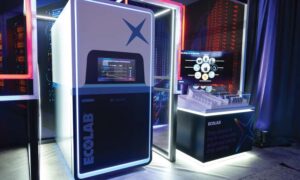
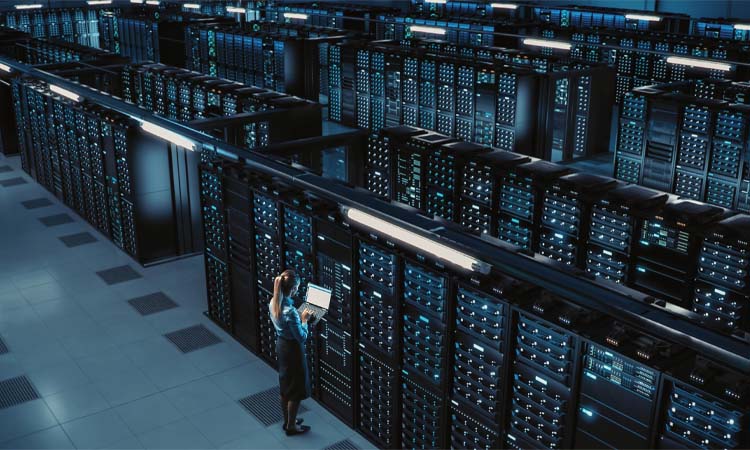
As data center development continues to surge around the globe, Ecolab will spend $4.75 billion to buy a Canadian company this year to become a bigger player in the data center marketplace. St. Paul-based Ecolab is acquiring Calgary-based CoolIT so their technologies can be paired to efficiently cool the microchips in data centers and dramatically reduce water used in the centers.
Ecolab, which does business in more than 170 countries and generated $16.1 billion in revenue in 2025, has a track record of helping customers manage water, including conserving and reusing water. “In the next four or five years, the whole planet will have a gap in terms of how much water we need versus how much nature can replenish,” says Ecolab CEO Christophe Beck.
“AI is driven by water and by power,” Beck says. “AI will need, in the next four or five years, the power equivalent of electricity of the whole of India and the water equivalent of the drinking needs of the United States.”
Beck, who became CEO of the 103-year-old company in 2021, describes this scenario as “a hell of a challenge that we need to manage.” Beck is also Ecolab’s president and chairman.
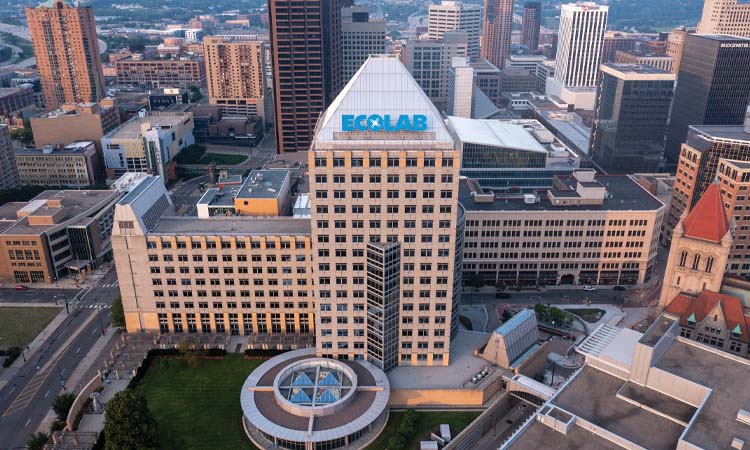
In an interview in his office overlooking the Mississippi River in downtown St. Paul, Beck explained why Ecolab is positioned to tackle this water and electrical resource challenge.
Many people know Ecolab for making cleaning products for hygiene and infection prevention. But half of Ecolab’s revenue from the first quarter of 2026 was derived from its water business. “There is no one in the world that masters water better than Ecolab,” Beck says.
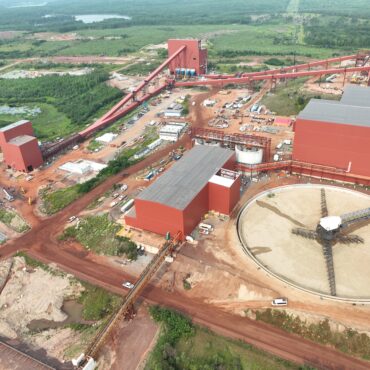
The CoolIT transaction is expected to close in the third quarter. It comes on the heels of another large Ecolab deal that’s linked to microchips and data centers. In December, Ecolab acquired Ovivo’s electronics business for $1.8 billion. That Ovivo division, based in Switzerland, developed technologies to provide ultrapure water that’s critical for manufacturing semiconductor chips.
A Vision to Recycle
Beck isn’t surprised that rapid data center development is getting pushback in Minnesota, the nation, and around the world. “People are afraid that power is going to be short, which means it will be more expensive,” he says. “It’s the same on water.”
But he believes new technologies will make it possible to dramatically reduce the water and power demands.
“To power AI, you need ultrapure water to produce the chips,” Beck says. “You need water to generate the electricity that runs those chips, and you need advanced liquid cooling to keep the most powerful AI data centers performing at their best.”
Microchips are manufactured in fabrication plants or “fabs,” as industry insiders call them. Ovivo is one of three leading companies with the technology to purify water to the high standards required for making chips, Beck says. Only about 5% of water used in fabrication plants is recycled, but Beck says he wants to shift that figure to 95%. “Instead of using 95% of fresh water, you’d only use 5% fresh water, because most of the water is being reused in the manufacturing process of the chips,” he says. “When we come together, Ecolab and Ovivo, we can help the industry recycle water while moving it at ultrapure levels.”
Josh Magnuson, Ecolab’s executive vice president and general manager for global water solutions, says that providing services to the microelectronics industry was a big component of the company’s overall water business long before the Ovivo purchase. But Magnuson and Beck say the introduction of more advanced chips, the escalation in data center construction, and the increased demands on water and electricity resources drove the need for new technological solutions and business services on a global scale.
Beck says that the Ovivo technology purifies water that comes from lakes, rivers, or municipal water utilities. The vast majority of the water isn’t reused after the chip manufacturing is completed.
“It’s by bringing Ecolab’s technology and Ovivo technology together that we get to the 95% recycling water goal,” he says, adding that reusing water is “what Ecolab has always done.” The company has worked with an array of businesses—dairies, breweries, car manufacturers, power plants—on methods to recycle water.
Read more from this issue

For many years, Beck says, Ecolab has been working with major chip manufacturers, including TSMC in Taiwan, Samsung in South Korea, and Micron Technology in the United States.
The Chip Cooling Challenge
Historically, the chips in data centers were cooled with a process akin to air conditioning that required water in cooling towers, Beck says, but it’s proving insufficient for modern data centers. “The new technology that’s being used is called direct-to-chip cooling technology.”
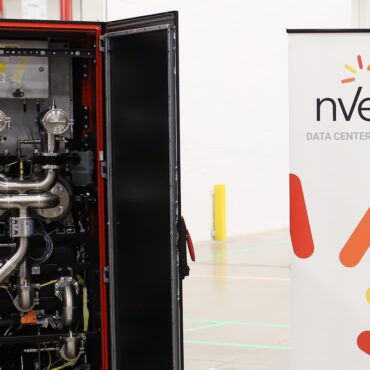
Ecolab is acquiring CoolIT for its expertise in liquid cooling of chips. Beck wants to marry CoolIT’s technology with Ecolab’s water capabilities to offer services that will be in high demand in the next-generation data centers. “Technology is changing the game,” he says. “A data center that was a huge water user can be an even more powerful data center that uses almost no water.”
Magnuson explains why the process was developed. “As chips have gotten much more complicated, they have what they call higher computing power,” he says. “They use more energy and thereby create more heat. Now air conditioning alone, or just passing air over the chip, doesn’t have enough heat transfer properties to cool that chip at a rate in which it can continue operating.”
Under the new system, Magnuson says, “they run a coolant through a cold plate that is actually like a radiator on the back of the chip, and that radiator pulls the heat off the chip.” The switch to liquid cooling “transformed the entire data center industry, because you could get much more dense computing in a single location,” he says.
As Ecolab’s customer needs changed, he says, businesses were looking for “efficient cooling with low energy use and low water use.” By acquiring CoolIT, Magnuson says, “we now have the power to go to our customers and help these data centers operate differently.”
Conversion to liquid cooling also changes how electricity is used. “Instead of using 40% of the electrical energy to cool, you can bring that down to about 10% of the power used in a data center,” Magnuson says. “Traditional data centers would need 40% of the electrical usage just for cooling.”
“A data center that was a huge water user can be an even more powerful data center that uses almost no water.”
—Christophe Beck, CEO, Ecolab
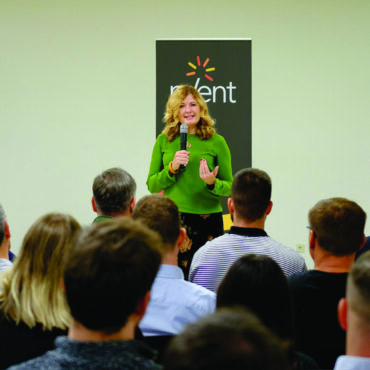
Beck says that he and others at Ecolab are actively responding to the “public uproar” against data centers. “We’re spending a lot of time with Minnesota stakeholders,” he says, “first, to understand what their worries are, and second to explain what the solutions are.”
In addition to Ecolab’s water recycling capabilities, Beck calls it remarkable that Xcel Energy will provide electricity in the coming years with 80% renewable sources. Coupling those facts with other Minnesota resources, Beck contends the state should be a leader in data centers.
Within Minnesota, data center locations can be chosen in an intelligent way, so disruptions to local communities are minimized, Beck says. “We have huge talent in this state. We are best positioned to operate data centers the right way, not the old way. Minnesota can become an example for the rest of the country and world because of technologies that have been developed and invented right here.”
In a March presentation to investors, Ecolab said the addition of CoolIT “doubles Ecolab’s global high-tech water market opportunity from $5 billion to $10 billion.”
J.P. Morgan research analyst Jeffrey Zekauskas characterized Ecolab’s Ovivo and CoolIT acquisitions as “taking steps to improve its long-term growth rate.” He also noted in a March 24 report that those companies fit Ecolab’s previous profile.
“Ecolab’s strength is its service capabilities because of its large, trained sales force,” Zekauskas wrote. “CoolIT should provide it with growth as data centers move away from air cooling systems to direct-to-chip cooling.”
Ecolab’s Growth Beyond Data Centers
In a Baird research report published April 28, senior research analyst Andrew Wittmann emphasized the importance of new Ecolab products to drive revenue growth.
“Product innovation and the company’s ability to consistently develop new customer solutions lie at the heart of Ecolab’s success,” Wittmann wrote. “Ecolab seeks to develop 30 to 40-plus new products per operating unit annually and to drive at least 35% of its sales from new products. We expect Ecolab to continue to invest heavily in developing and acquiring new customer solutions, particularly within the health care/life sciences, industrial water, and energy markets.”
Wittmann noted organic revenue growth of 11% in the first quarter of 2026 for Ecolab’s life sciences business unit, one of the company’s most ambitious divisions.
In the coming years, “we aspire to be a $3 billion to $5 billion business,” says Hayley Crowe, executive vice president and general manager of Ecolab’s life sciences sector, which serves pharmaceutical, biotechnology, and industrial customers. In 2025, Ecolab’s life sciences business reported sales of $748 million.
Ecolab’s drug production customers will provide a key growth opportunity. “The human population is getting larger and aging,” Crowe says. “We’re all demanding more medicines, basically to prolong our lives.” The category of biologic drugs, for which Ecolab does purification work, is a focus area. “Think of things like cancer drugs and immunotherapy drugs,” she says.
“Instead of using 40% of the electrical energy to cool, you can bring that down to about 10% of the power used in a data center.”
—Josh Magnuson, Executive Vice President, Ecolab
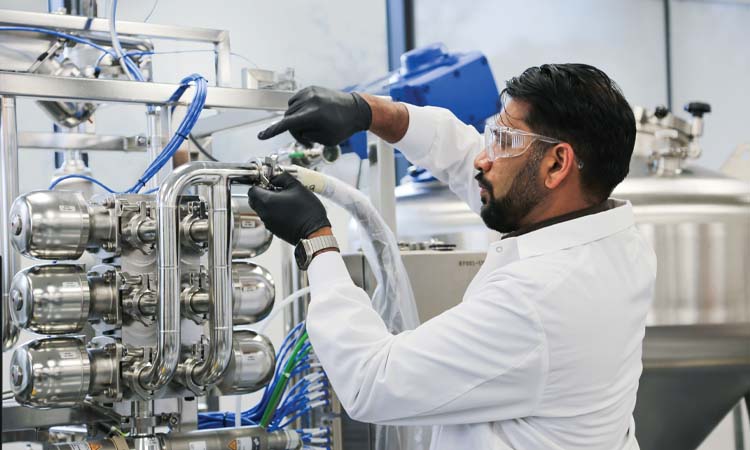
Resin purification is a process that’s used to separate target molecules from impurities during drug manufacturing. “It’s the single most important step in that process to go from, for example, a 25% purity to a 99% purity in a single step,” she says.
“While we are working inside the manufacturing space, we also support pharmaceutical manufacturers with pest solutions,” she says.
To meet the demand for biopharmaceutical products, Crowe notes that Ecolab expanded its manufacturing capacity in late 2022 in Wales. In May 2025, Ecolab opened a state-of-the-art bioprocessing applications lab in King of Prussia, Pennsylvania. This year, it opened a bioprocessing lab in South Korea.
“All of these have been extremely heavy capital investments to enable us to grow and meet high growth marks,” Crowe says. “There’s a lot going on.”
In the biologic drug area, Crowe says that “purification for us is a huge area of constant innovation.” By making the purification process more efficient, she says, “we are helping our customers get their drugs to patients faster.”