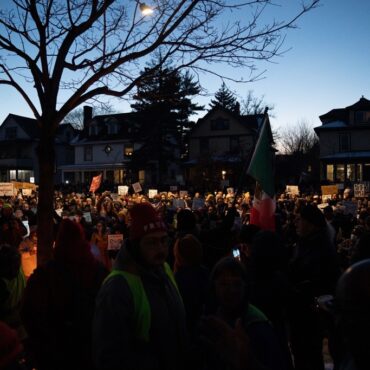



Fedor: After ICE Overreach, Congress Should Pass Major Immigration Reform
In our 2026 election year, Operation Metro Surge won’t last much longer.
The decision to swarm Minnesota with 3,000 federal agents was a political one. The decision to end the surge also will be a political one.
Numerous national polls show that a majority of Americans disapprove of the harsh video scenes of immigration enforcement they’ve seen from Minnesota, especially in Minneapolis where two citizens were killed by federal agents in broad daylight on city streets.
At some point soon, the Trump administration will declare that Operation Metro Surge succeeded in its mission to arrest and deport bad guys, and the contingent of ICE agents in Minnesota will return to a normal level.
Minnesotans will be left to repair the serious psychological and economic damage that’s been inflicted by the aggressive tactics of Immigration and Customs Enforcement (ICE) and Border Patrol agents.
Local law enforcement, parents, neighbors, business owners, teachers, school administrators, child care center directors, and other community leaders all will be needed to restore a sense of public safety across Minnesota.
But the killings of two citizens and the videos documenting rights violations against citizens and non-citizens won’t be forgotten by the American people. In many instances, federal agents didn’t bother following legal processes. In addition, the value of showing respect for the human dignity of all people was often discarded.
So how did we get here and how do we move on from this destructive chapter in the state’s history?
Stephen Miller, Trump’s deputy chief of staff, has regularly demonized immigrants and has pushed for mass deportations at every turn, arguing that federal agents should arrest at least 3,000 people a day.
Trump embraced Miller’s ideas. He campaigned on deporting “the worst of the worst” criminals. Trump wanted to strike back at Minnesota Gov. Tim Walz, who criticized Trump’s character and policies when he was running for vice president in 2024 on the Democratic ticket with Kamala Harris.
Trump also wanted to make an example of Minnesota for allowing several Somalis to commit fraud in government programs. “I don’t want them in our country,” Trump said at a Dec. 2 Cabinet meeting in front of multiple TV cameras. “Their country is no good for a reason, and their country stinks. We don’t want them in our country.” At the same event, Trump said that Minnesota’s Fifth District U.S. Rep. “Ilhan Omar is garbage.”
Trump always doubles down on his controversial statements and policies, with two exceptions. He reacts when stock markets experience major declines. He also responds to bad polling and bad optics.
Border czar Tom Homan arrived in the Twin Cities Jan. 26—sent by President Trump—to try to extinguish a political fire and establish some credibility in the immigration enforcement effort.
Homan spent a few days in meetings—talking to Gov. Walz, Minneapolis Mayor Jacob Frey, and law enforcement officials—before he held a news conference Jan. 29. Standing before the local and national news media, Homan appeared in a business suit, dress shirt, and tie, and he spoke slowly about what he wanted to accomplish. “I’m staying until the problem’s gone,” Homan said, emphasizing that he wanted “common sense cooperation that allows us to draw down the number of people we have here.”
On Feb. 4, Homan said at another news conference that he would reduce the number of federal agents in Minnesota by 700. In a KSTP-TV interview with Tom Hauser that aired Sunday, Homan said he was presiding over a “more targeted approach” to arrest undocumented immigrants. Homan also told Hauser that he has increased the number of internal affairs officers in Minnesota to investigate federal agents engaged in tactics that exceed their authority. “Several people have left the operation and are being investigated,” Homan said.
In tone and substance, Homan has provided a sharp contrast to the incendiary rhetoric and costumed personas delivered by Kristi Noem, secretary of the Department of Homeland Security, and Greg Bovino, who served as commander-at-large of the Border Patrol.
A majority of Americans have expressed their disapproval of the heavy-handed roundups of people of color, sending masked, armed men to arrest people without having warrants to do so, and the false and derogatory statements made by Noem and Bovino about shooting victims Renee Good and Alex Pretti.
Polls document disapproval of ICE tactics
In a Fox News poll conducted Jan. 23 to 26, 59% of voters said that ICE had been too aggressive. More than two-thirds (71%) of independent voters, who likely will determine control of the U.S. Senate and House in the November election, said that ICE agents have been “too aggressive.” The Fox poll also showed that 27% of Republicans surveyed held the same opinion.
A KSTP/SurveyUSA poll conducted in Minnesota from Jan. 27 to 30 showed extremely similar results. Registered voters were asked whether they approved or disapproved of ICE strategies to enforce immigration laws in Minnesota. KSTP-TV reported that 71% of independents disapproved, including 58% who said they strongly disapproved. In addition, 21% of Republicans either somewhat or strongly disapproved.
The poll results also showed that President Trump only has a 39% approval rating among Minnesotans. Among independents, 66% of Minnesotans disapprove of Trump’s performance, including 51% who strongly disapprove.
With open seats for U.S. senator and governor on the November ballot in Minnesota, extending the unpopular Operation Metro Surge for several weeks or multiple months would hurt Republican statewide candidates. If current trends hold, House Speaker Lisa Demuth will be the Republican gubernatorial nominee and broadcaster Michele Tafoya will be the GOP nominee for the U.S. Senate seat being vacated by Tina Smith. They can’t be elected with simply Republican base voters.
President Trump, whose trademark gesture is a clenched fist, told NBC News Feb. 4 that he supports “a softer touch” in immigration enforcement tactics.
If Trump and Republican leaders want to retain control of the U.S. Senate and give Demuth and Tafoya a chance of winning, it would behoove them to halt the immigration enforcement surge in Minnesota.
A small number of federal agents could conduct surgical operations to apprehend those undocumented immigrants with serious criminal records.
On a national basis, a small portion of those arrested by federal agents fits the description of hardened criminals. Based on an internal Department of Homeland Security document, CBS News reported that “less than 14% of nearly 400,000 immigrants arrested by Immigration and Customs Enforcement in President Trump’s first year back in the White House had charges or convictions for violent criminal offenses.”
So, pure politics likely will end the disruptive immigration enforcement surge in Minnesota.
Today, Feb. 10, there was a clear indication that Homan has done his job, which was to end a political catastrophe by ramping down the enforcement operation in Minnesota. Gov. Walz told reporters at a news conference that he spoke with Homan Monday, and he expects that federal agents will soon leave the state. “We are talking days, not weeks and months of this occupation,” Walz said.
“Pure politics likely will end the disruptive immigration enforcement surge in Minnesota.” –Liz Fedor, Senior Editor, Twin Cities Business
Minnesota, U.S. economies need immigrant labor
But there’s a demographic and economic reality that politicians in both parties need to act upon. The United States and Minnesota economies need immigrant labor. It’s impractical and doesn’t make economic sense to attempt to deport every person who entered the U.S. illegally in recent decades.
U.S. Rep. Mike Lawler, a Republican who represents New York’s Hudson Valley, made that case in a Sunday interview on ABC News.
“We have over 25 million people in this country who are undocumented. You’re not rounding them all up and kicking them out. It’s not realistic,” Lawler said.
For 40 years, the congressman said, federal politicians have failed to solve the nation’s immigration problems. He spoke in favor of the Dignity Act, which has Democratic and Republican co-sponsors, and he argues the American people want immigration reform.
“If you’ve been in this country, right or wrong, for 5, 10, 15, 20 years, your children and grandchildren are American citizens, people don’t want to see families broken apart,” Lawler said.
“There’s got to be a legal path forward, not a path to citizenship, but a path forward for people to come out of the shadows so that they can work legally,” Lawler said.
In Minnesota, it’s long been apparent that immigrants play an important role in the state’s economy, and closing the door to immigrants would shrink economic activity.
“The economic realities remain unchanged: immigration is an essential ingredient of Minnesota’s long-term economic success,” the Minnesota Chamber Foundation said in a 2025 report. “New Americans contribute to the economy as entrepreneurs, consumers, taxpayers, and workers, often filling high-demand roles that businesses struggle to staff.”
Almost 60% of Minnesota’s total labor force and employment growth—from 2019 to 2023—came from foreign-born workers, according to the report.
Lawler and other results-oriented members of Congress, including U.S. Rep. Kelly Morrison, a Democrat representing Minnesota’s Third Congressional District, understand the importance of enacting reasonable immigration laws.
“We’re long overdue for comprehensive immigration reform,” Morrison said during a Friday appearance on “Almanac.” Most Americans, she said, favor “a much smoother, more obvious path toward legal residence or citizenship here in the United States.”
Independents are sick of politicians failing to govern and keeping complex issues alive so they can whip their base voters into a frenzy. A January survey by Gallup shows that 45% of Americans consider themselves independent voters, with 27% apiece aligning with the Democrats or Republicans.
Pope Leo XIV is the most prominent international advocate for immigrants, and he’s encouraged Catholic clergy in the U.S. to stand with immigrants. In the Archdiocese of St. Paul and Minneapolis, Archbishop Bernard Hebda has stepped forward.
In a Jan. 20 commentary for the Wall Street Journal, Hebda noted there was a bipartisan immigration reform bill that passed the U.S. Senate in 2013, but the House didn’t vote on it. That legislation provided a 12-year path to citizenship for law-abiding undocumented immigrants.
“If recent events in Minnesota have clarified anything, it’s that we can no longer put off the hard work of immigration reform,” Hebda wrote. “What’s required is a comprehensive, long-term solution that reflects reality rather than ideology. That solution must include the granting of a lawful status for those who have put down roots, contributed to their communities, and lived here for years.”
Operation Metro Surge caused Minnesotans to rise against the federal government’s often inhumane and unlawful tactics. Videos of the deaths of two citizens engaged a cross-section of Americans, who now demand rational immigration laws.
The prolonged media spotlight on enforcement actions in Minnesota helped most Americans solidify what they don’t want their country to become.
U.S. District Court Judge Fred Biery, who serves the Western District of Texas, may have had the best summation of what really has been at play in the federal government’s excessive actions in Minnesota.
Biery, appointed to the federal bench by President Bill Clinton in 1994, was issuing an order in the case of asylum seeker Adrian Conejo Arias and his five-year-old son Liam, who drew national attention when federal agents detained him while wearing a bunny hat and carrying a Spiderman backpack outside his Columbia Heights home. The Texas judge ordered that the pair be released from an ICE facility, and the federal government subsequently filed a motion to expedite the deportation of Liam and his father to Ecuador.
“The case has its genesis in the ill-conceived and incompetently-implemented government pursuit of daily deportation quotas, apparently even if it requires traumatizing children,” Biery wrote in a Jan. 31 order. “This Court and others regularly send undocumented people to prison and orders them deported but do so by proper legal procedures.”
Biery wrote: “Observing human behavior confirms that for some among us, the perfidious lust for unbridled power and the imposition of cruelty in its quest know no bounds and are bereft of human decency. And the rule of law be damned.”