

Deliver Us from Delivery
I was in New York City in January. And when I’m in New York, I like to visit hot new food concepts to see what’s heading to the provinces in the coming years. More than ever, the new spots had one thing in common: They were small. How small? Nowhere-to-sit small. Bagels, artisanal pizza, sandwiches, smashburgers, dumplings—the food was all amazing, except that it was only 35 degrees outside with a stiff northwest wind, and I was nowhere near my hotel.
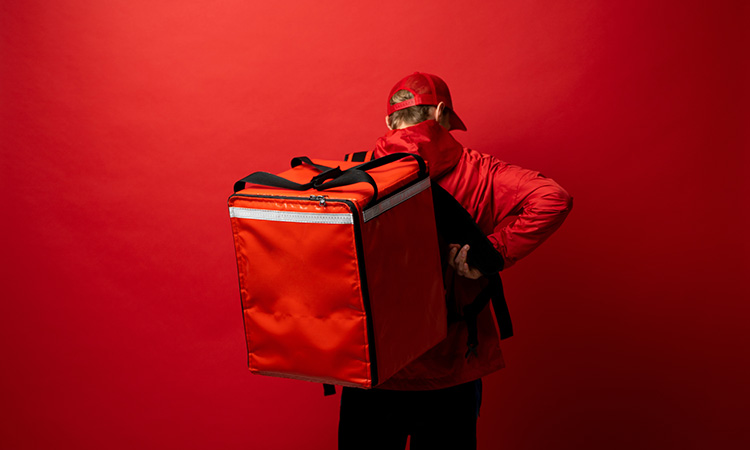
The bulk of the people waiting outside these tiny shops—where several cooks crowded into sweaty confines behind a register person—were not customers intending to eat the food, but delivery drivers. At Edith’s in Williamsburg, I tore into a Sephardi breakfast wrap right on the street—and a bunch of it dripped on my coat. Because no one has to care about how to-go food looks, the Fresno peppers and harissa mayo were all clumped in one bite and I started coughing. I didn’t have a free hand to carry a water on the subway. It was suboptimal.
A generation ago, a place like Edith’s would be a gathering spot for more than grumpy men in hoodies with an insulated bag. Today, rents in Brooklyn are too high, and though Edith’s isn’t cheap, its prices don’t support 75% more space for a dining room. And as the counterman told me, “Most people want to eat at home anyway.” Do they?
Delivered sandwiches routinely run $5 in fees above menu cost. I wondered, given how quickly eggs cool, what my wrap would taste like after 15 minutes in traffic.
Ordering and waiting were devoid of hospitality; there wasn’t even a napkin in the bag I was handed on the stoop. At other spots, counter staff often didn’t have any English—most customers order off an app.
At Shake Shack near my hotel, where I went for iced tea each evening, I watched a man return a burger he had ordered online for his own pickup, because Shake Shack had packed it in a paper sleeve that covered half the burger, then dumped it in a grocery-size bag sitting on an unheated shelf, so it was cold when he picked it up. The manager was apologetic, noting that most takeout business came from delivery drivers, who apparently don’t care. You’ve got a microwave, don’tcha?
I don’t get the appeal of cold food slopped in a box at 125% of menu cost, but my kids do.
This is where dining out is going in America. The National Restaurant Association reported that in 2023, 74% of restaurant meals were consumed outside restaurants, up from 61% in 2019. The stat was quoted by The Atlantic author Derek Thompson in his recent article, “The Anti-Social Century,” where he recounts the experience of a local Mexican restaurant evolving from a social center to an empty place where delivery drivers pick up bags.
Read more from this issue
The phenomenon Thompson identifies is the growing predilection of young Americans to spend entire days in their apartments, never seeing a single person. (Even DoorDash leaves the bag at the door, a Covid legacy.) Americans increasingly work alone, are single, and live alone. They get meals delivered. I don’t get the appeal of cold food slopped in a box at 125% of menu cost, but my kids do.
Yes, the social danger signs are flashing red, but this is a business magazine. The point I’m making is that the restaurant industry is an unwitting victim of this trend. Maybe you’re thinking, “Adam, they don’t need waiters, dishes, or anywhere near the space. They don’t need bars, bartenders, or mocktails. What a windfall.”
I asked Twin Cities-based Jonathan Maze, editor-in-chief of Restaurant Business, about that. He deems delivery a threat to restaurants, noting that there are rarely beverage or alcohol sales, typically the highest-margin part of the restaurant transaction.
More broadly, “a lot of occasions that used to go to sit-down restaurants have disappeared. In the ’80s and ‘90s we went to Applebee’s or Chili’s for lunch. But now we go grab Jersey Mike’s and eat at our desk,” Maze says. “We don’t eat pizza in restaurants anymore. So full-service pizza brands [like Green Mill, for instance] have disappeared or shrunk. It’s just making that dine-in occasion more infrequent. So full-service restaurants are competing for a smaller pie. And they have to account for consumer demand” to provide takeout, whether they can offer it with quality or not.
Food delivery jobs are not good jobs, nor are they socially beneficial. The plastic packaging pollutes the environment, while the cars clog the streets and habitually double-park. Food delivery takes good-paying tipped jobs from servers and bartenders. It is another bite out of the middle class.
Maybe the unions pushing to organize urban restaurants should look at the big picture and encourage their members to eat in one.