

Escalade Confidential
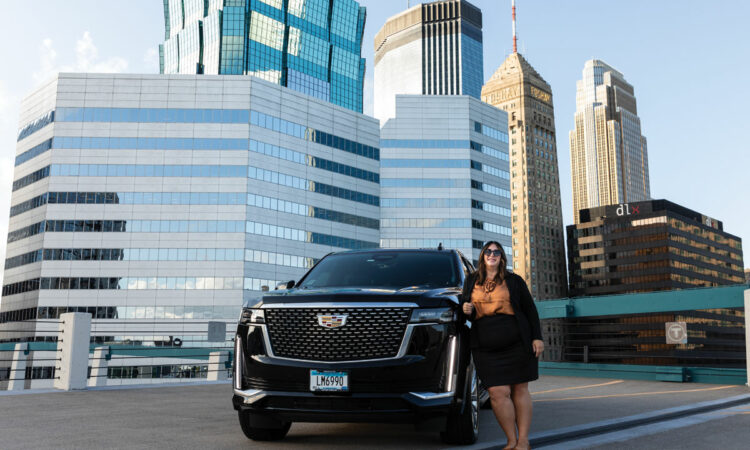
It’s 5 p.m. on an uncharacteristically rainy summer Sunday at the Mall of America, so the mall is jammed. Or at least the food court is. Inside it, at Mason’s Famous Lobster Rolls, I meet Chey Eisenmann, owner of Chey Car, a local black car service. Eisenmann has only one Escalade, but she has 20,000 Twitter followers, who avidly follow her punditry, rumor mongering, and early warnings.
“The out-of-towners come here,” she says, tucking into a Connecticut lobster roll, “Bar Harbor”-style, with extra lobster. “The Minnesotans are at Shake Shack”—a few feet away in the long lines. Like much of what Eisenmann says, it has an air of truth to it, you want to believe it, but it’s kinda impossible to be sure.
It may be Sunday, but Chey Car operates seven days a week, meaning Eisenmann, 43, is working, and Sunday is the sine qua non of airport pickup; everyone comes home on Sunday. We scarf our lobster rolls and discuss the night’s agenda. An arrival from Oslo (via Amsterdam), another from Jacksonville, and finally LaGuardia. But the dark skies are thick with intrigue. Both the JAX and LGA flights are late, with neither off the ground yet. “I might have to call in my reserves,” she says.
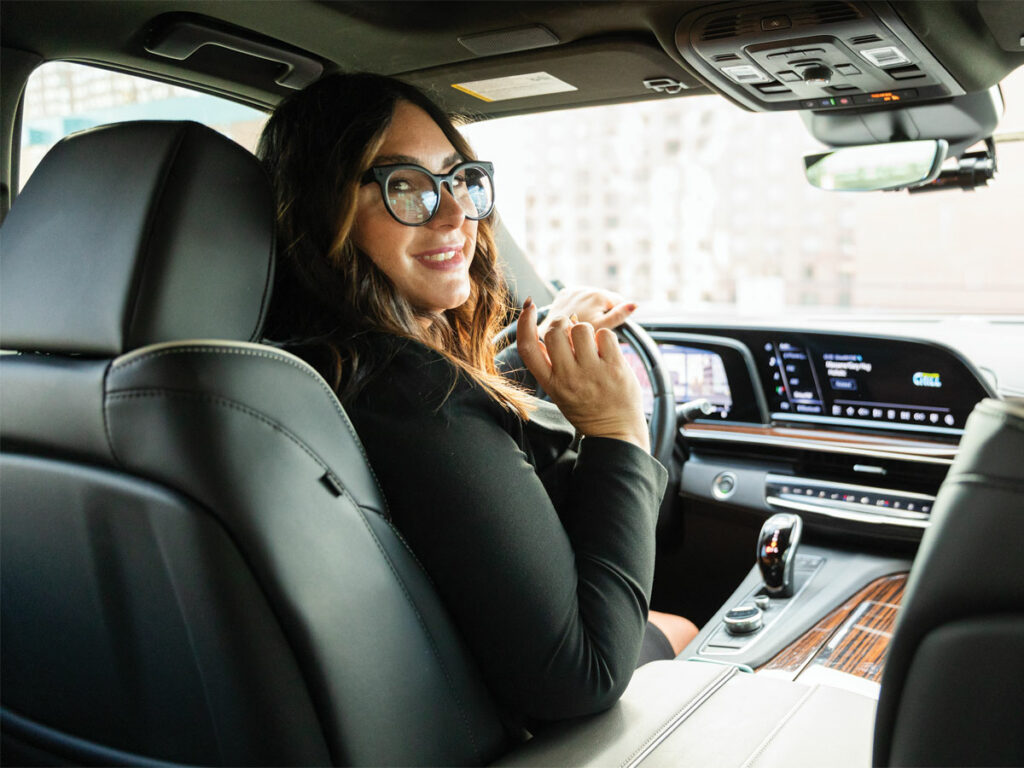
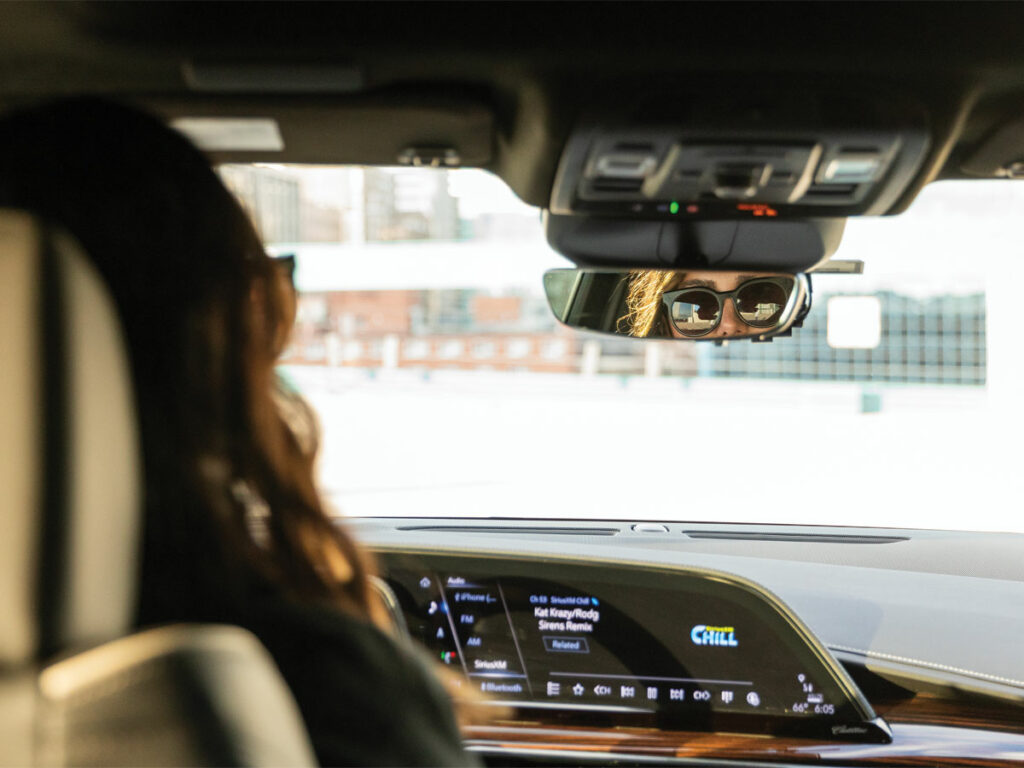
We approach the specialized ride pickup area at MSP. ’90s on 9 is playing on SiriusXM. The Escalade’s temp is set to 63. Eisenmann is in her uniform of black slacks and black jacket with a white or off-white shirt. There are FIJI waters in the door pockets and gummy bears in the cup holders.
I hope Minneapolis calls Uber and Lyft’s bluff. These companies can afford to give more of each fare to the driver.
In my opinion, the percentage drivers keep from each trip is predatory.
— Chey Cab (@CheyCab) August 18, 2023
After Oslo lands, Eisenmann texts a welcome, asks if they have checked bags, and tries to time her arrival to that. Unfortunately, the vagaries of customs and the airlines’ increasingly understaffed baggage operations make the calculus precarious. (BTW, she wants you to know that it’s illegal to pick you up at baggage claim, so stop asking.)
The Oslo ride is waiting for us, not a best practice—Eisenmann would rather be waiting for them, but Global Entry threw a wrench into that. They are a graying southwest Edina couple—he’s retired, she’s in wealth management. They talk about their trip on the Norwegian coastal ferry, the Hurtigruten. The banter is as Minnesota as it gets—everything was lovely, an amazing country; there will be no viral tweets emanating from this ride. We drop them off at their home and head for the park-and-ride near Fort Snelling to prepare for the Jacksonville pickup.
Oh, and if you’re wondering, yes, Eisenmann thinks people have been driving terribly since the pandemic. “There’s a general recklessness. Collective cognition downgraded. I see wrong-way drivers [on freeways] two to three times a month. The roads are far more dangerous.”
The JAX flight is 90 minutes late and getting later. The LGA flight is late too, but not late enough; the flights will likely overlap—not a nightmare scenario, but one that will take money out of Chey Car’s pocket. Eisenmann phones Omar, her top relief driver, who recently left Red Wing Shoes but grew up in the business watching his parents drive. “Customers love him,” she says. He takes LaGuardia in his Tesla X.
Then we’re back on Highway 5 headed to the Holiday at 34th Avenue for a quick wash (not her favorite wash spot, Paradise Wash, but it’s Sunday night) and tire shine. An array of cleaning products sits in a cubby in the back, including 3M Plastic Protectant. In winter the Escalade is washed three to four times a day, but in summer usually once will suffice. “Professional chauffeurs are obsessive,” she notes, with a pause. “About cleanliness of vehicles.”
The Business
Eisenmann’s led an interesting life (some of it’s being saved for her book). The CliffsNotes version: She’s an adopted kid raised in the Driftless region of southeast Minnesota. Educated at the University of Minnesota and St. Catherine University. Worked in ad sales for the Strib (there’s an erroneous rumor that she’s a former journalist), then a tech company. In 2009 she started “driving cab.” She transitioned in 2014 to a black car as Uber descended on the country. Chey Car barely survived the pandemic. Half the black car industry didn’t.
She says Twitter fueled her recovery (today the social site generates 70% of her new customers), plus a lot of big tips. “As soon as the boomers got their [Covid] shots, the phones blew up.”
“I like studying my community,” Eisenmann explains. “What do people need, talk about? I see it in real time. Every day now I get, ‘Are you Chey on Twitter?’”
Read more from this issue
It’s all rather ironic because it plays against the monastic culture of privacy in the discretion-oriented black car business. “I like to get the conversation beyond the weather,” she says. “In my job people tell me things.”
Which sometimes end up on X (formerly known as Twitter). Eisenmann says she hears “things” from nightclub attendants and bartenders (she has her fair share of concert and nightclub clients), plus detectives (who like a ride to Hudson, Wisconsin, where they go to drink) or perhaps an exec from a local Fortune 500.
When Eisenmann says she has a “Ph.D. in the streets,” it’s more than a commentary on her knowledge of local geography. She has lived and worked among an atypically diverse group of Minnesotans. Her cab days brought her in contact with a cross section of folks on life’s margins—sex workers, crime victims, journalists, cops, anyone whose beater couldn’t make it across town. Subsequently, her time in the black car industry has ingratiated her with the state’s corporate and political elite. As a result, her Twitter feed is full of whispers both local and from deep inside the far-flung gambling industry and the sex trade.
Before Covid, Medtronic was her biggest customer. But that was then, when the revenue pie was 70% corporate and 30% leisure. It’s now 25% corporate and 75% leisure. Only a quarter of her corporate business came back from Covid. “It’s bounced back in other markets,” she says, “but not here,” which will surprise no one who’s been downtown on any recent Monday.
The cab business was more eclectic, but it was not always safe or lucrative. The black car business is less volatile, but it’s a difficult business to scale because everyone wants to go to the airport at the same time and there are long stretches of tedium. And Minnesotans are hugely anal-retentive about their airport trips. “We have people in summer with pending reservations for December,” Eisenmann says.
And the worst flight times create the greatest demand. Plenty of planes arrive between 10 a.m. and the dinner hour, but that’s potential nap time, because “Minnesotans will always want to use you at 3 a.m. to get to the airport but will find a relative to pick them up at 3 p.m.”
Often Eisenmann gets only three hours of sleep a night. “I’d like eight hours sleep. [But] everyone has a complicated problem in their life. Quality of life is mine. I’m getting older and need twice the sleep I get.”
Oh, and about that 1 a.m. airport trip (“We get people in Highland who want to go at 1 a.m. for a 5 a.m. flight.”). She’d like you to know that the check-in counters and security rarely open until just before 4. Eisenmann really wishes you would stop asking to go to the airport at 1 a.m.
“I like studying my community. what do people need, talk about? I see it in real time. Every day now I get, ‘Are you Chey on twitter?’”
—Chey Eisenmann
The slowest months are summer. The busiest? Well, you know the answer to that: from MEA weekend in mid-October to spring break. Fun fact: Even during MEA or spring break, she’s never had a ride go to Forest Lake.
Oh, and Eisenmann says she’s a bargain. “Our rates are half of national averages. Minnesotans are price-sensitive. So we don’t charge what we need to. … Our costs have gone up 38% since 2019. I raised prices 24%, but anything higher got resistance.” Her lowest-priced ride is $72 (including the mandatory 20% service charge); $20-$40 is the average cash tip, she says.
Driving is a male-dominated industry, so “women [customers] and families come to me. I also don’t shun elders.” An increasing share of her business is transporting those clients to medical appointments.
Although Eisenmann says “it takes a community to take care of everybody,” she has avoided putting her overflow drivers on payroll. The pandemic and post-pandemic roller coaster was a reminder, she says, that her business model is precarious. Chey Car may have half a dozen vehicles on the street some mornings, but other than Eisenman’s Escalade, they are all independent contractors. “Scaling is risky,” she says. “I’m wary of it. You’re the first to get hit in a recession.”
She describes her job as “not a get-rich business. It’s too volatile. Independent operators like me have to do $150K in revenue to have enough to live on,” Eisenmann says. “That’s up from $120K five years ago.” She says 2022 was her best year, three times historical norms. This year has not been remotely similar.
As for that Escalade, a new one costs a hundred grand, because Cadillac stopped making the cheaper livery model. She replaces them every two years and averages 65,000 miles a year, but during the post-Covid boom she drove 90,000. The pandemic remains a dark cloud, hovering. “I’m still paying back pandemic loans. Unemployment saved me.”
Spend some time talking to her regulars, and the common denominator behind their loyalty is not the reliability, the pricing, or the clean sidewalls. It’s Chey. Not the stereotypical silent, invisible driver.
“She’s always up to date on news or current events,” says Matt Van Zant, an Orlando, Florida-based software exec who frequently visits MSP. “She can talk about anything. She’s got a good sense of humor. But she’s professional. If you have clients in the car, she adjusts accordingly. … She reads people well. She knows if you’re in a frame of mind to chitchat. It’s a mundane part of travel that I now look forward to. She’s become a friend.”
The most notable thing about Eisenmann relative to her industry is her loquaciousness. No topic is off-limits; she’s well-informed, and even when she isn’t, she might offer an opinion. And after realizing it endears her to customers, she sought out a soapbox. Some of what she hears each day goes up on X. And it’s been noticed. Word of mouth is no longer her business’s best resource.
The Social Experiment
Eisenmann says she got on Twitter in 2010 or ’11 when she was a cab driver. She believes she was one of the first cabbies on the social media site. She joined for news and traffic and then began to follow London taxi drivers, “to find out how my day would be in Minneapolis. If people are behaving badly in London,” she says, “they will also be here.” At press time Eisenmann (@cheycab) was closing in on 20,000 followers.
“Some of my first followers were reporters,” she says. “My cab would occasionally end up at crime scenes. I got to know journalists.”
She’s liked the soapbox. In 2014 she wrote a cover story for City Pages, “Confessions of a Lady Cab Driver.”
She says she’s never had viral tweets, but in 2020 she saw a big spike in followers due to lockdown isolation, because she was actually leaving her house and experiencing life outside. During the post-George Floyd social unrest, she gave rides to workers who couldn’t get home because buses had been pulled off the roads. She remembers calling in a gas station arson to 911.
“All info is valuable at some point,” she says. “The industry standard is to never talk about controversial things. I talk about them in the car. Customers understand that I listen and respect them. It’s a safe environment. I dig into what they’re saying to find truths. I can find common ground with anyone.”
Eisenmann’s clients say she has a way of providing the tantalizing details of a topic online without telling enough to lead to a specific source. “I don’t talk about anything confidential,” says local attorney Ryan Palmer, “but the stuff she shares on Twitter is anonymized in a way you can’t really figure out.”
Why people talk to Eisenmann, and occasionally open a vein, is an intriguing question. She has theories: “People are more isolated. They need someone to talk to. I had more people confessing crimes [in 2021] than in the last 14 combined,” she says. “To some degree the isolation continues.”
“I found her on Twitter,” recalls Palmer. “I’d had some bad Uber experiences. Chey is reliable, fun to talk to. We’ll chat for 20 minutes, and the next ride we’ll pick the thread up. She has an incredible memory.”
“The industry standard is to never talk about controversial things. I talk about them in the car. Customers understand that I listen and respect them.”
—Chey Eisenmann
Still, even anonymized tweets can rankle. “People are paranoid right now,” Eisenmann observes. She tweeted about “local dads” damaging her bumper trying to help with luggage, “and everyone thinks I am talking about them.” She occasionally receives requests that she retract a tweet. After relating an endearing conversation between a mom and her 12-year-old son on the appropriate frequency of masturbation, Eisenmann tweeted it sensitively, she believes. “Six moms asked me to take it down.”
She was one of the first to tweet about Gov. Walz’s spring meeting with Uber, she says, and far earlier about Rep. Ilhan Omar’s marital affair. “I was told, ‘You are not wrong, but that has to come down.’ ”
“If something about my tweet bothers you, I will always take it down,” she says. “Relationships matter more to me than Twitter.”
Eisenmann is not overtly political but is willing to run afoul of the zeitgeist. After a particularly depraved murder in St. Paul’s St. Anthony Park neighborhood this summer, allegedly perpetrated by a minor, she tweeted that had her kids committed the car theft gone murderous, they would need to be more scared of her than of the cops. (She has no kids.) The online liberal intelligentsia accused her of “custesfying” cops and advocating for child abuse. That tweet is history, too. “Anytime a tweet starts showing viral activity, I take it down.”
Tweeting might be good for business, but “I don’t think of [tweeting] as business solicitation,” Eisenmann says. “But the visibility makes you top of mind. People feel they know and trust me and then become good clients.”
Even when she’s revealing that 50% of her passengers with pets are blithely unaware that their partner drugs the animal before travel.
It’s all in a day’s work on Highway 5, between flights, and if you like the vibe on social, you’ll probably like the ride as well.
“Chey in the car,” laughs Palmer, “is the same as Chey on Twitter. A singular kind of experience.”