

How NRRI Can Rejuvenate Minnesota’s Natural-Resources Economy
Natural resources—notably, forest products and metals—have long defined northeastern Minnesota’s economy. And that’s where its future remains rooted, with several signs that extractive industries are on the cusp of at least a modest revival.
The region is seeing new opportunities in copper, nickel, and other in-demand minerals, as well as the Iron Range’s eponymous metal, which could be used to produce so-called “green steel.” Then, there is the promise of helium extraction, which might be followed by geological hydrogen.
These opportunities may not generate the vast number of jobs that extractive industries once did. And significant environmental concerns must temper enthusiastic risk taking. Still, these possibilities could deliver new forms of economic development.
The University of Minnesota’s Natural Resources Research Institute (NRRI) in Duluth is poised to play a key part in these explorations, in large part because of the institute’s sensitivity to regional ecology.
Not widely known even in its home state, NRRI is engaged in work that should raise its profile in the coming years. “We want to build an economy of the future, not of the past,” says Rolf Weberg, NRRI’s executive director.
According to Weberg, the institute, along with the economic development efforts it’s supporting in Minnesota, are garnering greater attention, not just at home but nationally.
“Industrial Transformation”: A New Approach
The state of Minnesota established NRRI in 1983, a time when northern Minnesota was noticing signs of disruption.
Many people, including then-governor (and Iron Range native) Rudy Perpich, worried that northeastern Minnesota’s iron and forest-products industries were experiencing a significant downturn. At the same time, it was becoming increasingly clear that the region’s tourism industry was becoming more crucial to its economic wellbeing.
The 1978 establishment of the Boundary Waters Canoe Area Wilderness (BWCAW), now believed to be the nation’s most-visited wilderness, demonstrated the economic nexus of tourism and environmentalism. NRRI’s mission was—and is—to foster the economic development of natural resources while engaging in sound environmental stewardship.
Since NRRI’s inception, the institute’s engineers and scientists have conducted fascinating research on how to use the state’s natural resources in new applications while still protecting the nature in which those resources are rooted. That’s still the case. But beginning with the hiring of Weberg as executive director in 2014, NRRI has become much more focused on what he terms “industrial transformation.”
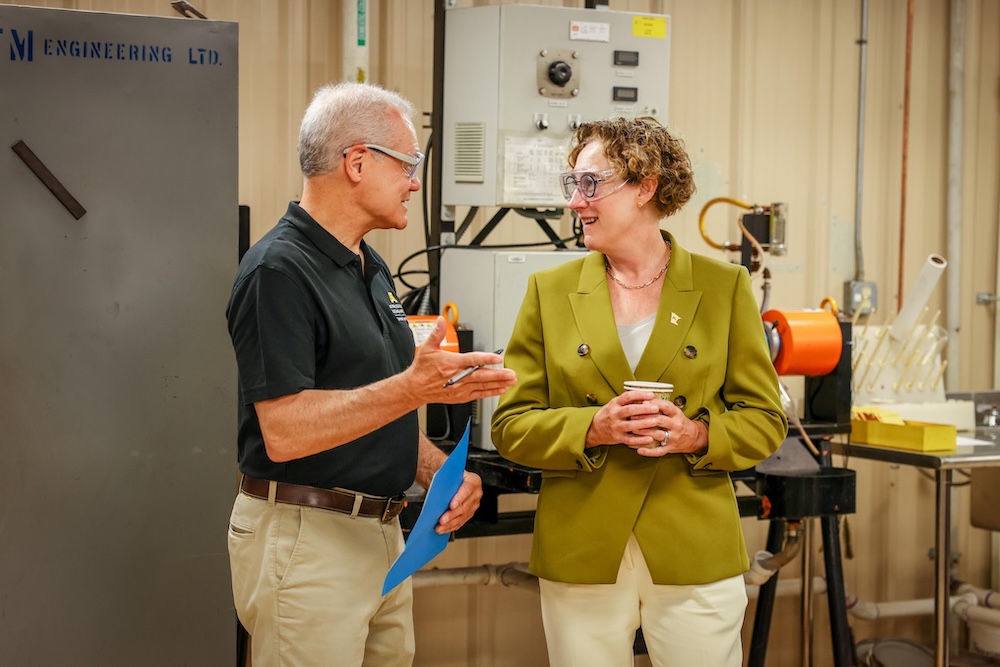
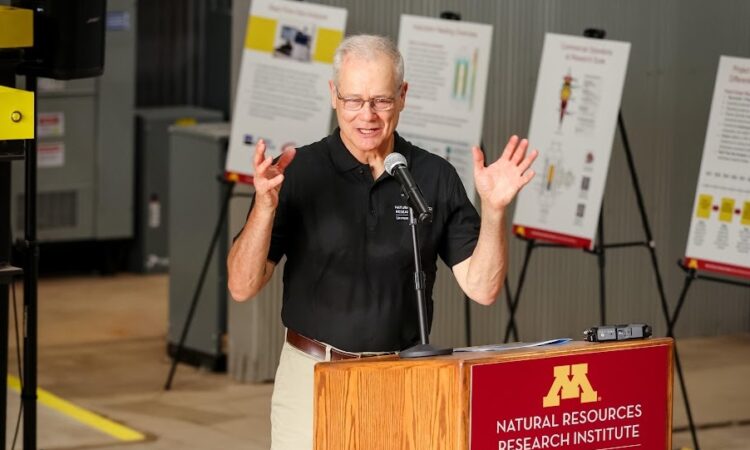
A native of Mankato who earned his undergraduate degree in chemistry from the University of Minnesota Duluth and a chemistry PhD from the University of Colorado, Boulder, Weberg spent 25 years in Delaware-based DuPont’s research-and-development division. Just before joining NRRI, he was the global technology manager for DuPont’s building innovations unit.
Before Weberg came onboard, NRRI focused more on what it could receive in grants, which dictated the type of research it pursued. Researchers could spend time on work they found most interesting. It was a hotbed of new ideas, but they didn’t always lend themselves to commercialization.
Under Weberg’s leadership, “NRRI delivers mission-directed research, focused on goals and delivery of impact for the state—and for the nation,” he says. In taking on a project, “we build a cross-functional research team around a well-framed challenge. The team can have an ecosystem scientist sitting next to a metallurgist sitting next to an engineer sitting next to an economist.”
In making its work more targeted and pragmatic, NRRI is pursuing three focus areas or “strategic initiatives”:
Ecosystem resilience
“This is where most of our work starts and ends,” Weberg says.
NRRI’s ecosystem scientists study “the impacts that we have [on the natural environment], how to manage them, and how to develop new tools to deal with them.”
This goes beyond “I study wildlife,” Weberg says—the attitude is “I study wildlife because it informs how we manage our forests and waters, how we think about climate change, and how we deliver real solutions.”
Forest products and bioeconomy
NRRI researchers are investigating how forest resources and the state’s four paper mills could be reinvented for the future—for example, by expanding the portfolio to include plant-based fuels, polymers, or carbon for metallurgical applications.
Future uses of iron and other minerals
Speaking of metallurgy: “Iron is undergoing a bit of a renaissance,” Weberg says.
Taconite saved the Iron Range once natural iron ore was tapped out, and it’s still in demand. But taconite “is also a commodity product,” he adds. “How do we start expanding the portfolio to include high-value iron products that can be used in magnets or lithium-iron-phosphate batteries?”
A broader portfolio of iron products would be “less vulnerable [than taconite alone] to the whipsaw of the economy. Furthermore, whatever we learn in these efforts is immediately applicable to other mineral opportunities in the state.”
For NRRI, these three focus areas are integrated: “We can’t conduct a minerals project unless we are taking care of the water,” Weberg says. “And if we are talking about water, we are also talking about healthy forests. Each of the strategic initiatives are integrated by a common goal of delivering vibrant communities, a clean environment, and a strong economy.”
That integration ties into the idea of what Weberg called “cross-coupled” industries. “If you can have industries working together, where the waste product of one … is the starting material for another, you’re evolving into a much more competitive industry,” he says.
For example, he mentions taking advanced iron and steel technology and combining that with advanced materials and fuels, as well as with critical minerals, which are natural elements or engineered substances considered essential to the economy, national security, and clean-energy infrastructure. “You’re talking about an industrial ecosystem that uses less energy and is more efficient and productive,” he says. “This is the concept we’ve been pushing.”
Here’s an example of this idea in practice: Up to 60% of a mine’s energy in spent on comminution—a technical term for grinding and crushing rock, a key process in mining. Recognizing that even modest efficiency gains can yield massive cost savings and emission cuts, NRRI acquired next-generation grinding equipment in 2024. The pilot testing that NRRI conducted on this equipment gave U.S. Steel the data-driven confidence to implement the technology at its Keetac facility near Hibbing.
That same year, with support from a state legislative appropriation, NRRI demonstrated that Minnesota iron ore could be processed into high-purity iron oxide for iron-air battery applications. An iron-air battery can store electrical energy for up to 100 hours, thus significantly reducing reliance on the grid. (Massachusetts-based energy-storage developer Form Energy is currently pursuing a pilot iron-air battery project in Minnesota via a partnership with Maple Grove-based utility Great River Energy.)
“That study informed the state that Minnesota iron has some interesting properties that can be refined beyond taconite,” Weberg says. He adds, “I’m not denigrating taconite at all.” But Minnesota iron could demonstrate properties that may generate new market possibilities.
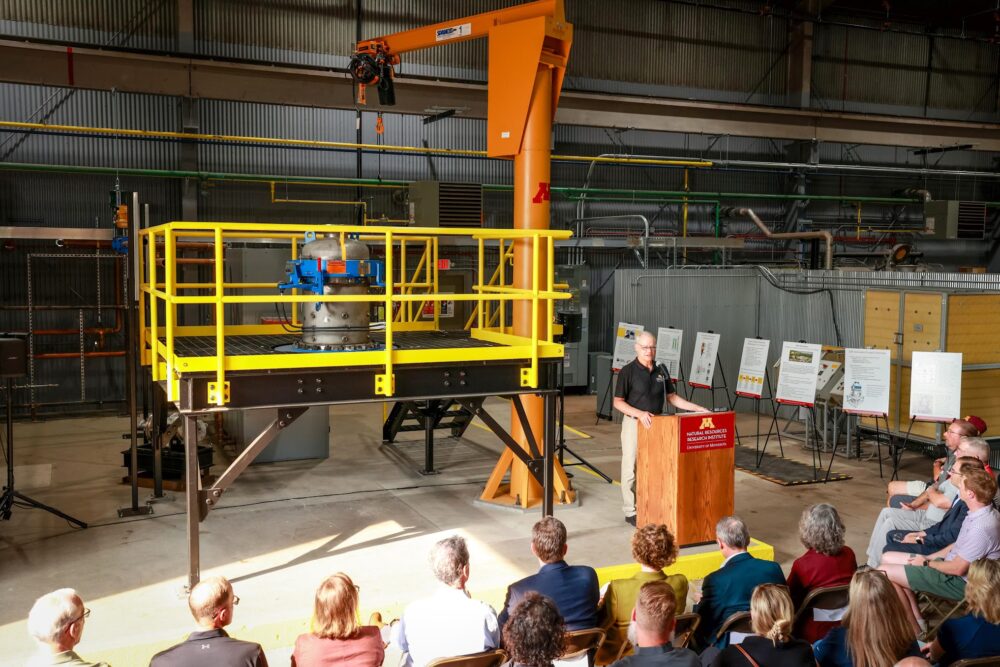
This year, NRRI installed a direct-reduced iron (DRI) simulator, as well. This may enable the institute’s global mining and steelmaking partners to optimize pellet chemistries for reduced processing energy and improved product quality. Unlike taconite pellets, DRI pellets can be used in electric-arc furnaces for making steel. And unlike the blast furnaces that use taconite pellets, electric-arc furnaces represent a growing market for domestic iron. This year’s opening of the Mesabi Metallics mine and DRI plant near Nashwauk could presage more diversification on the Iron Range.
Funding the Future
Seeing the value of NRRI’s work, funders have been pouring more and more money into the institute. Over the past five years, the institute’s staff has grown 25%, from 130 in 2021 to 161 currently. NRRI’s budget in fiscal 2025 was $22.7 million.
NRRI receives state money to support “the base cost of research,” in addition to operations funding from the University of Minnesota. A legislative trust fund covers NRRI’s mineral-related research at its second location in Coleraine.
In recent years, NRRI has been “magnifying” those state investments with grants and other funding from federal, industry, and philanthropic sources.
Currently, NRRI is about 40% “hard funded” and 60% “soft funded.” The former is a base amount that NRRI can count on each year. The latter is money the institute pursues. Most soft funds come in the form of grants, where NRRI has been “very successful,” Weberg says. Examples of soft funding include appropriations from the Minnesota Legislature and the state’s Legislative-Citizen Commission on Minnesota Resources (LCCMR).
NRRI also has attracted federal funding to pursue research into new technologies for natural resources-based industries.
In addition, NRRI generates funding through specialized service contracts, providing private industry access to its pilot facilities and technical expertise to accelerate technology development. “If a company hires us and we develop some technology together in that sponsored research program, the University of Minnesota will patent it and the company can license it—exclusively,” Weberg says.
An example is the InnovaTree, a fast-growing hybrid poplar whose applications include landscaping, erosion control, and biomass feedstock.
Perhaps the most significant partnership development is represented by the 2026 Joint Research Alliance, a strategic partnership between NRRI and the National Laboratory of the Rockies, a national laboratory of the U.S. Department of Energy.
“We’re highly complementary,” Weberg says. “What we have, they don’t, and vice versa.” The two organizations are collaborating to uncover ways to reduce energy and other costs of U.S. industrial sectors involving critical materials.
After 40 years, NRRI has assembled nationally unique facilities, equipment, and expertise that Weberg says would require millions of dollars to replace. “The assets we have, no one else has,” he says.
That’s one reason NRRI has been able to build partnerships and support. Another is that its work is gaining attention in a world that needs to maintain both its industry and its natural environment.
“If we can have that global impact, our economy will be strong, our communities will be strong, and we’ll have a healthy environment to live in,” Weberg says. “And that’s the economy of the future.”