

Klobuchar, Demuth Show Urgency to Grow Minnesota’s Economy
Through their policy positions and tones, U.S. Sen. Amy Klobuchar and Minnesota House Speaker Lisa Demuth revealed Monday that whichever one becomes Minnesota’s first woman governor is likely to lead from the political center.
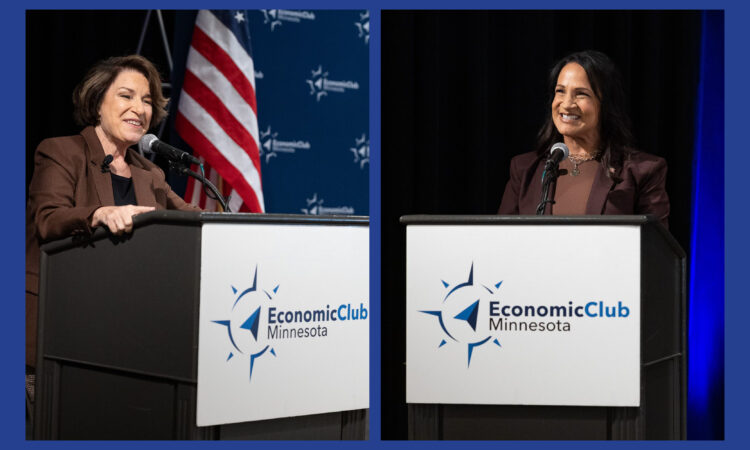
In a joint appearance before the Economic Club of Minnesota, Klobuchar, a Democrat, and Demuth, a Republican, weren’t afraid to talk about major fraud in state government that led Democratic Gov. Tim Walz to drop his bid for a third term.
Both women spoke in favor of legal immigration, the need for Congress to pass immigration reform legislation, and the positive role that future immigrants will play in filling vacancies for Minnesota employers.
They also acknowledged that Minnesota’s economic growth rate is below the national average, and it’s up to the next governor to use a variety of approaches to make Minnesota more hospitable for existing businesses and potential new companies.
Klobuchar and Demuth will participate in at least two gubernatorial debates before the Nov. 3 election. The Economic Club of Minnesota didn’t host a debate. Instead, it used a “discussion” format that allowed for longer answers than those normally given in debates, and neither candidate interrupted her opponent because they appeared separately in side-by-side conversations with the event moderator.
Klobuchar was given five minutes to address the live and online audience, and then she took questions from Sri Zaheer, the former dean of the University of Minnesota’s Carlson School of Management. Demuth followed Klobuchar on stage and took questions from Zaheer after she made her opening statement.
Zaheer, vice chair of the Economic Club’s board of directors, told the audience that “the governor is the CEO of the state.” To lead such a complex organization, Zaheer said she would ask the two candidates how they would grow the economy, attract and retain the best people for Minnesota’s workforce, and create a culture that serves Minnesotans.
A governor who spurs economic growth
“Minnesota still has remarkable economic strengths,” Zaheer said, but she referred to “dark spots on the horizon” because Minnesota trails most other states on important growth measures. “We rank near the bottom in terms of the growth in patenting, growth in R&D [research and development] budgets, growth in startup jobs,” she said, and wanted to know what the candidates would do to stimulate economic growth.
“We must be a state that makes stuff, invents things, and exports to the world,” Klobuchar said, and lauded Minnesota for being home to 18 Fortune 500 companies and about 500,000 small businesses.
“I look at a state that cannot rest on its laurels,” she said. “We have major challenges, and we have to acknowledge them. When we look at the rest of the country, it’s grown about 2.4% on average each year in the last decade. We’re at about 1.6%”
Klobuchar stressed that she would “cut through the red tape” and “transform our state government to a place where people want to come to do business.” She said she’d look at what Democratic and Republican governors were doing in other states for “getting things done faster, quicker, smarter.”
She talked about accelerating the permitting process for businesses and “consolidating a number of our state review processes.”
Klobuchar pledged to fix state government. She said she would do a cost-benefit analysis on programs. “I will stop spending money on things that don’t work,” she said. “The first thing I’m going to do when we get in there is a top-to-bottom audit of state government. That’s about rooting out the fraud, making sure we’re vetting contracts like we should, and modernizing our technology.”
The audit is about fraud, but Klobuchar said she also wants to get rid of duplicative functions and programs. She added that people who’ve committed fraud in Minnesota’s government programs should go to jail.
Klobuchar noted that Minnesota is fourth in the nation for agricultural exports. “I will be very focused on growing that international market for us,” she said. “These [Trump] tariffs have really hit us hard, as well as the rhetoric and the difficulties of how this administration has approached Canada.” Nonetheless, she said, she and U.S. Sen. Kevin Cramer, a North Dakota Republican, have been heading up a Canada-America group in the Senate.
She emphasized the need to expand domestic markets, including with new products such as sustainable aviation fuel.
“I don’t believe we should raise taxes,” Klobuchar said. “I believe, if we can, we should reduce taxes.”
Demuth said many aspects of state government are ripe for improvements to ensure “that we create a business environment that is pro-business.” She expressed concern over delays in permitting manufacturing facilities as well as “mandates that make it less affordable to do business.”
Minnesota is at a crossroads, Demuth said, adding that she would be a change agent for businesses and citizens. She stressed that her candidacy is an opportunity for voters to unleash change because she would focus on “ending fraud, lowering taxes, growing our business economy, [and] moving our education forward.”
“We have an educated and a hardworking workforce,” she said. But she added the recent state government “mandates that have been put on businesses—paid family leave, earned sick and safe time” have been problematic. Instead, she said, “recruitment and retention tools” are things that “each business should be able to do on their own.”
From her perspective, she supports a business climate and economic conditions that would be appealing to employers and employees.
To retain Minnesota’s university students and trades workers as well as attract people to Minnesota, Demuth said, “keeping taxes lower and making the state affordable helps people choose to be here.” Overregulation, she said, has been increasing the cost of housing in Minnesota.
She also said good schools and safe communities would strengthen Minnesota’s economy.
“Our educational scores are falling,” Demuth said. “We only have half of our fourth graders statewide that can read at grade level. Yet I remember when we were known for great educational outcomes leading up to high school graduation.” She indicated that local school districts need “the fair and flexible way to fund their schools, to handle classroom management, and to provide that basic education that is so desperately needed.”
She noted that crime is a workforce and business issue. “You’ve watched crime explode across our state,” Demuth said. “Crime in any area of Minnesota is unacceptable. The way we change that is always respecting law enforcement, the work they do, and holding criminals accountable for their choice in choosing crime.”
Building a workforce that supports growth
Klobuchar said she wants to double the number of apprenticeships in the state and be “smart about how we work with our colleges” regarding future workforce needs.
“I pledge to increase housing with the private sector by 100,000,” she said. Affordable and available housing is a major issue in Minnesota’s ability to support an expanding workforce for a growing economy.
“On the workforce front, I believe immigrants don’t diminish America, they are America,” Klobuchar said. “Particularly in Minnesota, we have flourished because we have been willing to bring people in from other countries.”
While acknowledging that immigration is a federal issue, Klobuchar said, “as a governor, I will be a strong advocate for smart changes when it comes to visas.”
Moderator Zaheer observed that “demography is destiny.” Citing data from a Minnesota Chamber of Commerce report, she said that in a recent four-year period 94% of the net growth in Minnesota’s population came from international immigration.
During Operation Metro Surge over the past winter, Klobuchar said, “we stood up to ICE because those were illegal arrests that were being made all over the state.” Because of the widespread actions Minnesotans took to protect their immigrant neighbors, Klobuchar said the solidarity could have a positive effect on the state’s workforce. She indicated that some young Minnesotans may choose to remain in the state because they were inspired by how ordinary residents responded to the aggressive federal enforcement actions. She said the peaceful ICE resistance also could attract some people to move to the state for work because they share civic values with Minnesotans.
“Legal immigration matters very much,” Demuth said. “There are members of my family, very, very close members of my family, that are legally immigrants here in the state of Minnesota.”
She spoke about making alterations to provide immigrants better pathways to citizenship. “Our federal government does need to make changes when it comes to immigration to improve that process,” Demuth said.
“What we can do here as a state is make sure that our universities, our higher education institutions, can attract [international] students,” she said.
Demuth emphasized that Minnesota needs to reduce the outmigration of Minnesotans to other states, including those leaving for “warmer climates, sunnier places.” To do so, she said Minnesotans need to envision bright futures. They need to see benefits for themselves as well as a state economy with more substantial growth, she said.
“Over the last 10 years, our state budget has doubled,” she said. “You have to wonder, ‘What did we get for that?’ I would say, ‘Not enough.’ ’’
Demuth said Minnesota residents need to know their tax dollars are being spent for good purposes. “I will stop fraud in the state of Minnesota,” she said. “It has [occurred] because of a lack of internal controls, a lack of seriousness.”
The fraud issue is a Minnesota story that has been covered by national media organizations. In the past year, Operation Metro Surge and the fraud scandals have dominated national coverage of Minnesota and affected how some people view the state.
“No one has lost their job because of fraud, and that is a pure disrespect to the hardworking taxpayers of Minnesota,” Demuth said.
Moving beyond exhaustion and division
In the last legislative session, the Minnesota House was evenly split 67-67 between Democrats and Republicans. The Democrats held a one-vote 34-33 edge in the Senate.
Division was omnipresent, but Demuth said the two parties had to find some common ground to pass legislation. Yet a divided legislature can be draining for lawmakers and citizens.
Moderator Zaheer talked about what Minnesotans have endured since 2020—Covid-19, the killing of George Floyd by the Minneapolis police, the assassination of former House Speaker Melissa Hortman, and intense federal immigration enforcement sweeps.
“Across the political spectrum, across the socio-economic spectrum, people are just tired,” Zaheer told the gubernatorial candidates and Economic Club audience. The exhaustion also is fueled by what people encounter on a daily basis.
“You hear it from employers,” Zaheer said. “They can’t hire enough people. Families’ monthly bills keep rising.” At the University of Minnesota, she said, budgets are being cut and faculty are being forced to teach larger classes.
She asked Klobuchar and Demuth to talk about the culture each would establish as governor, which would affect the psyche and reality of life in Minnesota.
“We need a state government that matches the drive and ambition of the people in our state,” Klobuchar said. “I’m someone that approaches things with a can-do attitude, with optimism. I’m willing to meet people where they are and find common ground and listen, and then go forward.”
Klobuchar said that Minnesotans aren’t looking for a governor to shift the state to the political left or right. Instead, she said, they want a governor who can move the state forward. “You’ve got to listen to a lot of people and be willing to make changes,” Klobuchar said. “Let’s do this together.”
Demuth said she’s visited with tired citizens, and some of them have told her that she gives them hope. “What I know about Minnesotans and those that are choosing to be here is that we are resilient and we want to move forward, but we need that hope,” Demuth said.
“This is a time for us to right-size the state budget,” Demuth said. “Democrats and Republicans can work together with the right leadership,” she said, adding that she demonstrated her leadership ability as speaker in a divided House.
With a platform of ending fraud, lowering taxes, and growing the economy, Demuth said, her candidacy is the “opportunity to make that change.”