

Sezzle’s Journey: From Buy Now, Pay Later to $5 Billion Market Cap and Becoming a Bank
By
Charlie Rybak
Air Date:
Wednesday November 18, 2026
How did a Minneapolis fintech company go from a $40 million market cap to $5 billion in four years?
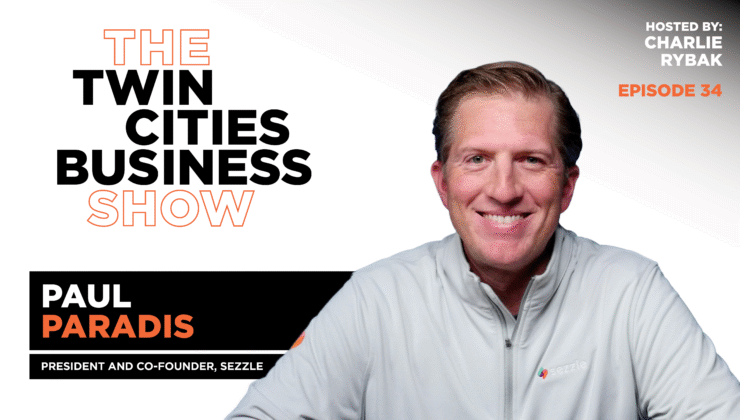
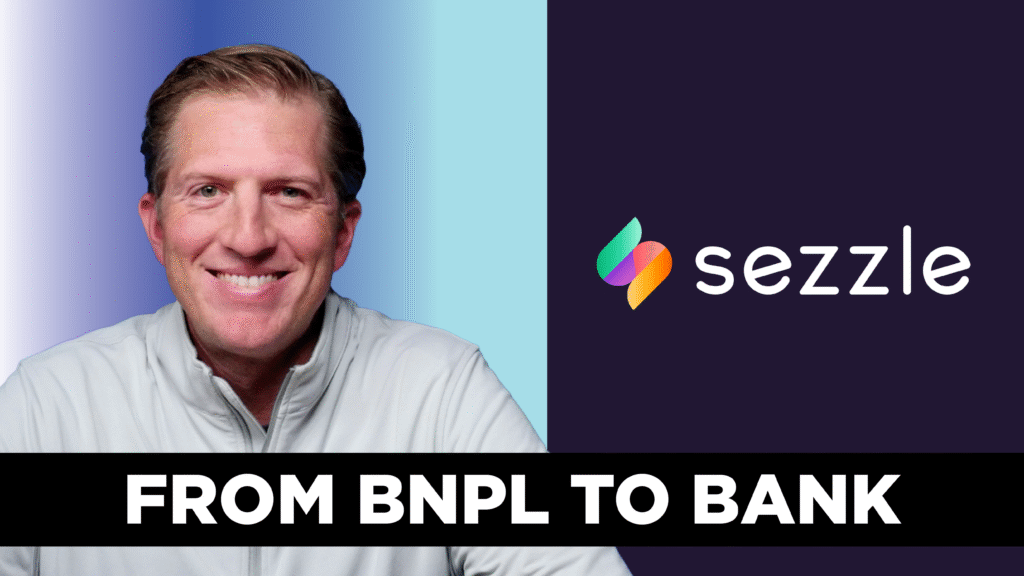
Sezzle Co-Founder, Executive Director, and President Paul Paradis joins us on The Twin Cities Business Show to tell the story: a pivot one month after launch, an early entry into the Buy Now, Pay Later space with their signature Pay In 4 program, an IPO in Australia, a failed merger with Zip, a hard turn to profitability, a Timberwolves jersey patch, and now an application to become a bank.
Paul also shares what Sezzle’s data says about the American consumer (including why 43% of people earning over $200K live paycheck to paycheck), how AI now deploys more than 90% of the company’s code, and the advice he’d give his younger self.
Read the transcript below or watch the full episode on YouTube here:
You guys just had a remarkable quarter, with revenues up more than 40% year over year. What is going so right for Sezzle right now?
PP: I think it’s primarily focusing on how we can deepen our relationship with our customer base. We started as more of a transactional use at checkout. Now we focus a lot on our mobile app, and it’s, how can we get people doing more with us? How can we do more for them? So we’re launching new products like cash advance [and] P2P transactions. We launched subscriptions that encourage people to just be in our app more. So adding more functionality, more value to the consumer—that’s probably the biggest reason why we’ve been growing so quickly lately.
The backbone of the company the last few years has been the buy now, pay later model, and you’ve evolved beyond that into being more of an all-in-one place where people do financial transacting. Can you tell people a little bit more about the buy now, pay later space and how you guys entered it?
PP: The buy now, pay later space came into prominence—well, we were the first ones to launch pay-in-four, which is kind of true buy now, pay later. I think buy now, pay later (BNPL) is a term that gets morphed, and different people attach themselves to BNPL because it’s become a popular industry. But as we define it, it’s short-term, interest-free installment plans for purchasing things.
If you think about how a lot of people purchase things, it’s with a credit card, or if they don’t have a credit card, maybe a debit card. We kind of sit right in between both of them. Credit cards have an approval rate maybe around 40%. A lot of people are declined for credit cards.
So 6 in 10 people that apply for a credit card don’t get one?
PP: Right around there. I haven’t seen the latest figures, but it’s right around there. And so there was this big problem around people needing more spending power but not being able to get it. And if you use your debit card, you can only spend how much you have in the bank today. So we wanted to offer a more consumer-friendly way for people to spread purchases over time, interest-free. That’s the core of what BNPL is.
We launched it in 2017. Now, Affirm at the time was doing installment plans, but they do long-term, interest-bearing installment loans, which have been around forever. What drew us to this short-term product was it was actually taking off in Australia at the time. There were companies called Afterpay and Zip that were making this really popular, especially with young consumers in Australia. And if you’ve been to Australia, it’s very similar to the U.S. in terms of culture and spending habits [and] shopping. And so we thought, why not take that model and bring it to the U.S.? Because at the time, we were seeing that credit card adoption rates were actually decreasing in the U.S.
In 2009, I believe, the CARD Act was passed, which made getting credit cards harder for young students primarily. And it was intentional, because there was a lot of predatory lending going on. You had the ’08 financial recession. So they raised the legal age of getting a credit card from 18 to 21 if you don’t have a parent co-signing. They made it illegal to market credit cards on college campuses. So when I was in college—maybe you too, I don’t know how old you are—you’d go on campus and there’d be banks giving away free T-shirts, whatever, for applying for a credit card.
I’m that old. Yeah.
PP: You remember that? So that’s illegal now. It’s also illegal to give away gifts for applying for a credit card. And so they were trying to get people to refrain from getting credit cards if they can’t afford them, and we saw a gap in the market that we could fill.
And we underwrite differently than banks too, because with the short-term installment nature [and] small ticket sizes, we don’t have this large revolving line of credit that we have to manage. We can underwrite each purchase, and it allows us to approve way more customers for our transactions. So our approval rates are around 90% at the transaction level, as opposed to a credit card [at] around 40%.
Let’s go back in time to 2016, when the company was founded. How did you guys meet, and how did you come up with the idea for the company?
PP: Charlie Youakim is our CEO, and he and I met at the University of Minnesota at the Carlson School full-time MBA program. This would have been 2008. We were there ’08 to ’10, and we became great friends. We worked on a project together for the Itasca Project, which is a local group of business leaders that try to spur economic development in the Twin Cities. [It] no longer exists, unfortunately.
We met working on that project together and had a great time doing it. We’re both from the area, and we actually clicked over ping-pong. We just played a ton of ping-pong together. Probably played too much ping-pong—should have studied more, but…
Seems like it worked out.
PP: It worked out. We became really good friends. He went on to start his first company right out of grad school, because if you remember, this was the financial recession. The typical post-MBA jobs were completely dried up. Nobody was hiring. So Charlie went to start his first company, which was also in payments, called Passport. He moved down to Charlotte to start that with his cousin. And Passport is actually used by the city of St. Paul. When you park on the street and pay via mobile app, there’s a few companies that manage those apps. Passport’s one of them.
I went the more traditional post-MBA route of consulting. I worked for a local firm called Dashe & Thomson, and then I went from there to the Abreon Group, which is a Pittsburgh-based consulting firm doing large-scale IT user adoption. Imagine if you’re Target and you’re implementing a new SAP module that you need to get 20,000 employees bought in [on and] trained. They’d bring in a firm like ours to help with the human side of a large IT change like that.
We’d stayed in touch. He actually tried to get me to come work for him at Passport, but I didn’t want to move down to Charlotte. I had started a family here. My wife and I are both from here. So he called me up at the end of 2015. He was actually leaving Passport due to a co-founder dispute with his cousin, and he said, “I’m going to start a new company. Do you want to come help me do this?” And I was looking for something new. I had always had kind of an itch to start something. So he moved back to Minneapolis, and starting in about January of ’16, we started raising money. Once we had raised enough money that we could pay ourselves, then I quit my job at the Abreon Group.
We formulated this company in January ’16, and it was a different idea initially. It was initially meant to save merchants processing costs by enabling digital ACH payments in checkout.
And ACH, for people that don’t know, is payments from bank accounts directly. It’s more complicated than that, but we’ll leave it there.
PP: Exactly. And up until then—and still today—it’s really only used for recurring transactions mostly, like utility bills, rent, things like that. And the reason is because it’s a very hard payment method to authenticate. When you’re paying via ACH, they’ll ask for your account and routing number. But if you write somebody a check, they have your account and routing number.
So the way you would authenticate is they would drop micro deposits into your checking account, like 2 cents, 6 cents. It would take a few days to clear, and then you would report back to whoever you’re trying to pay how much they had deposited. That was their way of knowing that you had access to your account. That does not work in a checkout when you’re trying to buy a jacket.
It’s a little inefficient.
PP: Does not work. And so there was new technology coming online that enabled instant authentication through bank login. You could choose, “I bank with Wells Fargo.” It would ask for your Wells Fargo username and password, and that would allow instant authentication, because you’re the only one with those credentials. And then you could now make a transaction with your bank account.
So we used that technology, and we reduced processing costs for merchants and then returned some of the savings back to the consumer in the form of cash back. And at that time, there was no more cash back on debit cards. There used to be a while ago, but I think it was the Durbin Amendment [that] regulated the interchange that could be charged on a debit card and made it really low, so banks couldn’t afford to pay rewards on debit cards anymore.
So a lot of what you guys are doing is coming into [the] post–Great Recession regulation environment and saying, here are some areas that have opened up to be innovated in, and running into those headfirst.
PP: That’s right.
You guys really get up to speed in 2016, but you haven’t yet launched the pay-in-four product. When did that come in?
PP: It was a really interesting pivot, because we had raised what was at that time a really good-sized seed round based on Charlie’s success that he had at Passport. He had this track record built up. I think it was around $2 million—a little less than $2 million—in a seed round, pre-product. And so we built this product. We had gotten, I think, second place in the high-tech division in the Minnesota Cup with this idea, and we had also made it to the finals of the Target Techstars accelerator program here in town. It was a really prestigious program. You get to work with Target and meet all their executives, and maybe there’ll be a pilot at the end of it.
And so we had launched this product—I want to say it was like May of ’17. And after about a month, Charlie was like, “This is not working. We’re not getting the traction we need.” And the rest of our team—we were probably five or ten people at that time—are like, We just launched this a month ago. [We] just spent a long time raising money. [There’s] a bunch of money on this idea. People like it; investors like it.
And then we had this final pitch for the Target Techstars accelerator event, and we had decided to pivot. It was primarily because when I was going in and selling—I’ve always been in charge of the go-to-market part of our company, so I’m typically the one going and talking to customers, and now my teams are—I would go to talk to merchant customers, and small merchants didn’t care about saving 150 basis points on their processing costs. They’re concerned with increasing sales. The ones that care about decreasing processing costs are the Walmarts [and] Targets of the world.
The big ones who are processing lots of transactions.
PP: Exactly. If I’m a small business, I’m just trying to get my business to grow, and we were not helping with that. So wheels started to spin about, OK, what are ideas that we could do that would help them increase sales? Well, credit is a big one. So what’s the area we could attack in credit? And that’s the whole buy now, pay later angle.
But I remember we were going into the final pitch for this Target Techstars event. We were trying to figure out which business model we were going to pitch. Were we going to pitch the one that we had made it through all these rounds of this competition to get into, or were we going to be truthful and tell them that we had decided to pivot away from this model?
Big decision.
PP: We decided to tell them the old model. We didn’t get in anyway. We ended up getting in the accelerator two years later because they relaunched it as kind of a later-stage tech accelerator program. But anyway, that was what pushed us to pivot into BNPL. And it was really Afterpay’s success in Australia that pushed us into this idea, because they were just soaring in Australia with young consumers especially.
I remember the first sales campaign that I used was targeting Afterpay merchants in Australia that were selling into the U.S. market, saying, “We’re the Afterpay for the U.S.” And it caught on like wildfire. We were getting tons of inbounds. We ended up hearing from Afterpay shortly after. That was kind of how the pivot happened into BNPL.
A couple of years go by, and then this Australia thing comes up again, because you guys decide to go public in Australia. Tell me more about that decision.
PP: We started to grow really quickly with this new buy now, pay later model. We had raised a Series A round, I want to say in early 2018, but it was led by Charlie, because he had exited from Passport. And this was actually interesting. We had a term sheet in hand from a VC for a Series A round, and Afterpay, the Australian company that I mentioned, publicly announced that they were going to be launching in the U.S. And they announced that they were launching with two or three really large merchants like Urban Outfitters—Revolve, I think, was one of them. And so the venture capital firm actually pulled their term sheet when Afterpay announced that they were coming in the market, because they didn’t think we could compete with them.
So at that moment—did you think that could be it?
PP: Well, no. We had a little bit of a runway, and we still had other venture capital firms that we could talk to, but it definitely helped that Charlie was able to come in when he did. And it’s paid off for him in a big way, so it was a great decision on his part.
I say that because now, fast-forward to 2019, and we ended up going public on the Australian exchange. It had been difficult fundraising after our seed round, and I think part of that has to do with being in the Minneapolis market. It is challenging, as opposed to if you’re in New York or in San Francisco. It was also challenging because there are only so many venture capital firms that will invest in lending startups. It’s just a whole different animal. Now you need to raise debt capital to be able to finance the credit that you’re extending.
You have to get into underwriting.
PP: Underwriting, yeah. There’s regulation involved. It’s just a lot more difficult. So fast-forward to our Series B raise, which would have been around 2019, maybe late 2018. We were having trouble finding venture capital firms that wanted to invest in us in the way that we wanted them to, in the capital amount that we needed. And an equity analyst from Australia was visiting Minneapolis doing research for Afterpay. Afterpay was in the U.S. market, and they were public in Australia, and so he was doing market research to try to understand what the market dynamics here in the U.S. look like [and] who their competitors are.
And so he comes and visits us, and he’s like, “Have you guys ever thought about going public in Australia?” We’re like, “No, why would we do that? We’re not there. We don’t have a business there.” And he’s like, “I think the investors there will love your story. They’re already huge into Afterpay.” So the seed’s been planted. Investors know the buy now, pay later model, and they would love the opportunity to invest in a U.S.-based tech company in that market.
So Charlie ended up going out and doing one or two non-deal roadshows, where this analyst brought him around talking to different institutional investors, and [we] pretty clearly realized that we could raise a lot more money at a much better valuation if we did that than if we did the private VC round here.
And companies tend to go public very early there, because they don’t have the VC market there that we do.
PP: Exactly right.
So that’s 2019. Had you heard from Afterpay or had a dialogue with them at all at this point? Because it sounds like you’re tracking this parallel line with them.
PP: Yes. Pretty quickly after we launched and were using the “Afterpay for the U.S.” campaign, they came knocking. We ended up talking. They were interested in acquiring us, but at that time, again, we had just launched this new business, and so the offer was much lower than what we were willing to be sold for.
And this is what year?
PP: This was 2017.
Do you have even a ballpark of what they would have wanted to buy you for?
PP: I do. I don’t know if I can disclose it or not, to be honest.
Looking at where you guys have come in that time, it would have been a pretty bad decision.
PP: It would have. Well, it’s funny, though, because since then, there have been points where it would have been a good decision and points where it was really bad. The last two, three years, obviously, it’s been a good decision that we went on our own. But there were points along the way—we’ve had a very up-and-down ride since ’17.
So then you’re public in Australia. What’s the next big down after that?
PP: The next big down was—fast-forward to, I think it would have been 2021—one of our large competitors, Affirm, ends up going public on the Nasdaq.
And they’re based in…
PP: San Francisco. Very successful. They were started by a PayPal co-founder, Max Levchin. They had already been a big company. Again, they were doing more long-term, big-ticket installment financing. People might remember their big merchant back then was Peloton. Everybody financed their Peloton bikes through Affirm.
The difference between you two is how many installment payments and interest you’re taking, right?
PP: That’s right. They were doing furniture purchases, electronics, fitness equipment, things like that—big-ticket items. [A] consumer [who] already has a credit card, but a merchant offering 0% interest over 12 months, that helps them capture the sale for the Peloton bike.
Affirm was around. They went public early—I think it was early ’21; I might have my years mixed up—but it was a very successful IPO. And we had visions of moving to the U.S. markets because, again, we didn’t have any business in Australia outside of just the listing. So we started the process of going public here. We were told we were going to go public very quickly, but at that time, there was this SPAC craze. I don’t know if you remember this, but there were all these early-stage companies going public via SPACs, and so the SEC was backlogged with tons of IPO applications.
Can you just give people a really quick [explanation of] what a SPAC is? Because it was a fascinating trend.
PP: I’m not a SPAC expert, but basically investors would raise money and create a public company that was really just an investment vehicle, and then they would go buy a startup so that the startup could then become public and have access to more capital. That’s my understanding.
Like a weird fusion of combining two entities and raising into them and backdoor going public.
PP: Yes. And most of them failed miserably when the tech crash happened about a year later. And so the SEC was taking forever to approve our IPO. And then Afterpay ends up announcing that they’re going to be acquired by Square, now Block, for several billion dollars—just a huge sum of money. And so we decided to parallel-path an M&A process, because the SEC was taking so long [and] because Afterpay had gotten this huge windfall.
And so we honestly started both processes, IPO and M&A, probably two or three months too late, because the fintech market started to turn first. This would have been, I think, again, late ’21. And what started as many interested companies in acquiring our business ended up really coming down to Zip, which is another competitor of ours from Australia. And so we agreed to be acquired by Zip. It was public news.
And pretty quickly after announcing this combination of us and Zip, it was looking tenuous, because the markets were really starting to tank. This was when Russia invaded Ukraine. And so both of our market caps were just tumbling, and the cost of the deal relative to our market caps became really, really poor. The cost was very high. And so we ended up breaking the deal shortly thereafter and getting a small break fee from Zip.
And that’s when we had to basically shift gears from growth at all costs to, we need to survive as a business. We weren’t profitable yet. So we had to shift to, we need to get to profitability, because our market cap had gone from, I think, a billion and a half in ’21 to like $40 million after this break occurred with Zip. So we weren’t going to be able to raise any capital at that low of a valuation.
$40 million.
PP: We would have just wiped out shareholders if we raised.
To put it in context, $40 million. Roughly where are you guys at today, four years later?
PP: Last I checked, I think we’re around $5 billion.
From $40 million to $5 billion. So it’s probably good you didn’t do that deal.
PP: Yeah, I think so. And I think Zip’s market cap is much less than ours, so we’re very happy with the decision we made. It made a lot of sense at the time. We had complementary geographies. They’re big in Australia. They were expanding into countries that we were not in. We were expanding into countries that they were not expanding into. Now both companies have ended up focusing almost entirely on the North American market, because we were each burning so much money trying to scale up in other geographies before we linked up. So it was a good decision in the end, but it was really hairy there for really all of ’22. It was a really tough year.
And then you guys say, we’ve got to get costs under control. You hadn’t achieved profitability at that point, right?
PP: We technically did, because we had gotten this break fee from Zip, but it was a one-time payment, so you couldn’t really count it. We did get to profitability slightly, I think, Q1 of the next year—so Q1 of ’23, I want to say—and then just started to grow again.
And it was tough, because when you make the decision for profitability, you have to say no to certain customers. You have to unwind deals that you did that seemed right at the time, when everybody was going through this growth-at-all-costs mode. But now that the markets were starting to reward profitability instead of growth, you have to again shift all of the ways that you’re thinking to just cutting every cost that you can [and] being very exacting about what deals you take on. So as a result of that, our market share now isn’t necessarily as big as some of our competitors like Klarna and Affirm, but our market cap relative to our market share is really strong, because we’ve become a very profitable company. We make very deliberate decisions about what we’re going to do. It’s worked out.
I just want to call out that you guys have ridden all these very interesting waves. I brought up the post–Great Recession wave. You’re in the 0% interest, grow-at-all-costs phase. You’re in the early tech tumult of the early 2020s phase, and all this fintech stuff is happening. Silicon Valley Bank blows up. All these things happen…
PP: We were working with Silicon Valley Bank at the time, by the way. That was tough.
I bet. And then all of a sudden, investors everywhere are like, “We need all of you to start making money now,” and you guys do it. How were you able to flip that switch that fast?
PP: I really give all the credit to our CEO, Charlie. He is an incredibly disciplined person. Go back to our pivot away from ACH to BNPL. He saw enough early data to know that we had to make the change, even though everybody else is like, “This is going to be painful. This is going to hurt.” But he just knows it’s the right move, and he just commits fully to it, and he gets everybody bought in. You’ve got to communicate clearly about it.
And that’s one thing that I think we do really well as a company. We do monthly town halls [with] all employees, and we’re very transparent about everything that we’re doing [and] everything that we want to do in the future. And so he was very upfront about, “Look, guys, this is going to hurt. There’s going to be some pain, but this is what we have to do to survive as a company, and we’re going to figure it out.” So I give all the credit to Charlie.
Then Sezzle ends up as a Timberwolves jersey sponsor. How did that come to pass?
PP: That was fun. Charlie and I, as I mentioned, were both from the Twin Cities. I grew up in Eden Prairie. He grew up in Coon Rapids. So we’re both lifelong Wolves fans. We’re both big sports fans. My first job out of college was with the Timberwolves, actually. I graduated from Davidson College down in North Carolina, I moved back home, and I got a job selling season tickets for the Timberwolves. And this was the last year of Kevin Garnett and then the first year post-Garnett.
That was probably an easy job.
PP: I tell people it’s the hardest job I think I’ve ever had…
To have people pay to come see Sebastian Telfair? I bet.
PP: Yes, exactly right [laughs]. I remember all the staff would get two lower-level tickets as part of our benefit package, and you could not give these to friends. And they were nice seats. They were lower level.
I spent two years at the Wolves, but I learned a ton. It was an awesome job. You work hard; you’re working long hours, but they invested a ton back in the employees—a lot of training. So I just learned a ton about how to sell a difficult product [and] how to talk to people. That’s when I went back and got my MBA—right from the Timberwolves.
Well, fast-forward a few years later, we had started Sezzle, and at the time, Ryan Tanke was the COO [and] Ethan Casson was the CEO. When I was at the Wolves, Ryan Tanke was my boss’s boss. He was the head of ticket sales, and Ethan Casson was the head of corporate sponsorships. So I knew both of them. I think they ended up doing the deal with Aura right before us. They came to us and wondered if we were interested in this new jersey patch deal that NBA teams were doing.
It wasn’t good timing for us, because at that time, the only way you could use Sezzle is if you found us as a payment method in checkout. And so the idea of needing national awareness wasn’t a big deal. It was more about, how do we convert customers at the checkout? We felt like it would have been a waste of money if we were just doing big, splashy awareness marketing campaigns.
And there’s no reason for people to know you, because you either show up at checkout or you don’t.
PP: Or you don’t. There wasn’t an app that you could go use and start immediately transacting.
Well, fast-forward three years later, now the Aura deal was done. I remember their head of sponsorships at that time invited me out to a playoff game, and this is when they went on that first long run in the Western Conference playoffs. And I remember going up to him, and I’m like, “We should talk about the patch. It might be better timing.” I learned later—funny enough, at the time when I told him that, he was talking to an NBA representative about their patch and what they were going to do.
And at that point, we had really evolved our business to be more direct-to-consumer. We had this app where you could go and shop. You could find deals and discounts, and there was much more of a need for us to do mass awareness marketing [and] advertising. And we were coming out of this period where we had terminated this deal with Zip. I think the perception was probably fairly low about our company’s chances of surviving, and so we wanted to finally do something that was a bit splashier and say, “Hey, we’re here. We’re ready to grow again.”
So it actually happened pretty quickly. I think I brought this up during the playoff run in the spring, and then by that summer we had a deal ironed out. And it’s been awesome. The timing was great, obviously, because the team’s done so well and [has] this boisterous personality. The number of nationally televised games that the team has gotten from when we did the deal till now is just night and day. It’s given us hospitality opportunities to entertain clients and prospects [and to] try out really innovative ways to acquire customers in an arena, through radio spots, things like that. So we’re learning a lot from it. It’s been awesome.
But it was this really cool, full-circle moment where I’m selling season tickets, and then now all of a sudden we’re on the jersey as the biggest sponsor of the team. So it was really cool.
Do you ever think about how much easier it would be to sell season tickets now than when you had to do it? You probably wouldn’t have learned as much, though.
PP: That’s exactly right. I think I heard—this was maybe a year ago—that the entire lower bowl was sold out with season tickets. I think it’s still the case. So they’re packing it every night.
As somebody who lived through the Michael Beasley-taking-25-shots-a-game Timberwolves years, it is sort of remarkable to watch.
PP: And the passing on Steph Curry. There’s been a lot of…
Why would you bring up my trauma on this show? That doesn’t seem fair.
Let’s dig a little bit more into the consumer app. You guys aim for profitability in 2023, and then you really push toward more of a consumer focus. Can you talk a little bit about that and the journey since 2023?
PP: We like to think of ourselves as being at the intersection of financial services and commerce. So in addition to the financial services aspect of lending money, now it’s, how can we help people save money on the purchases they’re placing through discounts, or how can we help them earn money? And so we started to add lots of features and functionality specifically for the customer that we work with, which is typically a young customer living paycheck to paycheck—oftentimes maybe even a gig worker.
And so we started launching products like cash advance, where now, in addition to making a purchase and paying us back over time, we’ll actually give you a personal loan, essentially, and allow you [to] pay us back over time for things that are maybe not just purchases, but other reasons you would need that money. We started opening up more deals and discounts through gift card and affiliate promotions on our app, selling advertisements directly to merchants. So we’re starting to monetize our app in different ways that allow us to launch more products that are consumer-friendly for this customer.
I think we’re going to continue innovating down both of those paths. We’re going to become a digital bank, where we’ll offer products that our customers can graduate into if they’re no longer just in the need for BNPL—if they want to get a secured credit card, an unsecured credit card, checking, savings, all the things that you need from a bank. But then also on the commerce side, are there other things that we can launch to help people save money, like receipt scanning? There are apps where you can upload a grocery receipt, for example, and you’ll get cash back from brands for purchasing those specific products from those brands. We just launched that recently [and] are starting to test it.
And there’s a lot more to come, but really we want to become this all-in-one financial hub where we can help people get access to more spending power [and] more credit, save money, [and] earn money. They can earn money by playing games in our app [or] by taking surveys. They can learn more about credit and other personal finance matters through—it’s called Sezzle IQ. So it’s really trying to become this hub where people will want to go for anything that’s financial-related, and, again, focusing on that young, new-to-credit customer.
Now you guys are moving towards becoming a bank?
PP: We are. We publicly announced that we filed an application with the OCC [Office of the Comptroller of the Currency in the U.S. Department of Treasury]—I think it was maybe two or three weeks ago. The process takes about nine to twelve months to fully bake, so we don’t know if we’ll be approved yet, but we’re hopeful. I think we’re in a really good position to be approved. It’s kind of like the next graduation path. We want to fully embrace the regulatory oversight of the OCC, of the federal government. It’s going to allow us to launch more products faster. Right now, we partner with a bank called WebBank that basically helps facilitate us launching products that you would need a bank charter to launch. But we think that this will allow us, again, to speed up. It’ll help us launch more products. So we’re really excited about it.
And it seems like the market has been very excited about where you are going, based on your latest earnings and stock movement.
PP: I think so. Who knows what the reaction was? We had a great result, which I think always really helps the stock price more than anything. We had a really good quarter. But I think investors do realize that the best thing for us and for the industry at large is to get under the regulatory oversight of the federal government. Right now, we’re having to rely on state-by-state regulatory oversight, which is challenging, because each state does things differently, and it forces you to offer your product in different ways in each state. It’s kind of cumbersome. And so once you become a bank, you now have to follow federal regulation, not necessarily state-by-state regulation. So it kind of streamlines everything that you do operationally.
And we’re not the only one in our industry to announce that they’re applying for a bank charter. All of our competitors are, and many other fintechs that are even outside of BNPL are now doing it as well. I think there was a period of maybe 10, 15 years where there was kind of a moratorium on new bank charters, but I think the Trump administration made it clear that, “We’re open for business. We want more fintechs, more companies to become banks so that we can regulate them appropriately.” And we agree. We think it’s the right move.
You guys have this fascinating lens into the American consumer. You have a ton of proprietary data on exactly where people are at [and] what they need. How would you classify where consumers in America are at right now?
PP: It’s a great question. I think a couple things. When you look at our loss provision, we’re not necessarily seeing a consumer that is under huge duress. We’re not seeing delinquent payments go way up. We’re not seeing hardship requests go way up. I think the consumer is doing well. However, what we are seeing is an increasing portion of our consumer base in the U.S. that is living paycheck to paycheck. An interesting statistic I saw recently was that almost half of people making over 200 grand a year—it’s like 43%—are living paycheck to paycheck.
Over $200,000?
PP: Over $200,000 a year. Now, you could argue, well, maybe they’re spending more than they should because they’re making that kind of income, but it just shows you how many of our customers are in a tight spot where, if something were to go wrong in their life, whether it be a medical emergency or if they lose their job, now all of a sudden they don’t have much of a cushion. So I think it’s a tenuous situation, even though currently all signs are pointing to it being strong. That could change quickly.
The big thing that we look at as a leading indicator is [the] unemployment rate, because, again, our customer—we say our customer is already in a recession. If they’re living paycheck to paycheck, they’re having to watch every penny that they spend.
They’re not paying for everything in one go. They’ll pay in four or something like that.
PP: Right. But where our customer could really get in a tough spot is if they lose their job. Unemployment has been really good over the last several years, but if that were to change—and this is actually a credit to our model that we’ve adopted, and one of the reasons why we went into the short-term pay-in-four model—we have only about two weeks of credit exposure before we could really tighten our models and make sure that we’re not losing money. The first time that we have an indication of someone’s ability to repay their loan to us is the two-week mark, because that’s the first installment we collect.
So let’s say there’s a major event that happens. We can tighten our underwriting models. Unlike a credit card, where they’ve given this huge line of credit that you can go out and use as much as you want, we underwrite every purchase that you make. And so we can say, “You know what? We’re seeing some distress here. We need to tighten our approvals a little bit.” And that protects us from the exposure to losses on the back end. So we’re in a good spot as a lender relative to others that do much more long-term or bigger-ticket financing.
So rather than being a recession-proof business or the opposite, you guys are a business [that] does well, but if unemployment goes way up, that’s where you would potentially have a hard time.
PP: Again, we’ve never seen a huge unemployment event since we’ve launched, but that’s the one that we look at closest to [decide], maybe we should make some tweaks to our underwriting model if we see this number start to move. I still think that we’re in a really good position to weather that. You would just have to change some of the ways you operate.
And also, in a recession or if there was an unemployment tick-up, I think the demand for our product would go way up, because now there would be a lot more customers that maybe historically didn’t need BNPL that now start to need it. So there’s this trade-off where we have to balance loss rates, but there’s going to be a lot more people that will want to start using BNPL.
Ideally you get through the bank charter process. You’ve had all the success the last couple of years. Looking out into the future, five, 10 years down the road, where do you guys want to be?
PP: I think the bank says it all. It’s wanting to become a more fully fledged bank offering all of the products and services that a Chime or a Wells Fargo offers, but doing it in a digital-first, consumer-friendly way, and, again, not abandoning the young consumer that doesn’t often get approved for or can’t have a relationship with a bank like that. So I think it’s going to be pushing into more financial services and products to deepen our relationship with our customer.
I think you’ve seen that in our numbers too, where this last quarter, I think the average number of purchases using our product was eight times in the quarter for a customer. That was an all-time high. It continually goes up. So it’s wanting to deepen our relationship with our existing customer base so we’re not losing them to a bank when they’re ready to graduate into more traditional products.
But then it’s also looking at what are new products that we could launch that help us acquire new customers and appeal to different customer bases. I mentioned the P2P product that we just launched. Think Venmo, but with BNPL layered in. So if you want to send your friend $100 for a concert ticket that they bought you, but maybe you don’t have that money today, you can pay them back in installments through Sezzle. We’ll front your friend the cash, and then you pay us back over time. And I think that’s a way for us to acquire a lot more customers, because now they’re sending money to friends that maybe have never used BNPL before or thought to use it in a transaction context, but they’re seeing, “Oh, I can use this to send money to my friends and family, too. I’ll try this BNPL flavor out.”
You guys have this fascinating combination, it feels like, of relentless discipline and focus and incredible speed to new product launches. Do you think that’s pretty rare?
PP: I do. I do think that’s rare, and I think that’s probably the biggest reason for our success, honestly. And again, I think that starts at the top with Charlie. I think that’s his nature—just constant innovation. He is a product-focused leader. He’s still extremely involved in what products we launch [and] how we launch them. And now, with the dawn of AI, we’re launching things even faster. I think the last statistic I saw from our earnings was over 90% of our code is now deployed by AI, not humans. So it’s become this tool that enables our engineers to just build more and faster. It’s been incredible.
For you personally, if you could go back in time and talk to the version of yourself that is just thinking about jumping in and helping start this company, what would you tell them?
PP: I’d probably tell them to enjoy it more. You get so caught up in every little moment and move, and everything seems like it’s life or death. Not to work less hard or anything like that, but it’s hard to sit back and look back on everything that you’ve done and the company’s done and appreciate it and just say how amazing that was. In the moment, you can’t do that. I should say it’s easier to do that looking back. So I would say, smell the roses. It’s all fun. It’s going to feel painful at times, and stressful, but it’s a journey that not many people get to go on. So just enjoy it a little bit more.
Hear TCB Show on:



Host: Charlie Rybak
Charlie Rybak is VP, Editorial Innovation for Twin Cities Business.