

The (Literal) Pulsing Heart of Medtronic’s Relationship with the University of Minnesota
Today, the Mayo Building on the University of Minnesota East Bank campus in Minneapolis serves as the hub for the university’s medical school. But before that, when construction finished in 1954, it was a hospital. Doctors performed open heart surgeries inside.
In 1958, Earl Bakken, founder of Medtronic, created the first pacemaker there.
Now, the University of Minnesota collaborates with Medtronic to reanimate human and animal hearts on the first floor of the building. Medtronic provided the U a formal contract in 1997 to begin research inside what is now called the Visible Heart Lab (VHL).
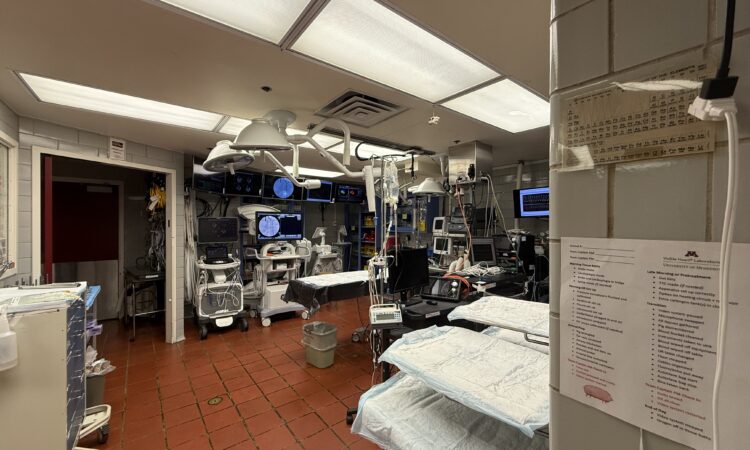
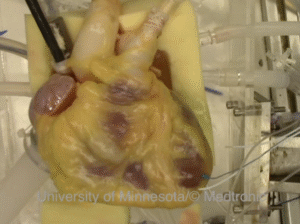
The room is crowded with tubes, pumps, cameras, and imaging equipment. Clear fluid courses through the arteries of a donated human heart. The heart sits on an operating table while monitors flash detailed images of valves opening and closing in real time.
Then comes the moment that still amazes the lab’s director, Dr. Paul Iaizzo, after nearly three decades.
“You shock the heart, and it goes into a native rhythm,” he says.
The lab Iaizzo co-founded has become one of the U’s most influential yet little-known engines of medical innovation. According to the university, it’s the world’s only laboratory where researchers, scientists, doctors, and students can see how medical devices perform inside a beating human heart.
Medtronic’s Relationship with the VHL
The VHL and Medtronic have a research contract to support collaborative preclinical research: this supports the many activities within the laboratory including microCT scanning of hearts and funding to support numerous graduate students. In return, Medtronic receives what’s hard to find elsewhere: direct access to realistic cardiac testing environments and a pipeline of highly trained talent.
On any given week, Iaizzo says between five and 15 Medtronic scientists and engineers work inside the VHL alongside university researchers.
The lab’s process is both technically complex and visually striking.
Using organs donated through the Minneapolis-based organ donor network LifeSource, researchers connect hearts to oxygenators and tubing systems that restore circulation. The organs can remain functional for four to six hours while scientists test medical devices. After that, Iaizzo preserves the specimens and scans them into a “heart library” across the hall. The library contains 850 donated human hearts in their own containers typically filled with formalin (a solution of formaldehyde in water). Shelves of studied hearts decorate the concrete walls of the library. Iaizzo’s team still has the lab’s first studied human heart from the late 1990s.
Last week, the lab reached a milestone: the reanimation of its 100th human heart.
“It’s a huge milestone and privilege to be able to have people who donate their organs for research,” Iaizzo says.
Each reanimation generates enormous amounts of information, roughly one terabyte of data per heart, which is equivalent to 250,000 photos, 250 high-definition movies, or 6.5 million document pages.
The VHL also studies swine hearts because of their anatomic congruency to human hearts and have researched nearly 3,000 to date.
“We call it a library because it’s open to any student or anyone from any company,” Iaizzo says. “We have people flying from around the world to use this hardware.”
VHL’s Impact on Medical Devices
The Visible Heart Lab’s impact on the industry over the past three decades can be difficult to put into words because the lab has tested so many device prototypes. Medtronic’s leadless pacemaker is one example of a device that got its start in the VHL. The lab had an entry about the pacemaker published in its Atlas of Human Cardiac Anatomy before Medtronic got FDA approval for it.
The lab also functions as a training ground for future medical leaders. Portraits of former PhD students line the walls near the ceiling. Many now work at such companies as Medtronic and Boston Scientific, including some who have become presidents and vice presidents.
Among the more recent students are sisters Audrey and Madeline Wethington. Both are former University of Minnesota women’s hockey players who completed master’s degrees at the lab and are now first-year medical students.
Despite its global reputation, the VHL has faced operational constraints in recent years. During the Covid-19 pandemic, staffing shortages and supply-chain disruptions limited how many hearts researchers could study annually.
Now, Iaizzo says, the focus is on growth. He hopes to add faculty, increase the number of human heart reanimations each month, and expand relationships to secure additional donated organs for research.
For Iaizzo, the mission remains rooted in the same goal that has guided the lab since the 1990s: helping doctors and device makers better understand the human heart before technologies ever reach a patient.