



Women’s Representation in C-Suite Is Slowing in Minnesota
Released this week in the April/May issue of Twin Cities Business, the 2024 Minnesota Census of Women in Corporate Leadership warns that the rate of progress of women’s representation on boards and in executive officer roles has slowed to a pace not seen in eight years.
“The slowdown in rates of progress, the loss of women in the C-suite, and the reduction or loss of DEI efforts create fragile conditions where the gains of the past several years could be erased,” wrote St. Catherine University School of Business dean Anupama Pasricha and retired associate professor and MBA director Diane Fittipaldi, who authored the report together.
Every year, St. Kate’s produces the report, analyzing women’s representation in C-suites and on boards of directors at Minnesota’s largest publicly traded companies. This year’s report focused on 73 companies in total.
Citing research from Harvard Business School’s Race, Gender and Equity Initiative, the report attributes the slowdown to a culture shift. The shift was “triggered by the conservative movement in the United States as well as the Supreme Court’s 2023 decision striking down affirmative action at the collegiate level,” the report states. “Taken together, these events reduced companies’ commitments to [diversity, equity, and inclusion (DEI)].”
The Minnesota Census research team now “urgently calls on business executives and board members reading the report to redouble their efforts to restore robust gains to next year’s Census,” Pasricha said in an email.
Notably, in 2024, the percentage of women on Minnesota companies’ boards reached a new 16-year high in Census recording: 30.4%—but “deeper analysis shows underlying disappointments.” Namely, this is a tiny bump from 30% in 2023, constituting the smallest increase in eight years.
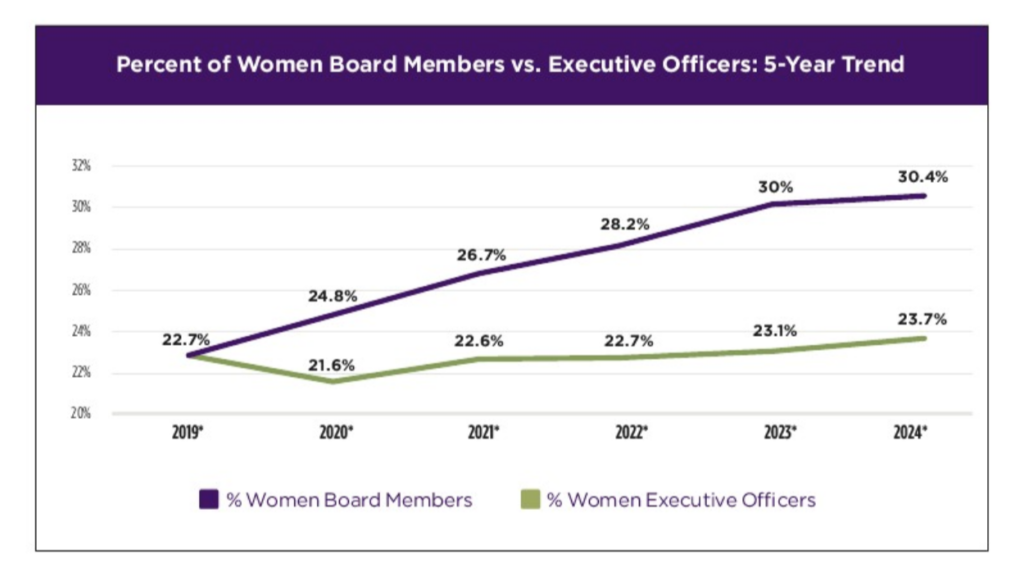
Source: 2024 Minnesota Census of Women in Corporate Leadership
It’s not just Minnesota; the report says this small gain reflects a national trend.
In fact, Minnesota’s figure barely edges out the average, if you’re measuring with the Russell 3000, according to the Census. That index includes large and midsize companies, aiming to represent the entire U.S. stock market. Russell set the percentage of women on boards at 30%.
But compared to the S&P 500, Minnesota companies lag. That index counted women in 34% of board positions. Minnesota’s 13 Fortunate 500 companies fall “disappointingly behind,” too—with a state average of 35%, versus 43% among all Fortune 500s.
As for women in executive offices? They lost ground into new lows, per the Census. Last year, the number of women holding C-suite titles dropped to 25. That’s a loss of 14 over the prior year. The report defines C-suite role specifically as CEOs, enterprise-wise presidents, COOs, CFOs, or CIOs. In total, women comprised 23.7% of executive officers at the 72 companies surveyed by the Census. That’s an increase of just 0.6% over the prior year.
For the nation, McKinsey reported 1% growth in the number of women in C-suite roles in 2024. “It’s unclear why women in Minnesota have lost ground,” the report states, “except to mention that the entire 2024 Census shows little to no progress for women amid shrinking commits to diversity and an atmosphere where affirmative action is likely to be challenged.”
The report also directs attention to BIPOC women directors, where it sees incremental gains amid a widespread dropping of DEI commitments. While U.S. Census data show that about 19% of the U.S. population identifies as women who are Black, Indigenous, or people of color, just 8% of board seats in the Russell 3000 are held by BIPOC women. In this year’s Census, BIPOC women exceeded this benchmark by 0.5 points, the report states, “a slightly favorable difference.” (Gains could have come via losses in white men and white women, analysis suggests.)
Minnesota’s growth rate of BIPOC women directors has slowed especially compared to 2021 and 2022. Those years, DEI efforts “peaked” after the murder of George Floyd.
Boards of directors are particularly important, the report states, because of their “unique power” to advocate for women’s progress, while women CEOs launch diversity action planning through the company’s hierarchy.
In this regard, research has revealed the “power of three,” the report says. That’s the “critical mass” of women in board membership needed “for women’s voices to be heard and to affect policy to improve corporate performance,” as per four studies going back to 2008. The Census also encourages shareholders at open-forum meetings to challenge leaders on gender-equity achievements.
“Systems change needs to be prioritized rather than focusing on women as individuals who need molding,” the report suggests. “Men and women alike are strong, capable workers with notable track records. Taking the bias out of systems such as recruiting and promotion policies will refill the pipeline and open opportunities for women’s advancement.”
At TCB’s Women in Leadership event on April 15, Fittipaldi and Pasricha will present their findings from the report, including a look at the 19 “Honor Roll” companies who perform above the state average for women executives and board directors.