

Minneapolis Magnet Company Attracts Funding from Big Automakers
This past Wednesday, Northeast Minneapolis-based Niron Magnetics announced that it is receiving $33 million in new funding. The big drivers of the new round were the venture capital units of automakers GM and Stellantis. Also chipping in were the University of Minnesota and the Prior Lake-based Shakopee Mdewakanton Sioux Community (SMSC), both of which contributed earlier funding to Niron.
What’s the attraction? It’s Niron’s permanent magnet technology, which uses iron nitride derived from rust as an alternative to rare-earth elements.
Permanent magnets are used in automobiles to help power vehicles’ audio systems, fuel pumps, and other components. They’re also a crucial component in drivetrains for electric vehicles (EVs), which are increasingly in demand.
Current permanent magnet designs require rare-earth metal alloys such as cerium (the most common), lanthanum, and neodymium. These rare-earth materials are sourced primarily from China, which currently controls 95% of the global market. Besides a near-monopoly in supply, production of rare-earth alloys generates high levels of toxic waste and pollution.
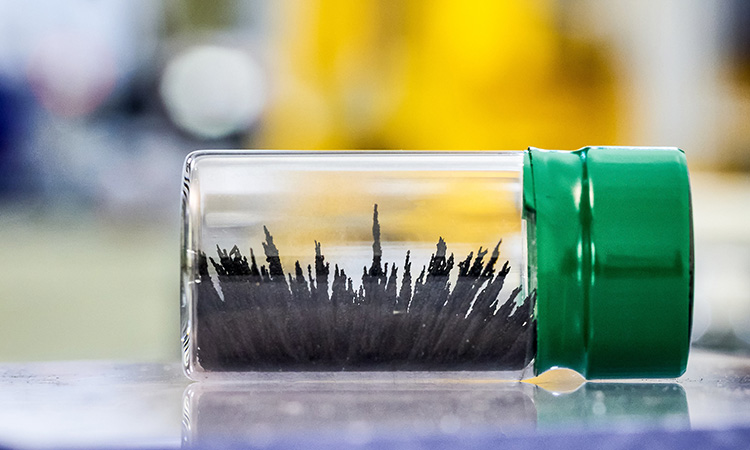
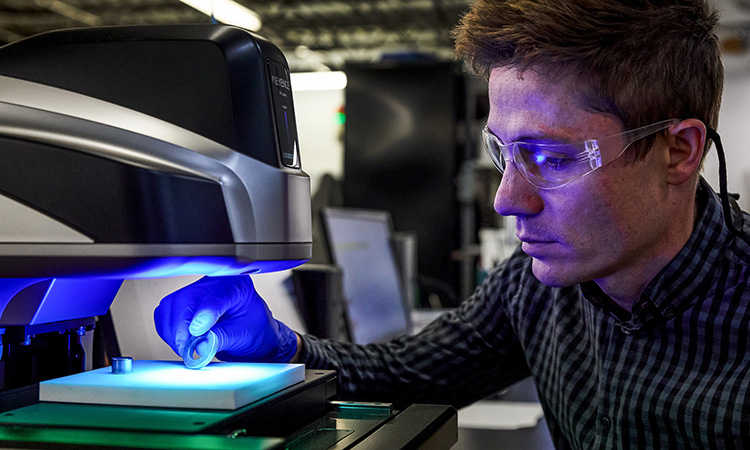
Photo by Sara Rubinstein for General Motors
Niron is offering a made-in-the-USA solution. Instead of rare earths, Clean Earth Magnets use iron nitride, a material developed at the University of Minnesota under the leadership of electrical engineering professor Jian-Ping Wang. Wang launched Niron Magnetics in 2014 to produce these iron nitride-based permanent magnets. In addition to his teaching and research work at the U of M, Wang serves as Niron’s chief scientific officer.
According to Tom Grainger, the company’s senior director of its commercial team, iron nitride is derived from iron oxide, more familiarly known as rust. Niron sources iron oxide and precursor materials from a variety of Minnesota suppliers, including iron and steel recyclers. The company believes that its alternative to rare-earth magnets can enhance vehicle performance while being more environmentally friendly to produce.
Supporters seem to agree. Last November, the U.S. Department of Energy awarded Niron $17.5 million to support the development of its permanent magnet prototypes. And, in addition to its investment news on Wednesday, GM announced that it’s partnering with Niron to develop iron nitride magnet technology for the automaker’s EVs.
While GM, Volvo, the federal government, and Stellantis are the big names, Niron’s most intriguing investor is the Shakopee Mdewakanton Sioux Community (SMSC). The tribal community was one of the first investors in Niron Magnetics, putting in $4 million in 2016. It contributed $5 million to the most recent funding package. While the tribe has actively invested in companies and in development projects such as the JW Marriott Hotel at the Mall of America, Niron Magnetics is unusual in that it’s a passive investment.
According to Thad Hellman, the SMSC’s economic development administrator, the tribe got wind of Niron through a community member who serves on the board of Discovery Capital, a seed-stage investment program for U of M startups. Tribal leaders saw that the company “could solve a pretty significant problem,” Hellman says. “Additionally, they had an environmentally friendly technology, and that aligns well with the tribe’s values around being a good steward of the earth.” What’s more, “the fact that it’s local” also appealed to SMSC leadership—as did the possibility of a strong future return on investment.
Niron Magnetics will use the new funding to expand its production facilities and develop sales and marketing capacity for the Clean Earth Magnet. Grainger says that the company has already started constructing additional space at its Northeast Minneapolis location. Whatever it ends up, Niron Magnetics has plenty of fuel for the road ahead.