

Why Is There Heavy Industry on One of the Most Upscale Parts of the Riverfront?
It seems like a relic from Minneapolis’ past. Stretching nearly three blocks along Second Street Southeast, astride some of the city’s priciest residential riverfront real estate, sits an imposing industrial building. The 165,000-square-foot structure, which dates back to 1900, houses the Minneapolis operations of Pennsylvania-based PTC Steel, a specialty tubing fabricator.
As the Minneapolis riverfront turned to the three R’s—residential, recreation, and retail—this multi-block stretch remains as it was. As Graco and other industrial users head for the suburbs, why does this high-profile plant remain? The answer involves some very modern factors, including industry consolidation, private equity, and logistics.
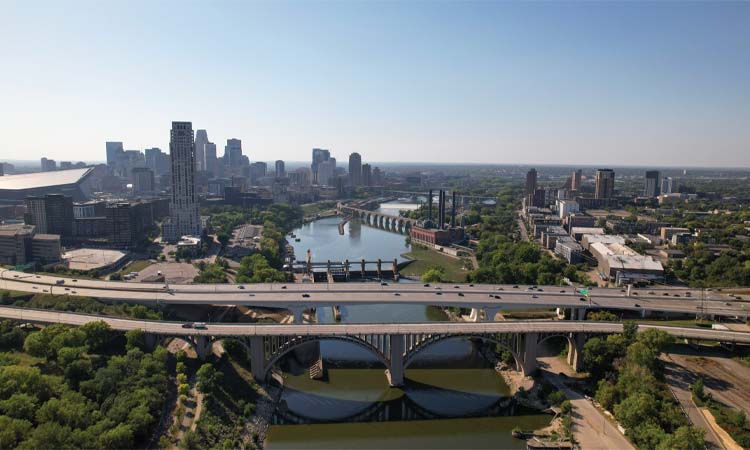
Not so long ago, the facility wouldn’t have looked so out of place—the riverfront was mostly industrial, because rivers move goods. Today, its nearby neighbors are shiny residential structures with “historical” names like Flour Sack Flats, Mill and Main, and Stone Arch Apartments.
In 2021, PTC acquired the facility’s owner, Metal-Matic, which manufactured carbon steel tubing for numerous industries. Metal-Matic opened in 1951 in North Minneapolis. In 1964, with business booming, it bought the Second Street plant from Pittsburgh-based metal fabricator American Bridge.
PTC’s history began in 1924, when it was founded as Pittsburgh Tube. The company flourished for decades, but in 2009 it filed for bankruptcy. Connecticut-based Black Diamond Capital Management purchased PTC Steel’s assets for $142 million. Black Diamond’s access to capital positioned PTC to acquire Metal-Matic, whose North location was closed.
Surely the joggers and patio cocktailers a block away wonder why a steel mill remains among the lifestyle businesses that make up the riverfront.
Meanwhile, PTC’s “new” neighborhood has experienced rapid change. In 2006, the city’s Community Planning and Economic Development Department (CPED) conducted an industrial land use study that determined PTC’s plant can continue to remain an industrial production use, says Jim Voll, a CPED planning manager.
Surely the joggers and patio cocktailers a block away wonder why a steel mill (and a grain elevator) remain among the lifestyle businesses that make up the riverfront, where workers eke by on minimum wages. The comparatively prosaic PTC evokes an era when industry was (and remains) living-wage work for people with only a high school diploma.
Read more from this issue
For now, residential and industrial coexist. “Believe me, if [a neighborhood issue] rises to a certain level, the first call people make is to me,” says Minneapolis City Council member Michael Rainville, who represents the district. But the types of issues he’s heard about tend to involve little more than a truck double-parked in the street.
In any case, Rainville doesn’t believe PTC is going anywhere. It’s got great freeway access, a well-funded owner, and workers who take home better-than-barista paychecks. So it’s likely that this still-productive example of Minneapolis’ industrial history will remain a neighbor for some time.