

CEOs Want a Bigger Role in Shaping Minnesota’s Economy
Richard Davis retired as CEO of U.S. Bancorp in 2017, but his name surfaced at a Minnesota Business Partnership event Thursday because he was a giant in serving Minnesota beyond his C-suite job.
Davis was an advocate for early childhood education and summer jobs for disadvantaged teens. He bolstered numerous cultural institutions, from the Minnesota Orchestra to the Guthrie Theater. Along with former Ecolab CEO Doug Baker and former Carlson CEO Marilyn Carlson Nelson, Davis said yes to Gov. Mark Dayton when he asked the three businesspeople to lead the effort to land a Super Bowl in Minnesota.
That’s just a sampling of the ways Davis was involved in multi-sector efforts to improve Minnesota’s quality of life. In 2026, Davis serves in the important role of chair of the Mayo Clinic board of trustees.
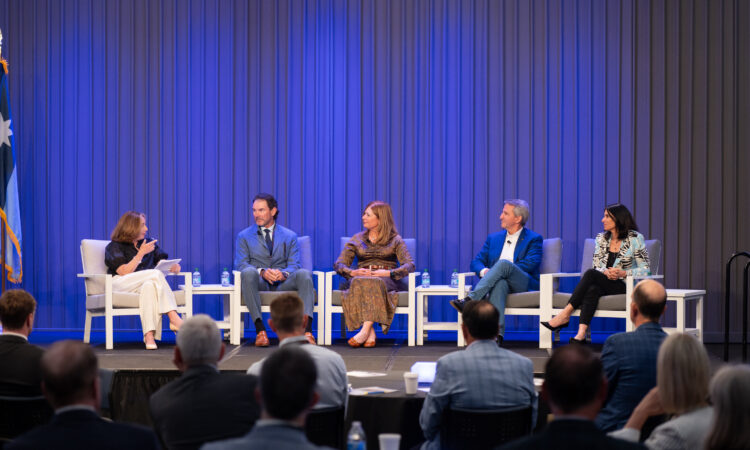
Russ Becker, CEO of APi Group, uttered the name of Davis during a panel discussion about the roles that CEOs play beyond their jobs of leading large corporations. Gathered at Best Buy headquarters in Richfield, the business leaders discussed competition and workforce challenges, recent poll results about Minnesota’s brand, and how Minnesota Business Partnership CEOs need to lead on several fronts to bolster Minnesota’s economy.
Becker, an Iron Ranger from Virginia, Minnesota, is a civil engineer who became CEO of APi Group in 2004. “When I was a younger CEO, Richard Davis was leading U.S. Bank, Doug Baker was leading Ecolab, and Dave MacLennan was leading Cargill,” Becker said to the assembled business leaders.
“For me, they were role models on how to be community advocates and for helping shape what our community looks like,” Becker said. “I look up to them and I aspire to that [type of leadership],” he said. “I think that we all can learn from each other, and hope to follow in those folks’ footsteps.”
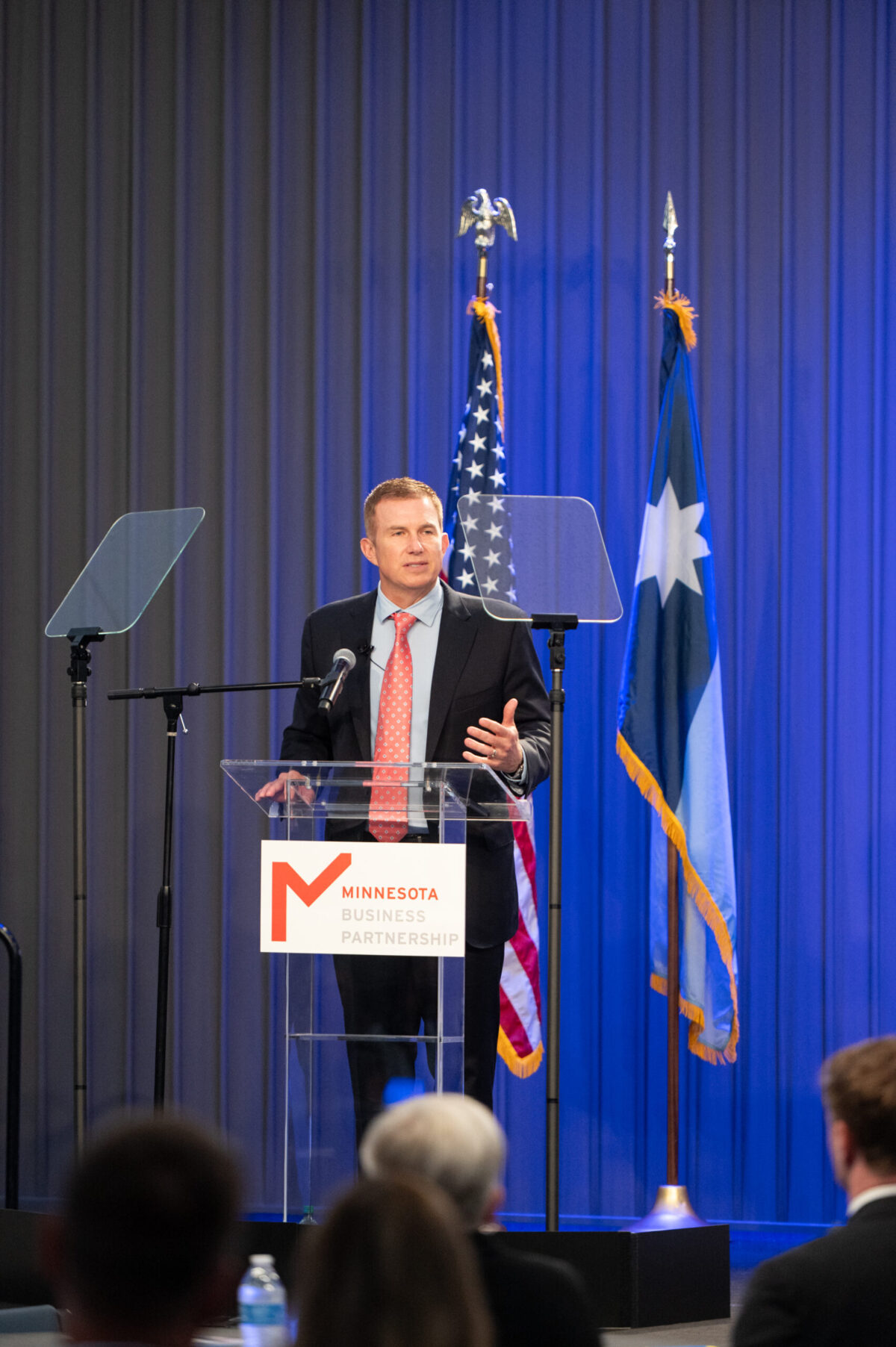
Medtronic CEO Geoff Martha, who chairs the Minnesota Business Partnership, followed up on Becker’s comments when issuing a call to action at the conclusion of Thursday’s event. Acknowledging that Davis, Baker, and MacLennan were “pillars” in the Twin Cities during their CEO tenures, he said that several major CEO leaders retired within a few years of each other.
“So we need a new generation that’s in this room,” Martha said. “That’s us, to step up and take those [leadership] reins.”
Doing business in a ‘more competitive’ world
As a business association, Martha emphasized that it needs to address three priorities. He defined them as nourishing and leveraging Minnesota’s existing economic strengths, reshaping government policy to create a more business-friendly environment, and building a strong foundation by “bringing CEOs and leaders together to strengthen our collective influence.”
Martha didn’t detail a specific legislative agenda. But he made a blunt point that CEOs cannot sit back and simply let others speak to the new governor and state lawmakers who’ll be elected in November.
Martha lauded a new Partnership legislative visit program, because he said it “started to show legislators an inside view of companies who have major operations here.” The net effect of that program, he said, is “you’re helping reinforce why Minnesota must remain a strong place to do business.”
He made the case that CEOs need to expand their engagement on government policy matters. “This work cannot be done only with an association staff like an MBP or our [company] government affairs teams,” Martha said. “It really needs your personal direct leadership, people from in this room.”
Martha cited anecdotal information and survey data from Morning Consult to support his argument that competition among businesses has intensified. In addition to the competition for customers, he noted how U.S. states and foreign countries are continually trying to lure Minnesota-based companies to relocate their headquarters or expand outside the state.
“The game has changed,” Martha said. “All of us compete on a national level. Most compete on a global level, and it is just flat out more competitive, more dynamic.”
The business competition issue was discussed at the MBP event by a four-person panel that consisted of Becker, Ecolab CEO Christophe Beck, U.S. Bancorp CEO Gunjan Kedia, and nVent CEO Beth Wozniak.
“Large companies will come here [to Minnesota] if it’s an environment that they can see that they can grow their companies,” Wozniak said. “Or, we will grow new companies here because they’ve started from some source of innovation, and they see that the conditions are right for them.”
But Wozniak emphasized that companies need “business and tax policy that allows us to compete,” otherwise Minnesota will be at a “disadvantage” for retaining and attracting business investments and jobs.
Kedia observed how competition dynamics are playing out on a national level. “There are lessons to be learned from where headquarters are moving, and the value proposition is very strong,” said the U.S. Bancorp CEO.
“A lot of the movement is going to places that make it easy to build a building, open a plant, hire people. You don’t have labor laws that are difficult. You don’t have a judiciary system that always rules against you,” Kedia said.
She referred to recent travel to Dallas. “You see massive complexes of companies that are actually headquartered in New York and California, but more and more of their [employees] are there [in Texas],” she said.
Ecolab’s Beck said it’s imperative to grow the economic pie in Minnesota, which begins with support for existing businesses that play a vital role in the state’s economic health. A shrinking pie “is the most frustrating way and the least inspiring way to drive the future of the state,” Beck said.
If more Minnesota-based businesses locate their expansion projects within the state’s borders, that will grow the economy, Beck said.
“At the end of the day, winners follow winners, and no one follows losers,” Beck said. “That’s true for companies. This is true for cities.” He supports a business climate that offers “an opportunity to win,” which he said expands the economy and generates the tax dollars needed to support an excellent public school system and other public goods.
“Christophe talked about people follow winners,” Martha said. “Well, it’s harder to win.”
Martha noted data from Morning Consult surveys that were conducted to give the Minnesota Business Partnership some reliable and current information about the state’s strengths and weaknesses.
One thousand Minnesotans were surveyed between Nov. 10 and Dec. 1, and more recently 1,000 Minnesotans were surveyed between June 8-15. The two waves of surveying occurred because Minnesota was in the national media spotlight over the winter for Operation Metro Surge immigration actions, extensive fraud in government programs, and the decision by Gov. Tim Walz to drop out of the governor’s race.
Morning Consult also surveyed 2,200 people on a national level in June. The business leaders wanted to learn more about the reputation and perceptions of Minnesota among Americans. In a slide presentation, the polling firm reported: “Minnesota gets little reputational credit for its companies: most of the country can’t identify them as Minnesotan, though doing so makes them view the company more favorably.”
Americans polled were asked: Were you aware these companies are headquartered in Minnesota?
Target was recognized as a Minnesota-based company by 27%, which was the highest awareness number. About one-fifth knew that Best Buy (19%), General Mills (19%), Mayo Clinic (18%), and Land O’Lakes (18%), were Minnesota companies. Ten other companies were listed, and those recognizing them as Minnesota companies ranged from 5% to 15%.
In his remarks, Martha highlighted some of the findings about state residents. “Minnesotans still rate the Twin Cities as a great place to live, but perceptions have slipped,” Martha said. “Views of the economy are essentially flat, and views of the state’s overall direction have gotten worse.”
He said a particular set of numbers caught his attention. “Nearly four out of five residents expect to still be living in Minnesota in five years,” Martha said. “That sounds great, but nearly half say that they would leave for the right job opportunities.”
He warned against getting comfortable with some advantages that Minnesota has, including a high percentage of professionals with bachelor’s and advanced degrees.
Other U.S. states and world regions “are making enticing offers by investing in talent, in infrastructure, in innovation, in economic incentives,” Martha said. “Families want assurances that they can build wealth and see a future here.”
When should the business community speak publicly?
When and how businesses use their individual and collective voices was a major topic of discussion at the Minnesota Business Partnership gathering.
One of the harsh realities of the Morning Consult data was that only 31% of Americans surveyed had ever visited Minnesota. “About half the country heard a lot or some about federal immigration enforcement in Minnesota, with awareness highest among older Americans,” Morning Consult reported.
The Partnership CEOs were interested in this data because they want to attract business investment and workers to Minnesota.
“We always want to be quietly competent without actually making the noise,” Kedia observed. “Maybe we should be a little bit louder.”
Beck had a humorous response to the news that Minnesota lacks a strong brand identity on a national basis. “It’s a great problem to have. It’s better than to be really bad and really known,” he said. “We don’t talk much. We do things. We deliver. We try to help each other. This is who we are here in Minnesota.”
But the CEOs seriously discussed a business community letter that all four signed in January following the killing of citizen Alex Pretti by federal immigration agents in Minneapolis during Operation Metro Surge.
The Jan. 25 letter was released the day after the Pretti killing, which was preceded by an Immigration and Customs Enforcement (ICE) agent shooting and killing citizen Renee Good on Jan. 7 in Minneapolis. “We are calling for an immediate de-escalation of tensions and for state, local, and federal officials to work together to find real solutions,” the business leaders said in the letter.
On the day it was released, the letter was signed by leaders of 64 businesses and other organizations. “I felt just really proud of the give-and-take and the amount of effort that [Christophe Beck] put and Geoff [Martha] put into just sort of corralling all of us,” Kedia said. She was texting with fellow CEOs over the letter’s language from a board meeting in Florida.
Beck, who chairs Greater MSP, said that most people wish the excesses of Operation Metro Surge “never happened for sure.” But he emphasized the importance of the business community uniting to try to bring an end to the surge of thousands of federal agents across Minnesota. “We all came together,” Beck said. “It didn’t matter from which company we were [from].”
He said people around the world admired Minnesotans for “fighting for their freedom, for their choices, what was right for the community and the families.”
Wozniak said there are multiple lessons to be learned from how businesses and Minnesotans responded to the mass deployment of federal agents to the state.
“We care about our employees,” she said, which is reflected in the culture that’s been built at the eight-year-old company. In business, she said, there “is a competitive advantage when you have employees who care about each other, about customers,” because that’s the kind of environment people want to work in.
As business CEOs, Wozniak said, “it’s not just about growing our companies, but it’s ensuring that the community around us is also strong.”
Becker was philosophical about the business community letter and the challenges that people and companies face. “Our society, and our world today, needs a little more grace,” Becker said. He and company leaders want to speak out more “to be a positive influence” in communities where they do business.
“We’re going to use our voice, and we’re going to let our values guide us,” Becker said, in characterizing the business community letter. “We’re going to do what’s best for our community.”
Going forward, Becker said, he and fellow executives feel “more empowered to use our voice.”