

Minnesota Craft Beer’s Next Round
When the news broke last week that St. Paul-based Summit Brewing was facing foreclosure because it allegedly owes BMO Bank more than $8.2 million, it was yet another example of a local craft brewery facing financial hardship.
Although Summit faces a challenging future, its founder Mark Stutrud remains confident he’ll keep the business open because its shareholders are interested in infusing additional equity to pay off its debt owed to BMO Bank, he tells Axios Twin Cities.
There’s been more industry news this summer. Bauhaus Brew Labs in Northeast Minneapolis closed in June due to financial struggles before reopening under ownership of ABV Technology. ABV is a manufacturer of equipment and services that remove alcohol from craft beer, wine, and cider. The business has served 120 Twin Cities breweries and wineries for nine years and has 21 employees.
ABV’s technology gives them the ability to vacuum out the alcohol from a beer. It can take a 5-ounce glass of beer, adjust the drink to the customer’s requested ABV level, and use filtered water to create two separate 5-ounce glasses of liquid. The liquid in one glass is clear and contains the alcohol. The other glass has all of the beer’s original aromas, sugars, and tannins, but is non-alcoholic (NA).
ABV’s CEO Ben Jordan believes the company’s product can help give it a path forward.
Glass half full: ABV Technology’s gamble
People are looking for something new, says Jordan, and he believes his company’s technology could be the solution.
“Beer and tap rooms were something that was popular 15 years ago. It’s not in the forefront of peoples’ minds when they ask where you want to go out anymore,” he adds.
Part of what Jordan believes needs to change is offering a more diversified menu outside of craft beer. Jordan says non-alcoholic and low-alcohol beer, canned seltzers, wine, and THC drinks are all generating more sales now than in years past at Bauhaus.
Jordan recently facelifted Bauhaus’ drink menu to appeal to the industry’s evolving customer base. He believes it now has the right business model on tap.
RELATED: From Church to Brewery: What’s Next for the Mount Olivet Chapel?
It costs ABV Technology $100 to make a barrel of craft beer. For NA drinks, it only costs $1.50 – $3 more. Plus, ABV’s tech yields twice the product after its vacuuming process. ABV also uses that clear, alcoholic liquid as “a base” for its cocktail beverages. Importantly, it can also operate under its previous liquor license because each cocktail still contains elements of a beer.
It’s an operation you won’t find anywhere else. That’s why Jordan believes he might have a solution to help other struggling craft breweries survive this moment.

Comedies, merch, and sex appeal
Bob Galligan, director of government and industry relations at the Minnesota Craft Brewers Guild, thinks the industry should focus on the role craft breweries play as community gathering spaces, “because there is a loneliness epidemic going on. This is what coffee shops have gotten right, and breweries should look at that as the formula.”
Galligan believes more craft breweries will begin to offer events like comedy and concerts to give these spaces more flair and to simply get more people in the doors. Minneapolis-based Sisyphus Brewing and Indeed Brewing are already ahead of the curve on this. Sisyphus has hosted comedies for over 10 years and even has an 88-seat comedy club next to its taproom.
Above all, Jordan says taprooms need to be transformed, including his own. Cavernous interiors with high-top plastic barstools set on concrete floors used to cut it, but today, they may repel parts of the customer base that they need to attract.
There’s still only so much craft breweries can do. And when there are global and local political issues mixed in, it can create a “perfect storm,” Jordan admits.
Glass half empty
What has put the craft brewery industry in its current position?
According to the Brewers Association, 2025 was the second consecutive year in which U.S. brewery closings outpaced openings (481 breweries closed while 300 opened.) And in Minnesota, more craft breweries closed than opened last year, Galligan says.
He adds this trend is attributable to younger generations drinking less alcohol, input costs rising, and the customer’s desire to drink something new—like THC beverages.
The industry has seen these ups and downs before though.
In 1990, there were only 200 or so craft breweries in the U.S. By the end of the decade, the market exploded by adding nearly 1,000. But by the turn of the millennium, over 100 closed because of oversaturation and mediocre product, according to Tasting Table.
Then in the 2010s, the industry exploded. The number of breweries more than quadrupled to 8,000 over the decade, and craft volume nearly tripled to 27 million barrels, according to Forbes. In 2024, the U.S. had its most breweries ever before losing hundreds last year.
Is what’s happening out of the craft brewery industry’s control?
A long-running and well-documented trend has been a decrease in alcohol and beer consumption among people that drink. That trend dates back to the Covid-19 pandemic, Galligan says, when people had time to reflect on their eating and drinking habits and when socialization declined.
“A lot of people realized that being at home with a bottle of bourbon all day was not beneficial to their health,” he says. “They have taken second looks and stepped away for a bit.”
Issues like tariffs and war also play a major role in the health of craft breweries.
The U.S. and Canada’s tariff battle—along with warfare in the Middle East—have driven the cost of raw materials like aluminum needed for canning to a four-year high in 2026. That’s made it increasingly expensive to make beer.
“So, for the younger generation, they are going to go out to the bar, because they are not able to afford their local craft producer,” Galligan explains. “They’re going to turn to a cheaper option or ready-to-drink cocktail that gives them more bang for their buck.
In Minneapolis, Jordan says regional events have taken an additional toll on the craft brewery industry. The murder of George Floyd in 2020 and Operation Metro Surge earlier this year resulted in less people wanting to come to the Twin Cities, he adds.
But the industry can’t predict when ICE and Border Patrol will be in the streets—just like it couldn’t see the Covid-19 pandemic coming.
THC production saved the industry—but now looks in peril
Omar Ansari, founder and president of Minneapolis-based Surly Brewing, has long been an innovator in the craft brewing industry. Surly launched one of the first destination breweries in the Twin Cities and has pioneered concerts and other initiatives to try to stay ahead.
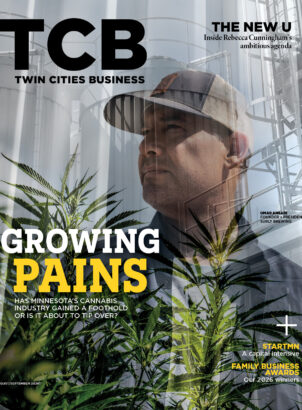
As people consume less beer, Ansari shifted production from 100% beer to about 60% hemp THC beverages, TCB associate editor Erik Tormoen wrote in his story about the struggles of the local cannabis industry. THC production soared after that at Surly, in part through their partnerships with national brands who paid them to produce their products.
That’s why Galligan has been an advocate for hemp-derived THC production at breweries, and several local players were able to keep the doors open by embracing the new products.

“I think a lot of people are taking a look in their mirror and asking themselves, ‘what makes us different from the brewery down the road?’” he says.
On Dec. 11, Surly will face a crisis as a result of national THC legislation that will ban sales of hemp-derived products with more than 0.4 milligrams of THC per container—which effectively covers all THC products produced by breweries. The U.S. Hemp Roundtable advocacy group reports the ban will erase 95% of the United States’ $28.4 billion hemp industry and wipe out more than 300,000 jobs, many of which are located here.
Bauhaus Brew Labs has produced THC/CBD seltzers for three years—long before ABV Technology bought and reopened the business in August. Jordan says he’ll continue to offer those drinks as long as the government will allow to attract younger generations who are more likely to order them.
Last call
Jordan is optimistic the industry will recover. “Beer is not going anywhere,” he says. “Things are going to become much more nuanced in the short term.”
Galligan adds, “the industry needs to realize we have to step back and look at what it needs to be different. People tend to silo themselves when times are tough, that is not the way through. I don’t think that there is any way through except together. No one has ever succeeded in isolationism.”
Whether it’s offering new beverages, hosting speed dating events, or selling merchandise, the consensus is that the industry is evolving—just like any other.
“A taproom isn’t your place unless it’s been reimagined,” Jordan says.