


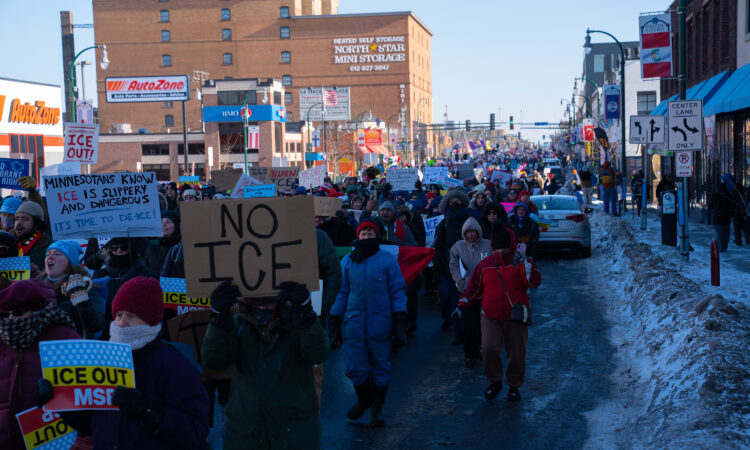
Report: ICE Surge Likely Cost Minnesota 4,600 Hospitality Jobs, $71M in Wages
Minnesota’s leisure and hospitality sector likely lost 4,600 jobs and 3.8 million working hours because of Operation Metro Surge, totaling $71 million in lost wages.
That’s according to an analysis released Tuesday by North Star Policy Action, a progressive, union-backed think tank based in Minnesota. By creating a “control” version of the state, against which to compare Minnesota’s latest employment data, the institute has attempted to put hard numbers to stories earlier this year about restaurants and hotels struggling during the federal immigration crackdown, which began in December and stretched at least through mid-February.
“Reporting on Operation Metro Surge in Minnesota has focused on economic harm to several industries with large immigrant worker populations, including construction, child care, and agriculture,” North Star’s report states. “But one industry has appeared particularly hard hit: restaurants.”
The institute concludes that the federal immigration crackdown most substantially and consistently hurt Minnesota’s leisure and hospitality sector, with recovery remaining slow through March 2026. (North Star notes it ran similar analyses for other industries.)
The institute reports a likely loss of 3.8 million total working hours, 2.6 million of them lost by employees who kept their jobs. This inactivity would have resulted “as demand and labor supply dried up or as [workers] stayed home due to fear.” The remaining 1.2 million hours would represent the 4,600 lost jobs.
Minnesota’s total job losses the first three months of the year amounted to a 2.1% decline, the largest in the nation over that period, North Star states. The United States gained 38,000 leisure and hospitality jobs those same months, a 0.2% increase.
North Star concludes that substantively more economic harm came from workers losing hours on the job than from workers losing jobs outright. In total, workers would have lost $71 million in wages January through March. Leisure and hospitality makes up 8.7% of the state workforce, the report states, and is among the lowest-paid sectors, “meaning the lost wages are likely to be relatively small in dollar terms even when a large share of the workforce is affected.”
In January, average weekly hours across the private sector reached their lowest level in Minnesota since at least 2007, North Star adds. Specifically in the leisure and hospitality industry, January marked the lowest average for hours worked since December 2022. The last time Minnesotans in the sector worked fewer hours was April 2020, as the first Covid wave crested.
Methodology
To isolate Operation Metro Surge’s impact, North Star attempted to extrapolate Minnesota’s employment statistics in early 2026 absent the occupation of Department of Homeland Security personnel.
This involved creating a “synthetic” Minnesota. North Star reports it devised this hypothetical, unoccupied version of the state from the average of other states’ employment statistics, weighted to align with how Minnesota was trending years and months before the surge. (That data came from the U.S. Bureau of Labor Statistics’ national monthly employer survey.)
North Star found that the gap between the real Minnesota and the synthetic one widened after December 2025, implying an externality: the surge. The report notes “there were no other large [simultaneous] shocks to hit Minnesota.”
Minnesota lost a total of 5,800 jobs in leisure and hospitality between December 2025 and March 2026, and North Star’s modeling suggests the surge resulted in roughly 4,600 of those, meaning the state would have lost about 1,200 jobs without the surge.
The state’s private sector as a whole, meanwhile, appears to have felt no major impact. North Star ran models examining changes in jobs and average weekly hours for “the entirety of Minnesota’s private sector.” It found a negative impact from Operation Metro Surge but “a proportionally smaller reduction in jobs and hours that did not reach conventional levels of statistical significance.” The private sector’s evenness appears to reflect the surge’s concentration in urban areas and focus on sectors like leisure and hospitality.
Read the full report here.