

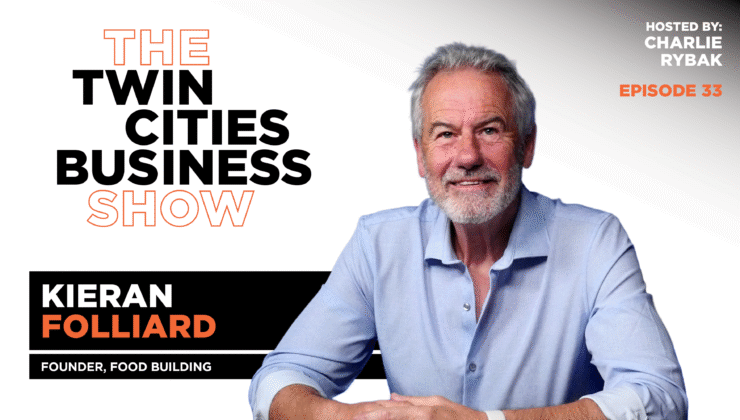
Kieran Folliard on Irish Pubs, Whiskey Wars, and Building the Food Building
By
Charlie Rybak
Air Date:
Wednesday November 4, 2026
Kieran Folliard has lived many colorful lives. His journey has taken him from County Mayo in Ireland to Saudi Arabia to the early days of Nicollet Mall’s 1990s renaissance to restoring a run-down building in Northeast Minneapolis.
Along the way, he started two pubs (Kieran’s and The Local), two whiskey companies (2 Gingers and Red Locks), grew an international dairy brand, built a space in the Food Building that accelerated the local food scene, and gave Diane’s Place a home.
In this interview from The Twin Cities Business Show, Kieran shares his thoughts on shifts in drinking culture, going head-to-head with Jameson after being their biggest customer, why we should all care more about where our food comes from, and why you need to think about the kind of life you want to lead before diving headfirst into starting a business.
In this episode:
- 0:00 Intro
- 0:35 Irish vs. American drinking culture
- 2:50 Working in Saudi Arabia and launching Almarai
- 5:34 Why business is half art
- 7:00 Moving to Minnesota and starting Kieran’s Irish Pub
- 9:03 From Molly Malone’s to Kieran’s
- 10:41 Opening The Local
- 14:56 Becoming the world’s top Jameson account
- 16:31 Inventing the Big Ginger
- 18:04 Launching 2 Gingers Irish Whiskey
- 20:41 The legal fight with Jameson
- 23:48 Beam buys 2 Gingers
- 25:17 Buying the Food Building
- 25:54 Why Irish whiskey faded after Prohibition
- 29:46 The idea behind the Food Building
- 32:57 Paying farmers more and stone milling flour
- 36:20 Building Baker’s Field Flour & Bread
- 40:40 Breaking even after 10 years
- 43:13 Getting back into whiskey with Red Locks
- 45:54 The whiskey industry downturn
- 46:40 How COVID changed our habits
- 48:41 How downtown Minneapolis keeps shifting
- 49:43 Are people socializing less?
- 51:37 Diane’s Place
- 55:12 3Leche botanical beverages
- 56:03 How to visit the Food Building
- 57:26 Mayo’s All-Ireland win and the curse
- 1:06:05 Is this the Vikings’ year?
- 1:08:05 Kieran’s advice for entrepreneurs
What do you think are the biggest differences between Irish drinking culture and American drinking culture?
KF: If you had asked me that question five years ago, I’d have given you one answer, and today I give you a different answer. First, I would say the fact that alcohol is legal at 18 in Ireland. And of course Ireland has a reputation for drinking and for being fun. In fact, we were just named the friendliest people in Europe by Condé Nast or one of those big companies. The culture of drinking—the pub, the public house, the egalitarian gathering spot where the community would go—was very, very prevalent. I mean, when I was growing up—and I was born [in] 1955, so I mean in the ’60s, ’70s, and ’80s—there were 52 pub licenses in my village of Ballyhaunis in County Mayo when I was a kid. The hardware store had a license to sell, the drapery store had one. Then there were legit pubs or whatever, and the people lived overhead. Today there are four pubs in my home village of Ballyhaunis, and two of them are for sale.
And so it has changed—you know, the advent of television, of course, and then also, I guess, off-licenses, liquor stores, etc., and also health awareness has changed it dramatically.
So all over the world, people are spending more time at home, drinking more, things like that?
KF: Yeah. I would say drinking less now, no question about that. In the U.S., there has been the advent of THC. What’s happening in this country around health awareness is exactly what’s happening, I would say, in Ireland as well today.
I want to dig into your story. You’ve had many interesting chapters, and I would love to start with what you were doing in Saudi Arabia.
KF: Yeah, I had a great opportunity to go out there. I saw an advertisement in the Irish Independent on a Sunday. This was a full half-page advertisement looking for four graduates to go work in Saudi Arabia for an Irish food company. Masstock was the name of it. The brand was Almarai. And I got turned down for it three times, and I kept telling them, “You’re making a mistake.” I really wanted to go there. I had all of these great romantic notions about Saudi Arabia and the desert and, you know, Arabian Nights and all of this. And eventually they said, “Fine.” I wore them down and they gave me the job.
And I went out there with three other guys from Ireland that I didn’t know, and we’re all still great friends to this day. One is retired and lives in Boston, one’s in Dublin, and one’s in Belfast. And we stay connected. They’re all retired because they’re smart. I’m the idiot that’s still going around trying to, I don’t know, do whatever.
So it was a dairy products business started by Alastair and Paddy McGuckian, two brothers [who] had a big farm in Northern Ireland, Massereene, outside of Belfast. And Alastair in particular was a very entrepreneurial character, and he was going to build these farms in the middle of the desert. They didn’t have full control of them, because the Saudis figured out after the Aramco debacles—the oil debacles in the ’30s and so forth—that any foreign companies, they had to own at least 51% of, and they were smart about that.
And these farms—you go through the desert, and all of a sudden you come across a square mile of sorghum grass 8 feet tall and center-pivot irrigation systems from Nebraska. The cows [were] flown in from California and Australia by the Flying Tigers, who are no longer around, and they were in air-conditioned housing. And we launched the brand Almarai, which today is probably the most successful indigenous brand in the Persian Gulf outside of the oil business. It’s a huge food company, gone way beyond the dairy business.
What did you learn in that job that you’ve carried through to your role in the Food Building today?
KF: No matter how daft or how crazy your ideas are, there’s always the opportunity to pursue it, with a lot of persistence required. And that you’re doing it more for the love of the idea than to look at it from a monetary standpoint, a financial standpoint. So is it the idea itself that really engages you and makes it interesting?
So it’s almost like you’re stuck between doing business and art to some degree, and that’s where the magic is?
KF: Yeah. And you may not be good at either one of them. And so you combine the two of them and you come up with a third thing. Maybe. I don’t know!
Then you arrive in Minnesota. Take me through your first couple years and starting Kieran’s.
KF: Yeah. 1987, April 16th. It was Holy Thursday, 1987. And people said, “How come you remember it was Holy Thursday?” Because on Good Friday I said, “This is a heathen country.” Because back then it was the only day of the year, Good Friday, the pubs were not allowed to open in Ireland. That has all changed now, but back then it was real. And obviously I was joking when I said that.
And I worked with Dennis Anderson at Encore. They did a lot of HR headhunting, HR services for startup companies. So I got to meet people like Scott Olson with Rollerblade, Bob Walker with Select Comfort, the Breathe Right guys. I mean, so many of them that we did work with, and that was kind of inspiring.
So I had these ideas—I mean, I really did want to work on my own. I had a lot of ideas. I had so many bloody ideas, but I really wasn’t technically very good. You know, I don’t have a strong science background, strong math background, etc. I had more of a humanities kind of background. And so, honestly, one day somebody asked me, they said, “Where do you go for a good Irish pub around [here]?” And I said, “Well, there are some good American Irish pubs.” You know, there was O’Gara’s at the time—long gone now—but McGovern’s, etc. And I thought, maybe I should start an Irish pub. And that was it. I mean, I literally just thought, “Okay, I’m going to do that. I think I can figure it out.” That was it.
So then you open a second one. Take us through that journey.
KF: Well, I had Molly Malone’s in a partnership with John Rimarcik, who owned—God rest him—the Monte Carlo, but he also owned a couple of buildings on Washington Avenue. And there was a closed restaurant there. It had been Waters. He and I, we didn’t exactly culturally see eye to eye, and so we parted after a year.
And there was a great character, Mike Meets, who used to run Towle Financial. He owned Towle Financial eventually. He used to come into Molly Malone’s. He says, “Well, there is a vacant space in the building I’m in, the Towle Building, over near City Hall.” And he said it used to be called the Irish Elephant, but it’s been closed for years. And the next day I went and saw it, and it was now owned by the lender, American Express. And I signed a lease for it within days and opened up Kieran’s, and, you know, that was March 16th, 1994.
And then you opened the Local a couple years later.
KF: Yeah. December of ’97.
Take us through that process of saying, “Well, I’ve opened one pub. It’s going well. Let’s do another.”
KF: Yeah. And I would say that that was more to do with, you know, my own nature, probably being a little bit restless, and about ideas. Kieran’s was really kind of a community effort. I mean, a lot of the people that worked with me, they were all artists. They did a lot of the paintings in the place and all the drawings. And so many other people were involved—people that worked with me and also did the physical design of the place. So it really was like a community center or a cultural center. I mean, we had theater in there. We had a satellite on the roof for carrying sports from Ireland, Gaelic football and rugby. And, you know, in fact, Keely Doyle, who works with you—her dad had photographs in the pub for me as well.
So it was that type of community. But by nature, I was probably not a routine person. The routine of doing the same kind of thing every day doesn’t suit me so well. So I started looking out [for something and] came across a building on Nicollet Mall, and in fact Susan Miller was the real estate person on it. And then through Dennis Anderson, I met a number of different people who got to invest in it. And the idea was we’re going to put this fabulous boutique hotel upstairs and this grand pub downstairs, and that it was going to be built so that it could be around for a hundred years or more. And we achieved that part of it.
Some great characters involved in that. God bless Nathan Stanley—did a lot of the woodwork on the back bar. And that was a great experience, and again, so many people were involved and supportive of it. And, you know, Dermot from O’Donovan’s—now, he was the original general manager there. And yeah, great, great characters. I mean, it was out of control, but whatever. It was super. It was busy, and we didn’t really have the systems and so forth in place. So the idea of the creation of things was really what appealed to me, just from an imagination standpoint.
So the part that you really love is creating new things that don’t exist?
KF: Yeah.
As you can see from the table around us, it seems like you’re pretty good at it.
KF: Well, I don’t know about that. I mean, if one of the universities did a business study on the whole thing, you wouldn’t be getting an eight out of 10 from a business strategy standpoint. Well, I shouldn’t say business strategy, but from a financial success standpoint, I don’t think you would. No.
But maybe there’s something in it. You talk about the art being a really important piece of it, and it seems like that’s kind of what drives you.
KF: Yeah, I would say that that is a big part of it. I haven’t really had a whole lot of interest in material things.
A couple years go by, and then you guys are selling so much Jameson that you get international recognition. Tell us how that whole part of your journey came about.
KF: Well, it kind of started with the Guinness area manager. [He] came one time—and this must have been around, I want to say, probably around 2007, maybe ’08, not 100% sure—and said, you know, “The Local here is the top-selling Jameson account in Minnesota.” And I said, “Well, who is it in the United States?” And he came back months later and said, “It’s you guys.” And he said, “Number two is MGM in Vegas.” And I think they had nine bars in the place or something like that.
And the Local is outselling all of them?
KF: All of them. And then [I] said, “Well, who is it in the world?” And it took him over a year to come back. And he said, “It’s the Local. You’re the number one Jameson account on-premise—not liquor store, on-premise—in the world.” And they brought the brass plaques. The brass plaques are in the terrazzo floor at the Local, and they are—so it was five years.
And a lot of it had to do with—you know, I still remember challenging the managers and the bartenders: What do we have to do to sell more Irish whiskey in the summer than we do in the winter? And somebody said, “Well, you need a cocktail.” And then somebody else said, “You know, this mixology stuff is coming on in the East Coast and the West Coast.” And somebody else said, “Well, you know what? I don’t think people are going to hang around in an Irish pub for 10 minutes and pay 12 bucks or 15, whatever it is, for a [cocktail].” Somebody else said it needs to be as fast and the same price as a beer. And that’s where the Big Ginger came up. Ginger ale, Irish whiskey, over ice, lemon and lime—ward off scurvy—and the same price as a beer.
So Tim Kenny is a patent lawyer in town and used to come in for lunch, and I sat with him one day, and I said, “What do we have to do to patent it?” And he said, “Well, it can’t be descriptive.” And there were other things, but that was the main thing. Can’t be about ginger. And so I said, “No, it’s about a red-headed Irish person. That’s the Big Ginger.” And he said, “That can be done.” So we had the Big Ginger and the Skinny Ginger, and we started to sell a lot more of it during the summer. I think it took years for it to surpass the winter sales on it. Good few years. That was it.
And then, you know, around 2010, Jameson, which is owned by Pernod Ricard, the French company—the second-largest liquor company in the world after Diageo, which of course, Diageo owns Guinness and Baileys and Johnnie Walker and blah, blah, blah—they put the price of Jameson up three times [in] 2010. And I said, “But we can’t put the prices up in the pub three times.” And then they said, “Well, this is it.” And [they] obviously built a very successful brand and all of those things.
And so I called up John Teeling, who I’d met in 1985. And John was a great character—is a great character—still in the whiskey business back at home in Ireland. And I said, “Here’s what we’re doing with Jameson in America. I want to come out with our own blend and our own brand of Irish whiskey.” And he said, “Well, come on over.” So I went over. His master distiller, Noel Sweeney, is from County Mayo, where I’m from. In fact, I saw him recently, just about six weeks ago. And we came up with 2 Gingers Irish Whiskey—[named for] my mother and my aunt. It was just going to be sold in the pubs. That was the whole idea. We still were going to sell every Irish whiskey that was available in the market, but this would be our featured [one] and the one that we promote and drive.
And it goes in the Big Ginger?
KF: And it goes [in] the Big [Ginger]. We changed, obviously, the patent to have it as Big 2 Gingers, and that’s the brand that owned the patent on it. And we launched on March 16th of 2011 in the pubs, and, you know, again, we were promoting it, and so it was the number one-selling one by about May. And I said to Henry and the other minority owners in the business, “You know what? You guys are going to buy me out and I’m going to take the whiskey on the road.” And we signed the papers on July 4th, 2011—Independence Day. And we launched on the market down at Surdyk’s the day before Thanksgiving of 2011. That was fun. We sold 65 cases that weekend. I was in there signing all the bottles. I mean, a lot of friends and supporters of the pubs over the years all came in. It was a party. It was good fun.
So in there you have two points of conflict with Jameson. You have the price increase, and then you end up in a legal fight with them. Can you talk a little bit about that from your perspective?
KF: You know, obviously they’re a huge company and obviously a very successful company. But we had the patent, and I was working in a liquor store up in Brooklyn Park, and I got a call from our head of sales, Liam Scott, who had a lot of history in the liquor distribution business, and [he] said that Jameson had just come out with Big Jameson Ginger and all of their POS and all of the stuff. And it was a national campaign that they were bringing out for St. Patrick’s Day in 2012. And I [was] like, okay, so they’re basically trying to put us out of business straight away. So I called Tim Kenny, and I said, “Right, Tim.” This was a Friday night. I said, “We’re going to sue them on Monday. Give me some advice.”
He talked me down off the cliff for a little bit and said, “Okay, let’s look at this.” And we took the week, basically, and then we did issue proceedings against them to say, basically, this is an infringement of our brand. And they had a big fancy law firm out in New York. I mean, when I say big fancy law firm, they were so effing arrogant and so forth. That really was a little bit of their downfall, because that just gets you all fired up. And so it was back and forth. It was in the newspapers. I mean, there were some liquor stores—friends that own liquor stores, supporters of myself and the brand—who actually said, “All right, we’re not going to bring Jameson in,” and so forth, which was a bold move, because it’s obviously the biggest-selling Irish whiskey.
And eventually, there was one Friday—and this would be maybe a month later—and I remember saying to them on the phone—I was out of my mind, ’cause you’re under a lot of pressure. It’s a startup business; you know, none of it is easy. And I said, “You know what?”—and their lawyers in New York were on the phone, and our guys were here, and I was on the phone—I said, “You know what? You’re French. You’ll eventually surrender.” And that was it. It got settled the following week, and we had to sign a piece of paper that said we had an amicable settlement. And then Tim and his firm threw an amicable settlement party, and I said at the party, “They didn’t say that we couldn’t say it with a smile.” So that was it, and it was all fine. I mean, it’s just—you know, really, it was good fun.
So then you’re out of the pubs. You’ve launched 2 Gingers. You’re through the lawsuit. But at this point, you’d already bought the Food Building, right?
KF: No.
What year did you buy the Food Building?
KF: Well, there’s 2000—and another thing happened in early 2012. I got a call from John Teeling, and he said, “I couldn’t tell you, but Beam”—Jim Beam, but basically Beam—had bought the distillery in Ireland.
Upstream, that was producing 2 Gingers?
KF: Correct. Cooley Distillery, that John had founded in 1987—actually the year I came to America. I think it was 1987. John was—yep, still is—a great character. He got his PhD at Harvard, 1973, I think it was, and his thesis was the demise of Irish whiskey in America after Prohibition, which of course is a great story in itself, and yeah, books have been written on it. And so he said, “I told them to be good to you.” And so, again, I won’t bore [you] with all of the ins and outs of it, but that December of 2012, Beam bought 2 Gingers, and they put me on a contract for five years to support the brand and the other brands that they had. Very good brands—Kilbeggan, Tyrconnell, Connemara, etc. And [I] enjoyed working with them. But, you know, then they got bought out by Suntory, the Japanese, and now it’s Suntory Holdings, I think, is what it is. And I did [that] based out of here.
But then I bought the Food Building. It was a building in Northeast Minneapolis, right on 14th and Marshall—there was no roof, no electricity, no plumbing, no nothing. A 31,000-square-foot building with extra parking and so forth, and it was really cheap. That’s where the problem started. Seriously, I’m not joking. I should have gone fishing. I’d be now in the west of Ireland, looking out to sea, saying I’m some sort of a genius, instead of being here a couple of blocks away from the Food Building saying, “Good God.”
I’m grateful you did it. Before we get too much into the Food Building, can we go back? I am so curious about the demise of Irish whiskey after Prohibition. Can you tell us a little bit about that?
KF: Yeah. Well, in the 1800s, Irish whiskey was by far and away the biggest-selling liquor brand in the world, or category in the world. And, you know, a lot of that had to do [with]—there were so many immigrants that left Ireland with the famine in 1847 through the early ’50s, and [it] continued after that. And, you know, that’s why St. Patrick’s Day is so big around the world, because of the million and a half people that left Ireland over those periods, and then all of their offspring and blah, blah, blah. And so that spread. My uncle came to New York in 1929—oh, great year to come—and so I have six first cousins that are American-born and raised and so forth. And so you had all those people, and the Irish people were in the pub business as well, etc.
And 1922—I mean, of course, we had separation from England after—and we had the civil war. We had the uprising in 1916, civil war, separation from England. We didn’t become a republic till 1948, but we had separation from England—at least 26 of the 32 counties. There’s six that they’re still holding on to. We won’t go down that road. So you had separation from England, so we lost the colonies—you know, Australia, New Zealand, Hong Kong, South Africa, India, Canada. You had Prohibition in America, 1929—wasn’t it 1929? I think it was around that. Yeah, Prohibition. So now all of these markets that were huge for the Irish market all literally almost disappeared—not quite overnight, but very close to overnight.
So there’s this breakup with the British Empire that actually drives some of that.
KF: Yes. And Ireland itself was impoverished, so the sales weren’t going to be strong in Ireland. It was always going to be an export market—and still is to this day. And America [was] the biggest market. And then during Prohibition, there were all of these Irish-branded whiskies that were being made in Canada, brought in [through] Windsor, being brought across through Detroit, and they were awful. And Irish whiskey got a terrible, terrible reputation. And then of course you had World War I and World War II, and you had all the British soldiers—American soldiers, I should say—based in the UK, and Scotch became the preferred whiskey in America, partly because of the wars. But also, well, yeah, the GIs coming back home, and Scotch—Johnnie Walker did a great job when Prohibition ended. And John F. Kennedy’s—Joe Kennedy, the father—was also quite instrumental in how he introduced Scotch into America after Prohibition. You know, he might have had some inside information about when it was going to end, you know.
I’m glad we did that diversion. I could listen to that for quite some time. So you have the Food Building. You bought it. It’s cheap. Then what?
KF: Well, then you’ve got to build it out.
And sorry, why did you buy the Food Building?
KF: Well, there was a guy that worked with me that I had met through Steven Brown, who was the opening chef at the Local. Steve introduced me to [a] guy, Mike Phillips. Mike had had his own restaurant but [had] a strong butchering background, and he did work with us at the Local. He was interested in opening up a salumi business—salumi [is] overarching for salamis, whole-muscle cures, etc.—and utilizing pigs from here in Minnesota, etc. [I] thought that’s a good idea. What other products are there? Okay, there’s grain from Minnesota. There’s milk from Minnesota. And so this was almost taking me back to, like, you know, where I grew up. I mean, basically everything that is in your community is used, and that’s what you eat. It’s minimally processed, and the quality is real. And so that was Red Table Meat Co. That’s now Lowry Hill Provisions. And then we had—yep, [the] point right here—Baker’s Field Flour & Bread with Steve Horton. Steve is no longer involved. He’s out in upstate New York. And then we had the Lone Grazer Creamery.
So we were utilizing hogs from Minnesota, organic grain here, for the most part, from Minnesota, and then we had milk from cows that were grass-fed year-round. And all of them, I mean, super difficult businesses. Part of mine, besides utilizing products from here, the idea was: How do you democratize? My wife’s background is a nutritionist, dietitian in oncology. I mean, she’s told the same story for, you know, 25 years—minimally processed fruit and veg, get your protein, blah, blah, blah, and so forth, but, you know, like grass-fed, etc., and just basic sort of stuff, really, which is really how I grew up. And, you know, democratize it so that people have access to it. Well, it would be quite impossible—I shouldn’t say impossible—almost impossible without some other things happening. You know, things like the farm bill in this country. The commodity products are cheaper—and it’s hard to say cheap nowadays just because of inflation and the cost of food and so forth. But the family farms we work with, they couldn’t do the work they do at commodity prices. So we pay our farmers two to three times the commodity price.
And with that, you get these great products that, from a nutrition and a flavor standpoint—I mean, it’s the most pure, healthy, and flavorful food that you can get.
So it’s genuinely better stuff, and you pay more to get the good stuff.
KF: Yes. And so then you have to charge more for it. So that takes away the democracy piece of it, because there’s a lot of people that can’t maybe afford that. You know, they’ve got families and so forth, and they end up then having to buy more of the commodity products. It is—you know, like even the flour here. So, Baker’s Field Flour & Bread. I mentioned to you about this loaf of bread. This was grain yesterday morning. So this gets stone-milled—first time in Minneapolis in over 100 years, stone milling. We had to actually get the city to change the ordinance to allow stone milling. So what stone milling does, it leaves over 80% of the bran, the germ, and the endosperm in the flour.
What is the alternative to stone milling?
KF: Well, the roller mills, the big commercial mills.
And that squeezes out a bunch of the nutrients?
KF: You know, when you see flour on the shelf in the supermarket and it says “enriched,” they’re putting Humpty Dumpty back together again. ‘Cause it’s heavily in the endosperm—starch, sugar. And they put Humpty Dumpty back together again, right? But it is less expensive, cheaper, and it can sit on the shelf for years. This can’t sit on the shelf for years. So this is to be used, I mean, within months, basically, is what you’re talking about. But the breads that we make—I mean, literally, it was grain yesterday and then it goes out to the stores.
The co-ops are our big supporters, because obviously they’re value-aligned. And I will say that the co-ops here in the Twin Cities, and now Co-op Partners, who does distribution in the Upper Midwest—the Food Building would not be open today without their support. Now, we have many other great restaurants in town and other retail stores and so forth that [are] supporters, but they are the foundation, for sure—the co-op business here. And, you know, it’s challenging at the minute. We all read the headlines, you know.
I just would like to offer up an unsolicited endorsement that this bread is phenomenal, and if you are watching, find yourself some of this. Where can people find this?
KF: Well, the co-ops, again, are our big supporters, but also, you know, there’s people like Surdyk’s. And actually, go to [the] Baker’s Field website, bakersfield[TK].com, because we list—you can find all of the different products. You know, now the flour in bulk—so this is the flour—again, the co-ops are big supporters of the flour here. But there’s also a lot of restaurants in town that use our flour. There are a lot of pizza places that use our flour as well. And, you know, I have to be very careful about naming names, because then you leave somebody out. It’s like inviting people to the wedding, you know, and you leave somebody out and you’re like, you know, whatever it is. But I will say, so we do have a “find the products.” And then, of course, at the Food Building, Diane’s Place has her marketplace now in it, and people can buy products there—the flour and the bread, also, and the salamis, and our botanical beverages, 3Leche.
I want to ask about building Baker’s Field and how that went. You go through this process, you get stone milling legalized, you say we’re going to do all this, and now there are a bunch of products. Can you take us through the journey of building Baker’s Field and what that has been like?
KF: Yeah. Well, I would say the first thing is—you know, I will say, Steve Horton [was] a very passionate guy about the business, about baking, and his belief in the stone milling. And even though he left during COVID, Patrick [TK], who worked with him and is now the head miller, head baker, really stepped up to the plate and took on the responsibility for keeping what I would say [are] the values and the culture of the work that we do. And also, I would say, the relationships. So it’s the relationships with the farmers that we work with. We’re still working with the same farmers we [were] working with for the last 10 years.
And when you meet those farmers and you go out to the farms and you see the work that they’re doing—you know, I like to say that Luke Peterson out in Dawson, Minnesota, is our poster farmer. I mean, he has regenerative certification, which is beyond organic. He does some work with Patagonia, who are now in the food business as well. And so you get these people that are super passionate about it, and they explain exactly their process and why they’re doing it, and you see they have families and so forth. And then you get that grain directly from them, and somehow you look at that grain and you think differently about it. Because you’re not getting it from a corporation—nothing wrong with corporations—but it becomes very personal when you know the individual and the family behind that grain.
So that grain then is stone-milled, and so that flour—I mean, the smell of it, the color of it, everything about it. And now you’re going to put it in a bag for retail sales for other people. But when you’re making the bread, and you see the people mixing and shaping bread—and all of our breads are naturally leavened, so there’s no commercial yeast involved. So they’re proofing for days. Like, if somebody called us today and said, “I need 100 extra loaves tomorrow morning,” we couldn’t do it, because it is proofing for a number of days. And so every step of the way, you see, is connected. There’s no disconnect in terms of a value system. There’s nothing let down. And then the product goes out into the market.
So it’s the farmers you work with, and then it’s all of the colleagues and the people who work with me inside. I don’t do a lot of work in there. They wouldn’t want me doing a lot of work in there, within Baker’s Field. And I can tell you, to a person, those people have so much talent and so much passion for what they’re doing, and they would economically do better, probably, working somewhere else. You know, it is part of it. And the end result of that—there is a lot of good that comes out of it. And I think there is also a lot of—you know, it struggles with it as well, because the people working in the place should really be paid more, you know, and you’d like to pay the farmers more, and you’d like to do all of these sort of things. So it’s a very balancing act to play on it. But thank God, you know, I think we have a pretty good shot at breaking even this year, after 10 years.
That’s pretty exciting. And this year of all years, it’s a pretty amazing one to do it. What have you learned? What’s changed? What’s allowed you to get close to turning the corner?
KF: I think it’s the slow—like, you know, has been said by a lot of great business leaders going back—you start with your core group of evangelists, people who believe in what you’re doing. They see what you’re doing, it’s aligned with their values, and so they begin then to support it, etc. And I would say, well, most of those great business leaders probably wouldn’t have said it should take 10 years or whatever it is. But I think the slow burn of the support from the co-ops in the very beginning, and how that spread to many other people over the 10 years—it is a slow, slow build. We’ve also been hampered by—you know, we don’t have huge budgets to work with, and so our marketing efforts, etc., aren’t really probably where they should be. And a lot of it is, okay, how do we stay in the game and do the building that we’re doing right now? And so, particularly, the flour sales have really grown this year.
Now, these are low-margin businesses. We’re not doing software or pharmaceuticals or whatever it is, or drugs or some bloody thing like that. We’re not doing GLP-1s. It’s the opposite. So they are low-margin businesses. But again, where do you get the satisfaction? I mean, the satisfaction has to come from somewhere, that’s for sure. And I would say, for me, certainly the satisfaction comes from the passion I see [in] the farmers and the people that work with us, and what they do for it. It would mean, like, you can’t give up. How could you? You’ve got to stick with it. You know, so that’s where we’re at.
You’re on what was once a new journey with the Food Building. You’re moving along, and then you decide to get back into the whiskey business. How did that happen, and why?
KF: Oh, good God. Well, I thought at one particular stage that I was really good at being ahead of the curve, because I got ahead of the curve on the Irish pub business. After Kieran’s opened, [came] the manufactured Irish pubs. The first one in America was Fadó down in Atlanta, and that was, I want to say, late ’96, early ’97.
So you beat it by a couple years.
KF: Beat it by a couple of years. The first ones were some people from County Mayo, where I’m from—what the heck were their names?—they opened up Kitty O’Shea’s in Paris, and that was a number of years before that. But that started the whole kind of trend, and it really took off. I mean, there’s Irish pubs in every bloody country in the world nowadays. So we got ahead of it.
The Irish whiskey business—we launched 2 Gingers. There were three distilleries in Ireland. Three. Today there are 44. And there were 44 within about 12 years of that. So by early 2000s—and now you could buy probably half of them today. But I think there is literally a distillery in all 32 counties of Ireland.
Maybe that’s your next adventure.
KF: No, no, no, no, no.
I saw you start twitching when I brought that up. So, Red Locks.
KF: Yeah, [I] get a bit of a twitch. All right. So, Red Locks. So this was back with Noel Sweeney and John Teeling, because John, when he sold Cooley, he bought the old Harp brewery that had been defunct for years in Dundalk, north of Dublin, and he converted [it into] what is now the second-largest distillery in Ireland. But he doesn’t really have a branded product. He does work for people like ourselves. So Noel Sweeney put this blend together—a four- to six-year-old Irish whiskey. It’s got a rye component, and [it’s] fabulous, with a lot of awards, etc. And it comes from the Great Northern Distillery. It’s only available in Minnesota.
But I would have to say the market has changed so dramatically. I think, if I’m not mistaken, Jameson sales last year was the first year they didn’t grow in America. Somebody might contradict that, but if they did grow, it was by very little that they grew. So there is a big downturn. I mean, it’s evident. I mean, Beam—they’ve closed the Jim Beam distillery. They’re not producing product for this entire year because they have so much stock in place, etc. And so, you know, there’s many others. I mean, we see it with the microbrewery business in Minnesota, distillery business in Minnesota. Things have [had] dramatic changes since COVID.
What do you attribute that to?
KF: Oh, I think COVID changed an extraordinary amount of things. I think it changed people’s behaviors, not just about alcohol or anything like that—about so many things. It changed behaviors because all of a sudden you weren’t getting up in the morning and just going to work and going to school and coming home. Now you’re at home. You’re doing different things. People were re-examining their lives. I mean, everything changed. And then you come out of that—you know, it’s like if you’re always in the rut, you keep doing the same kind of thing, and every now and then maybe you jump out of that rut and you get into doing something else. But COVID forced, I think, all of us to get out of certain ruts, you know. Not so much with the Food Building, because we were still open. I used to walk there every morning and walk home during COVID—four and a half miles each way. And nobody out. No cars on the road. It was—wow. I wish I was one of the great Irish writers, to be able to write about the things that I felt around it.
And so I think that changed things. You know, I mean, it’s a lot more complex an issue than my brain can figure out. But certainly from a standpoint of social media as well, and what that does. And I think also the health issues—people looking at that. THC, for sure, that we mentioned earlier—how that all has changed it, no question in my mind. New generations [are] having different experiences, and they will create their own ruts now over the next, whatever, 10, 15, 20 years, and then there’ll be more change. You know, it’s like when I came here first—Minneapolis—I think about 7,000 people lived in downtown. I think there’s over 60,000 now. It was the other side of Nicollet Mall. It wasn’t the convention side, right? And then Brit’s opened up, then we opened the Local, and then Target headquarters, and all of those things happened, and it flipped from the other end, close to the river. And then now it’s flipped to the Warehouse District—well, North Loop, not Warehouse District, North Loop, etc. And so I’m sure there’s very smart real estate guys out there looking at, well, where’s the next one going to be? I mean, it could be 20 years from now. But it’s somewhere.
I worry about how much less people socialize now. Do you?
KF: Boy, you know, that’s an interesting question. I see people in the Food Building—okay, so I’m around a lot of young people. I see them very engaged with each other. I live 100 yards from a school, a grade school, and I live opposite a park, and I see so much engagement with people out in the park, all the schools, the buses coming, all the different—and so I see a lot of activity around all of that. I would say I also see friendships that [have] been re-engaged as well. I’ve seen evidence of it, like, in myself, not just anecdotally or whatever. So, you know, I don’t know. I’m not sure. I’d have to think a bit more about that.
Do you see a lot more positive socialization?
KF: Well, I’m around so many people all of the time, so maybe I’m not as— And I tell you, my wife and I, we take the dog out twice a day, go around the lakes, whether it’s Harriet or Isles or wherever it has to be. I mean, we see so many people out there, you know, a lot more than we used to. We’ve been going around it now for over 20 years.
Another very interesting recent development around the Food Building is Diane’s Place. Can you talk about how that came to be and has become just this incredible sensation?
KF: Yeah. Well, there’s so many different connections. You know, [Diane] worked initially with Tim McKee at La Belle Vie, and, you know, Eric, who’s my partner in Lowry Hill Provisions—Eric Sather—he also worked there with Tim McKee. And the cross-relationships over the years. And she was the pastry chef at Spoon and Stable—of course, we know—and Bellecour, and they bought the flour from us, and they still buy flour from us. And then she was looking for places, and we were one of the places that she looked at. And we had the facility there that during COVID was Kieran’s Kitchen, and it was closed.
And so she and I met, and I’d have to say we hit it off on a personal level. I have great admiration for her. I met her parents. They’re farmers. I mean, they’re immigrants from the Hmong community from northern Laos, and they came here farming [in] Wisconsin. They still farm in Wisconsin. They still come every week and bring her all of her lemongrass and her garlics and all the onions. Everything is phenomenal. But I met them, and you could tell straight away the cloth that she was cut from.
She’s very business savvy—a lot more business savvy than I am—very talented, smart, [a] hard worker, and she had a clear vision for exactly what she wanted to create. She wanted the restaurant, but she also wanted the event center piece as well. She wanted to do events, because that certainly helps on a lot of different fronts as well. And I would say she’s crystal clear about who she is, what business she’s in, what it is she wants her customers and supporters to experience. And she is no-nonsense about that. Very crystal clear. So there won’t be any dropping of standards. Sure, in this business—in that business—you’re still people-oriented, so, you know, mistakes will happen, whatever it happens to be. But the quality of the product that she produces, and what I would say is, you know, the uniqueness—it’s very true to [being] Hmong American, but she’s got a French pastry training background as well. And I think the culture she’s building—I feel it every day, ’cause I see all of them. I’m right there. You know, they let me eat the staff meal.
I bet that’s the best staff meal.
KF: It is. It’s great. And just the multiculture of the staff, and—yeah, she’s the real deal.
It’s a phenomenal place. Exceptional food, great energy. I have just had a great time going there.
KF: Good. Well, thank you for the support.
Of course. Tell me about this.
KF: Marco Zappia. Marco is one of the great mixologist guys around town, and I’m partnered with him in the building—botanical beverages. And he’s doing some work on rebranding at the minute, but very successful. Primarily, their business, though, is doing, right now, larger-volume botanical beverages—3Leche—in larger containers that go to restaurants and so forth, and they use it as their mix with the alcohol that they add to it. So they’re all non-alcoholic ones. And so, yeah, I would say a lot of the same customers that we have—because it’s values-based as well—are the supporters of the product as well.
If somebody’s interested in visiting the Food Building right now, when should they come? What should they do? What should they expect?
KF: Yeah. Well, I mean, obviously the most accessible piece is to go to Diane’s Place, the restaurant. She does have the marketplace, and you can buy all of these products at the marketplace. And then, if you’re dining at Diane’s that day, I’d [say] take a walk through the Food Building. It’s open unless there’s a private event on—which she does have a lot of private events. I think she has one every night this week. It’s great.
It’s a great energy. That’s the one thing I would say, too, that Diane has brought. She’s brought a great energy and relationship to our friends at Baker’s Field, Lowry Hill Provisions, and 3Leche, because we’re all in the same environment, and everybody seems like, you know, they’re all cut from the same cloth. It’s very strong values-based. Fermentation is also the theme with the businesses in the building, you know, because all of 3Leche’s is fermentation. Same with Lowry Hill Provisions. And the fact that we naturally leaven everything—all of our breads are sourdough, but everything is naturally leavened as well. So it’s fermentation, gut health.
Shifting gears a little bit, a lot of people listening to this are long-suffering Minnesota sports fans. We are just dying for a championship. Can you tell everybody what happened in County Mayo this year?
KF: Well, so, 32 counties in Ireland—26 in the Republic and six in the north of Ireland. And every county has a Gaelic football team. I’m not going to start explaining Gaelic football, other than to say it’s got a ball and there’s 15 players on each side, and the objective is, of course, to score more than the other team.
And this is the big sport?
KF: It’s the big sport to play, and Ireland in general [is] sports mad. Small country—I think we’re now the highest level in a long, long, long time—five and a half million people in the Republic of Ireland, I think about 1.6 [million] in the north of Ireland. But every county has a team, and you have to be from the county to play for the county. It’s amateur, so they’re not paid, but they all participate at a professional level. They would hold their own against any professional soccer team, American football team out there. They’re superb athletes, superbly well-trained. And the All-Ireland Gaelic football championship has been going since 1884.
Now, my home county of Mayo won in 1936, 1950, 1951. I’m born in ’55. All of my friends I grew up with—I played Gaelic football all the way through. We’ve been in 11 finals since 1951. Two replays, so that’s 13 games. I was at six of those finals. We’ve lost all 13 games.
This year, we got into the final, which I would never have guessed back in May that we were going to. And the final was the end of July. I went to it with my oldest son, Séamus.
And you probably said, “Here we go. In for another one.”
KF: In for another. [We] were playing last year’s finalist, Kerry. Kerry have the most wins. They were going for their 40th win since 1884.
So it’s the Patriots, it’s the Lakers, the Yankees.
KF: Absolutely. Hands down. We’re in the stadium with 84,000 people—Croke Park in Dublin. That’s our headquarters. And my son Séamus [and I], we didn’t sit down for the game. Stood up. That was it. We’re basically nine points down—nine to one points down after 16 minutes. And you’re feeling, okay, all right. But they’re tackling and playing like, “Okay, this is not over.” Previous years, I might have said, “Oh, we’re done. We’re done.” But the ferociousness of what they were doing was unbelievable. And then a couple of key scores right after 16 minutes, and they’re only a point down at halftime.
And we went and had a pint at halftime and said, “Right, this is heading in the right direction.” And they came back out in the second half—oh my God. They tore into the Kerry team, and it was like—oh, I don’t know. There were Kerry bodies all over the place, and Mayo are just tearing it, and they’re taking chances, and scores. And it was inspired by the strategy of Andy Moran, who was also one of their all-time great players. [He] played for Mayo for many years, and it was his first year as a manager, and his strategy was just go for it, play your game. He didn’t over-strategize, over-manage it, or micromanage it or anything. [It] is this young team with some old heads as well. And, honestly, when it ended, it was like—the relief. It was extraordinary.
And even, in fairness to the Kerry supporters, they didn’t leave the stadium at the end, and they waited for the presentation of the cup, and then the singing of “The Green and Red of Mayo,” a great song—our anthem, basically—ironically enough, written by a band from County Galway, our next-door neighbors. Now, if people say, “God, that’s maybe kind of interesting,” [go to] YouTube, put in “Mayo v Kerry 2026,” and you’ll get a 22-minute highlight of the game. And if you’re a sports fan, it’s worth it.
Now, there was a curse, and they said that’s why we lost all the things. 1951—the curse was supposedly that—the team that wins, the county that wins, they go to every town with, well, nowadays a bus, but it used to be a lorry, with the Sam Maguire Cup—the cup—and they go to every town and thank people and blah, blah, blah. And they were in a town in Mayo, and supposedly they crossed a funeral, and the priest said Mayo will never win [an] All-Ireland until every man on that team is dead. The last man died in 2023.
You’ve got to be kidding me.
KF: Dr. Mick Loftus. He ended up being a doctor in San Diego for his whole career, and he died in ’23. And so that was part of it. I mean, most people didn’t believe in the curse, but, I mean, you lose 13 games, you’re beginning to think, right?
I believe in the curse. I just found out about it, but that sounds real to me.
KF: So Mayo’s colors are green and red—their jerseys. A week before the final, they had to have a coin toss, because Kerry are green and gold, so they couldn’t have it. So Kerry won the toss, and they said, “We’re going to stick with our traditional color.” So Mayo had to pick a different color. They picked all white. The last time they wore all white in an All-Ireland final was 1951. So all the stars aligned. The captain of the team in 1951 was from my hometown, Ballyhaunis. Seán Flanagan was his name. The captain this year was from Ballyhaunis—Jack Coyne. So you start to believe in stuff.
You got all of the mystical lined up, and that’s all it took.
KF: I was back down in my hometown, Ballyhaunis, after the final, on the Tuesday, and the team came to Ballyhaunis. Ballyhaunis is about 2,700 people, and that includes the hinterland around Ballyhaunis—the farmland and everything—and there must have been 10,000 people in Ballyhaunis. The town was closed. There was a big stage down in the square, and there was bands playing, and people were out. I was there at 3:00, and the team weren’t arriving until 6:30, and it was just packed. And Noel Sweeney, our distiller, he was there—he’s from Mayo—so he joined me. And I saw all my old friends that I’ve known since, you know, we were in baby class with the Sisters of No Mercy back in 1959, starting off. And it was magical. There are books being written about it right now that won’t even actually probably be so much about the game. It’ll be about community, about the passion for things, and everything else that comes along with, you know, the stories that are told. I can’t wait.
One day when the Timberwolves get across the line and I’m having a Guinness over at Kieran’s, I’m going to remember this moment.
KF: Yeah. Well, I tell you, you know what, though? Now what I’m feeling—and I typically don’t bet—I’m thinking of putting a couple of bucks [on it]. I think it might be the Vikings’ year. All because of that, because I get to see Justice Alan Page—one of the Purple People [Eaters]—I get to see him almost every day, because now he’s on a bike thing that he goes around the lake on. But he walked for years. I’ve seen him for years and say hello, and he’s a lovely man, etc. And I saw him the day after I came back, and I’m thinking about the game, and I’m thinking about all the passion, everything like that, and I thought, geez, I says, this might be the year for the Vikings. So I think I better put a tenner on them. All right, it’s on video. If this happens, this video clip will go ballistic. Could be the Vikings’ year. That’s what I’m feeling.
This is what we’ve needed all along—for you to believe.
KF: My sister-in-law, Janet Kane—Jay Kane—her license plate is GO VIK. And she knows all the stats from 1961. I literally couldn’t even be in the same room watching—well, she wouldn’t let me—watching a game with her. She gets fired up about it.
My grandma went to all four of the losing Super Bowls, so we have our own little familial situation. We’ll get there one day.
KF: Yeah. Well, and I think about the Mayo thing. I think about it back towards these businesses. It’s like, you know what, you just got to keep at it. You got to persist, you know?
When people come to you and they say, “I want to do what you did. I want to start a business,” is there one piece of advice that you tell them?
KF: I would say—and I’ve met a lot of young people, and I still know a lot of young people who have started businesses or decided not to start businesses, etc.—you know, my general sense is that I would talk to them about: What sort of a life do you see yourself living? Like, what’s the motivation? Like, if money is the main motivation, you better be very careful about what business you pick. But if it is a passion for a product, if it is a passion for solving a problem—which I think is probably the best one, solving a problem out there in the marketplace—and that you have the knowledge to be able to actually do that. My thing is I never had the knowledge about any of these businesses. I was looking at people. So who’s the person that can actually execute and make this actually work to the level that it needs to be, to do some good out in the community?
And so that piece, I would say, at the end of the day, is self-knowledge. Do you have a really good understanding of who you are at your core? What are the things about your value system that haven’t changed since you were 8, 9, 10 years of age? And if you can channel that—because that’s probably going to still be the same in 40 years from now. So can you channel that, and how does that align with what you have in mind in terms of a business? So, yeah, the self-knowledge piece, I’d say, [is the] biggest thing.
Hear TCB Show on:


Host: Charlie Rybak
Charlie Rybak is VP, Editorial Innovation for Twin Cities Business.