The University of St. Thomas’ D1 Gambit
When longtime University of St. Thomas benefactor Lee Anderson learned of the St. Paul school’s intention to upgrade its intercollegiate athletics program from Division III to Division I, he was skeptical.
The NCAA had never allowed such a move before because of the financial burden it imposes on schools. D1 schools need to generate substantially more revenue to pay for athletic scholarships, increased staffing, and distant travel. To Anderson—the owner and chairman of APi Group, a construction and engineering firm—it appeared overly ambitious.
“I wasn’t really convinced at the beginning that this was the right move because of the costs involved,” Anderson says. “I’m a businessman, so I was concerned. Where in the world are they going to get all this money to support this program?”
That’s a fair question, given UST’s small facilities and modest attendance—at least on days the football team plays someone other than arch-rival St. John’s. But athletic director Phil Esten’s pragmatic approach to D1 ultimately won over Anderson and his wife, Penny—noted philanthropists who donated $60 million to UST’s student center and recreation complex in 2007. It was in that student center on Jan. 17 that the Andersons announced a $75 million gift—the largest single private monetary donation to a Minnesota college or university—toward the proposed $175 million basketball and hockey arena on campus, the centerpiece of UST’s D1 leap.
“I’ve always been sports-minded, so the idea of a new arena at St. Thomas resonated with me right from the very beginning,” says Anderson, 83, a 1961 West Point graduate who played football and basketball there. “My wife and I felt the first contribution we made there, for the student center and so forth, worked out so well that we’d like to do something further while we can. This seemed to be a perfect fit.”
But that sizable gift won’t pay day-to-day bills or keep the lights on. University officials concede it will take millions more year-over-year to fund the venture, the latest example of its institutional ambitions in the higher education marketplace. The goal: Building a national brand that attracts more students from outside Minnesota—vital to UST’s future, since Minnesota’s college-age population is set to plummet.
“In part, we’re building a long-term strategy for the institution,” says Mark Vangsgard, UST’s vice president of business affairs and chief financial officer. “The success or failure of our D1 move will be measured 15 years from now, and we will have the benefit of hindsight.”
Footing the bill
The timing of the move wasn’t UST’s idea. It had toyed with the idea a time or two, but was always scared off by the projected costs. So it remained in the Minnesota Intercollegiate Athletic Conference (MIAC), made up of D3 private schools throughout the state.
But UST’s dominance in the MIAC—it won the conference’s All-Sports Award for men and women every year from 2008 to 2019—irked some of its peers. So did far-reaching academic endeavors like reinstating its law school and launching a College of Health, both competing with offerings at other MIAC schools. Plus, UST’s undergraduate enrollment of 6,100 was more than twice that of the next largest MIAC institution, St. Olaf College. (Total enrollment, including the graduate school, runs about 10,000.) UST withdrew in 2020 when it became apparent the conference would disband if it didn’t.
The 16-school Summit League conference, noting UST’s $500 million endowment, urban location, and 110,000 alumni, invited the school to jump directly to D1. Its commissioner, Tom Douple, helped UST navigate the reclassification process with the NCAA, reducing the normal 12-year transition period to five and eliminating a mandatory stop in Division II. But it meant UST had to move fast.
Division III, the largest of the NCAA’s three divisions, had been a good fit for UST. Athletic scholarships were prohibited, keeping costs in check, and most MIAC schools were short bus rides away. D1, on the other hand, has become known for its excesses—exorbitant coaches’ contracts, massive TV rights deals, and schools switching conferences seemingly on a whim.
Esten, a 1995 UST grad and baseball alumnus, begins any discussion of finances by noting the vast difference between the D1 hierarchies separating UST’s and that of the University of Minnesota, Penn State, or Ohio State, schools at which he previously worked. The Summit League and Pioneer Football League, home of UST’s football team, aren’t major conferences like the Big Ten. Neither has its own television network or robust media rights deal. So Summit League athletic departments operate much more frugally than their larger D1 cousins.
College athletic department finances can be accessed two ways: Via Equity in Athletics Disclosure Act (EADA) Reports, which are public, and NCAA Financial Reports, which schools aren’t obligated to release. EADA Reports provide a snapshot of athlete participation and spending for Title IX compliance. NCAA Financial Reports offer much more detail, including individual salaries of coaches. UST declined to release its NCAA Financial Report. (The U of M posts both documents online.)
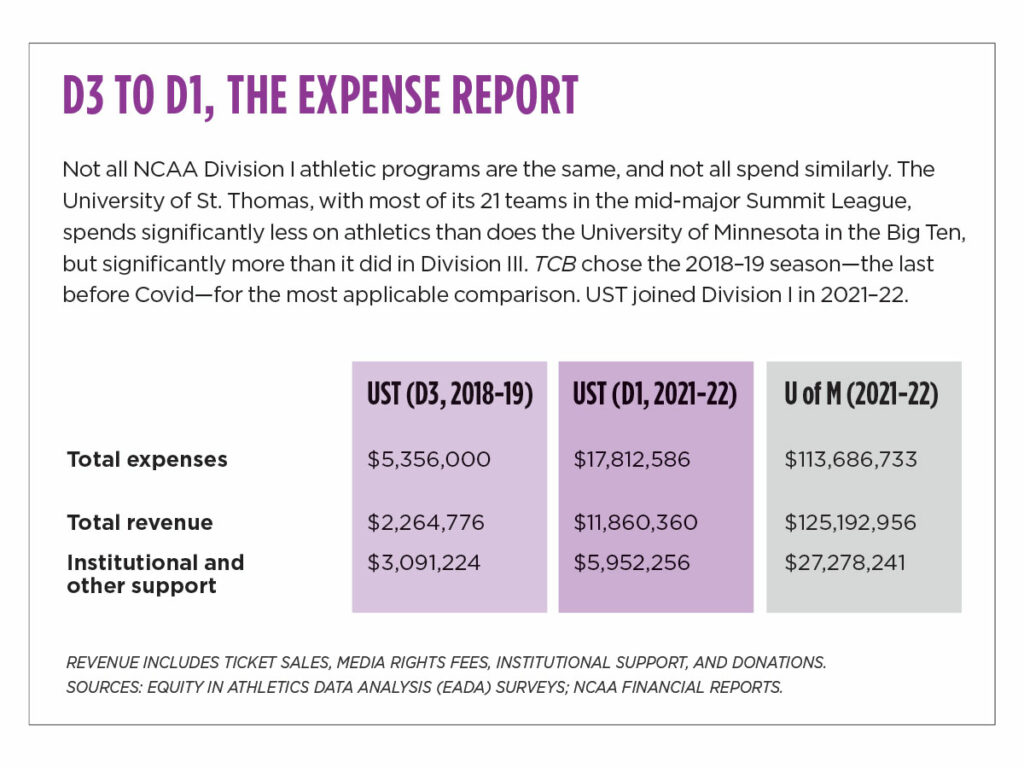
According to EADA data, UST spent about $17 million on athletics in 2021–22, its first year in D1, more than three times what it spent annually in its final years in D3 (roughly $5 million a year). UST Athletics earned $11.8 million during the same period, not counting support from the institution and donors, which filled the gap, and Esten says he is encouraged that the deficit was 5% smaller than he had planned for. UST expects to fund athletics this way over the next four years as it adds more scholarships and expenses increase. At the same time, it hopes to keep the gap manageable by generating more revenue from ticket sales, multimedia rights/sponsorships, and philanthropy.
By 2026, when UST completes its D1 transition, Esten estimates UST’s budget will fall between $21 million and $24 million—in the middle of Summit League institutions. That’s far less than the U, which spent more than $130 million in 2021-22 and took in about $135 million in revenue, according to its NCAA Financial Report. Ohio State reported more than $225 million in expenses while generating a school record $250 million in revenue for the same period. The Buckeyes earned about $30 million from sponsorships and licensing agreements alone.
In D3, UST footed almost the entire bill for athletics from general operating funds. Ticket sales contributed some, but not much. The exception: The years UST hosted the annual Tommie/Johnnie football game. The 2017 game at Target Field attracted 37,355, then a D3 attendance record. But with UST’s rise to D1, this annual fan favorite is history.
Read more from this issue

Vangsgard says UST likens the D1 move to investing in a startup. It took a similar approach with other initiatives over the years, from opening its Minneapolis and Rome campuses to launching the schools of law, engineering, and health.
UST’s administration agreed to continue its annual $5 million commitment. With that in hand, Esten formed a five-year plan for gradually increasing staffing, spending, and athletic scholarships. He estimated athletics needed another $35 million over those five years to cover expenses while revenue from ticket sales, sponsorships, and multimedia rights ramped up. Early sponsorships were sold to United Healthcare and Wings Financial Credit Union.
Esten and Ben Fraser, senior associate athletic director for development, have also been hitting the pavement in the Cities and elsewhere, engaging alums in backyards, bars, restaurants, and the like. Their approach has been to ask for feedback, not money. When folks learn what UST is planning, they’re more willing to give.
In previous UST expansion initiatives, the school’s board of trustees provided seed money from a development fund it controls. For the D1 move, the board gave athletics $15 million to tap over five years. The Summit Club, a group of athletics and business advisors assembled by Esten, with a donor obligation during the D3 to D1 transition, kicked in another $13 million. A $300 student fee, charged to last year’s freshman class and all subsequent enrollees, will add another $1.25 million annually to the pot. That brought the total to $34 million, leaving athletics to raise $1 million to reach its goal.
Vangsgard says the board of trustees doesn’t expect athletics to repay the seed money. But that doesn’t mean the department gets a free ride. “The board looks at return on investment whenever they make an investment in the institution,” Vangsgard says. “Certainly that’s what they’ve done in the past, and what they’re expecting for the move to D1 as well.”
“University officials concede it will take millions more year-over-year to fund the venture, the latest example of its institutional ambitions in the higher education marketplace.”
Overall, Esten says athletics added 60 new employees in compliance, ticketing, marketing, training/nutrition, and coaching. Each sport now has at least one full-time assistant coach, and many have several; in D3, only football had full-time assistants. Conversely, UST saved more than $4.1 million on athletic scholarships by joining the Pioneer Football League, the only non-scholarship D1 conference in the country other than the Ivy League. “It’s a tremendously fiscally responsible way to have a Division I experience,” says football coach Glenn Caruso, whose team won the league title last fall, the Tommies’ first in D1.
UST’s teams occasionally fly commercial but still travel mostly by bus, sometimes as far as Indiana and Oklahoma, though the football team charters aircraft for the farthest flung cities in the Pioneer League, such as San Diego and DeLand, Florida.
The D1 transition hasn’t been totally seamless. A move to drop to men’s and women’s tennis backfired when the women threatened to sue and UST was found to be out of Title IX compliance. A settlement restored the women’s team, but not the men’s.
For coaches, D1 means longer seasons, more travel, and more time away from home. The changes weren’t for everyone; longtime softball coach John Tschida left for a similar job at his alma mater, D3 St. Mary’s in Winona. But men’s cross-country and track coach Pete Wareham, a UST alum and the longest-serving staffer in athletics (this is his 30th season), says he’s grateful for the challenge.
“Any time you’re doing anything new, and any time you’re looking at what needs to happen to have success, everyone gets a little bit nervous, because change is not always easy,” he says. “But I think our people have done great. I feel I’m as enthused as anyone in the department about what we’re doing, and within my team as well.”
Sports as attention-getter
The D1 gambit is not, at its core, about wearing out its welcome in the MIAC. It’s about UST’s desire to become a national Catholic educational brand, and having a place in the most visible NCAA athletics tier is a pathway to it. Greater visibility will attract more students from outside Minnesota.
Basically, Vangsgard says, high school graduation numbers in Minnesota are declining, with fewer graduates going on to college. “Demographics are running against all colleges and universities in the state,” Vangsgard says. That shrinking pool means UST and every other Minnesota institution must draw from elsewhere to fill future freshman classes.
“The best phrase I’ve heard about what higher education is facing is we’re entering a winner-takes-most market,” says UST president Rob Vischer, formerly the dean of the law school. “To be among those who flourish, we just have to grow our reputation beyond Minnesota’s borders.”
More institutions are turning to athletics to do that. Loyola University of Chicago was just another Loyola until its Final Four run in the 2018 NCAA men’s basketball tournament. Remember Sister Jean Dolores Schmidt, their 90-ish chaplain? Her story helped put the school on the national map. UST is a long way from March Madness, but that’s the kind of name recognition Vangsgard believes is possible.
“St. Thomas is not a city in the Virgin Islands, which we hear a lot,” Vangsgard says. “We want to have the visibility where people say, ‘St. Thomas? Yeah, it’s in St. Paul, Minnesota.’” (There are two other St. Thomas Universities in the U.S., in Florida and Texas.)
Ultimately, UST would love to schedule more Midwestern Catholic institutions like Creighton University, which beat the Tommies in men’s basketball in Omaha earlier this season. UST officials plan to target sizable alumni contingents in Milwaukee and Chicago, which could mean opponents like Marquette, DePaul, and Loyola appearing on future schedules.
Pay to [watch them] play
In D1, Esten says, UST hopes to generate revenue through three sources: Ticket sales, multimedia rights, and sponsorships.
Esten says UST athletics never had anyone specifically responsible for fundraising until Fraser arrived from the University of Minnesota in 2020. They launched the Tommie Athletic Fund (TAF) that year, with three ways of giving: The 1904 Fund (named after the first year of intercollegiate athletics), for scholarships and operational needs; the Forever Purple Program for endowed scholarships; and Esten’s Summit Club advisory group. TAF has raised an additional $12 million for operational and scholarship support beyond the Anderson gift and Summit Club dollars.
“Raising money comes down to building great relationships, getting to know people who are interested in what you’re doing,” Fraser says.
Ticket sales require a similar strategy. In D3, UST charged $7 or $8 for football games at creaky but serviceable O’Shaughnessy Stadium, which opened in 1948 and holds about 6,000. Now tickets, all reserved, cost $35 for chairbacks at midfield and $15 elsewhere. Esten says there’s a waiting list for season tickets in the Fowler Veranda opposite the main grandstand ($335), and discussions are underway to expand the premium area, but a new stadium is not under discussion. A typical gameday features food trucks and a party on the plaza outside the student center.
“The best phrase I’ve heard about what higher education is facing is we’re entering a winner-takes-most market.”
—UST President rob vischer
At 1,800-seat Schoenecker Arena, UST added 48 courtside seats for D1 and sold them out this season. It also offers 93 chairback seats on the upper level for $25 each. UST charges a third less for men’s basketball ($10–$30) than the U does ($15–$45), as well as for women’s basketball ($5–$10, compared to $10–$15).
There’s not much UST can do at St. Thomas Ice Arena—the 1,000-capacity home of men’s and women’s hockey; it’s a high school rink more than seven miles from campus with bleachers on only one side. Single-game hockey tickets cost $5–$15.
Jason LaFrenz, senior associate athletic director for external affairs, says overall single game sales are up 20% across all sports over 2021–22. After slow early sales, men’s basketball sold out a Feb. 9 game against Summit League leader Oral Roberts, and several others in January and February drew more than 1,500. A Feb. 4 men’s hockey game against nationally ranked Minnesota State (Mankato) sold out as well.
“We’ve had good growth, but we need to grow it another 20% next year,” LaFrenz says. “Our goal, especially moving into the new Anderson Arena in a couple of years, is to get more of our people who are coming to five or six games a year to buy season tickets.”
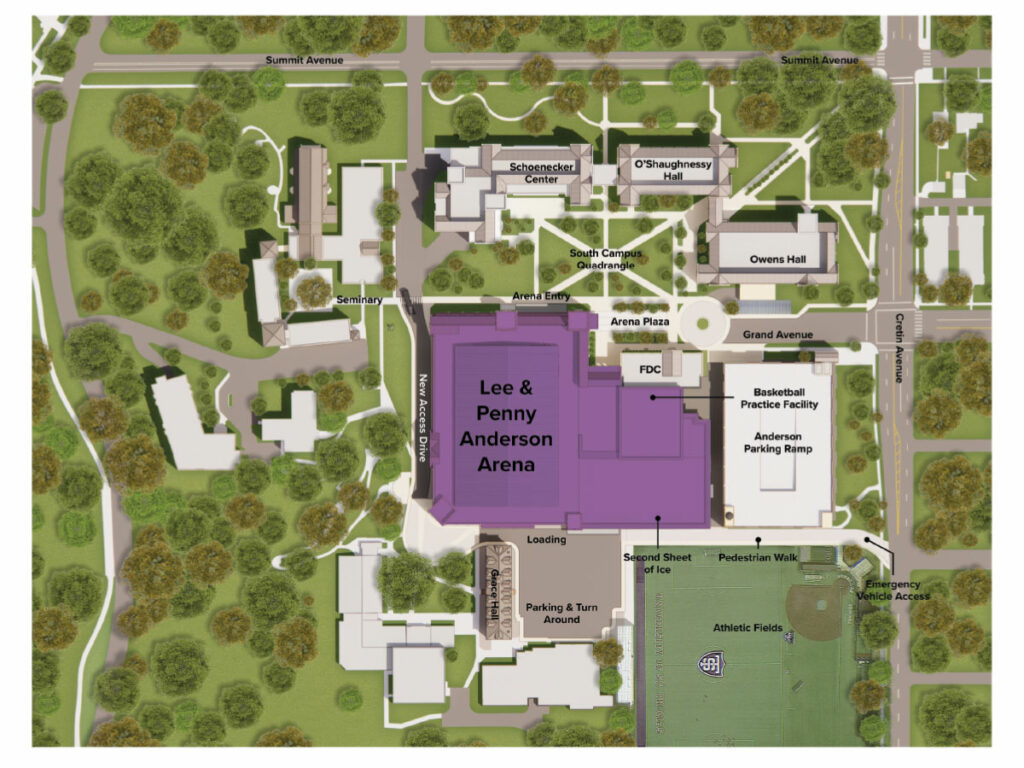
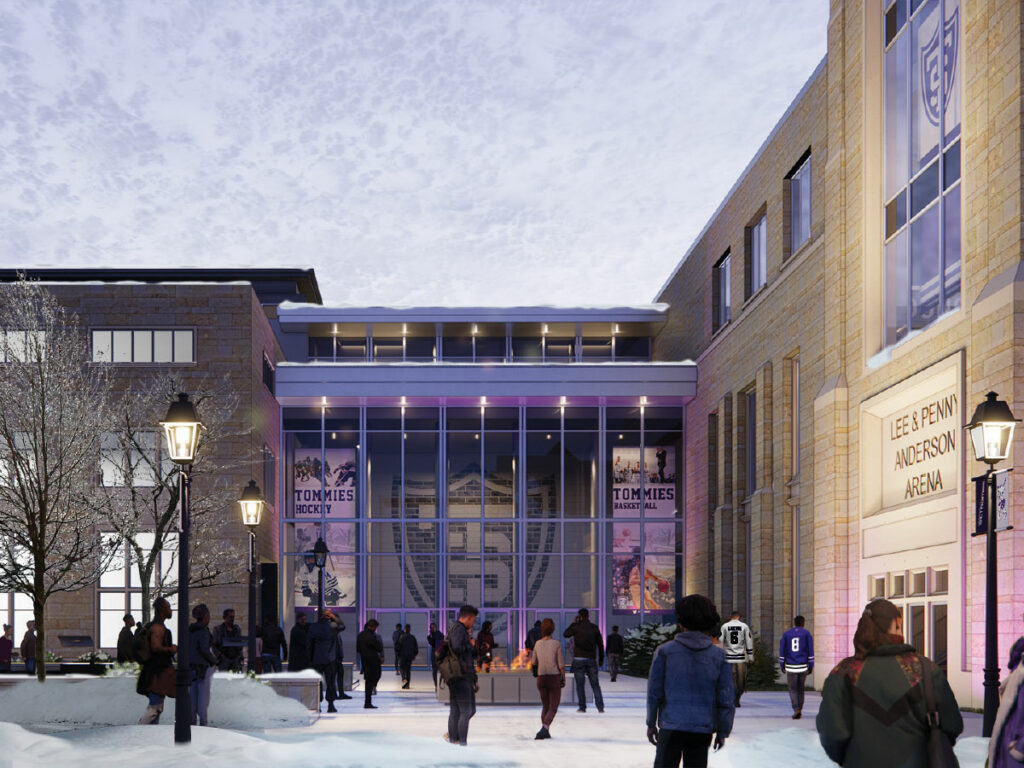
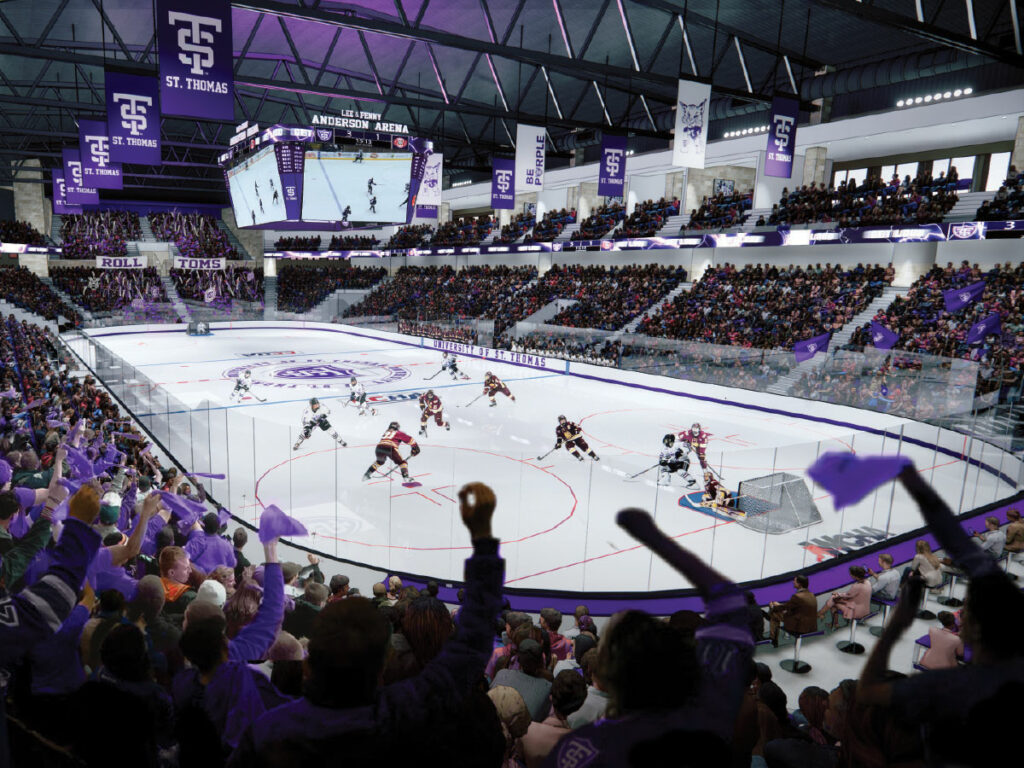
The Anderson Arena, expected to open in 2025 on UST’s south campus (that is, south of Summit Avenue), will seat roughly half of similar venues in the Cities—4,000 for hockey, 5,000 for basketball, and 6,000 for concerts and special events. UST’s tight campus footprint and shrinking college sports attendance nationwide led Esten to think smaller, not bigger.
“I’d rather put 4,000 people in a 4,000-seat arena than 5,000 people in a 7,000-seat arena,” he says. “I think this arena at 4,000 to 5,000 seats is filling a void in the marketplace. The [Minneapolis] Armory might be about that size, but it’s a different kind of a deal.”
Esten says he believes UST will fill the arena. Barring another $75 million donation, UST’s success in D1 likely depends on it.
The Summit League’s Douple, now retired, likes UST’s chances, having guided four schools through D2 to D1 transitions. “Division III to Division I has never been done before. A lot of people had questions,” Tom Douple says. “St. Thomas is showing them they’re going to be a Division I program. There’s no doubt. That’s a credit to their leadership. If you have good leadership, you’re going to get some things done with the money you raise, because they’re going to spend it wisely.”
And the primary benefactor remains all in. “It’s ambitious, but as people say, if you’re not moving forward, you’re falling behind,” Lee Anderson reiterates. “Time will tell, but I feel really good about it.”