TCB Q&A: The Twins’ Joe Pohlad
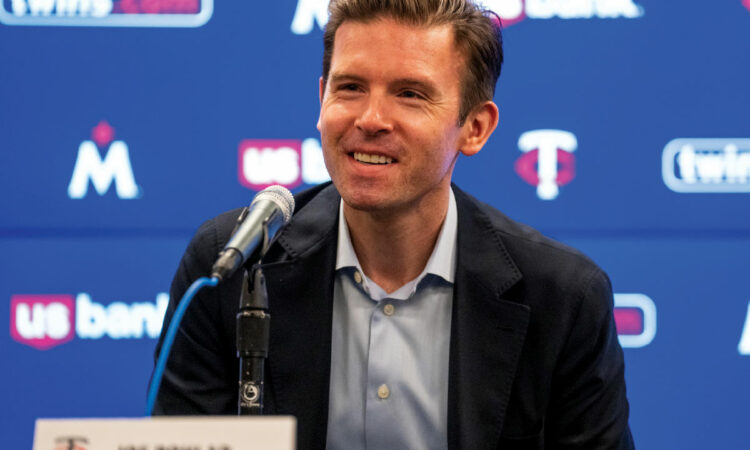
Joe Pohlad took over this winter from his uncle, Jim Pohlad, as the family representative responsible for the Twins. But Joe, 41, who spent the last 15 years working in and around the Twins organization, plans to play a more active role in the team’s leadership structure. A 2004 graduate of Stonehill College in Massachusetts, Joe has spent his career within several Pohlad businesses. He lives in the Twin Cities with wife Sara and sons Sam, Noah, and Isaac. Dressed in a white button-down shirt, blue sweatshirt, blue sport coat, slacks, and tennis shoes, with jazz softly playing in the background, Pohlad sets a modern tone, with a demeanor that, though not gregarious, manifests a bit less modesty than his parents’ generation. We spoke at his office overlooking the ballpark.
TCB: How old were you when your grandad Carl bought the team in 1984?
Joe Pohlad: Two years old. We had just moved to Portland [Oregon]. I was born in Oklahoma, moved to Portland, and moved [to Minneapolis] in 1987, the year we won the World Series. I do have memories of that, as I do of [the] 1991 [World Series victory].
Q: Why were you in Portland? What was your dad doing?
A: Pepsi. My dad bounced around a bit with Pepsi.
Q: You’ve been part of the organization for how many years?
A. Fifteen. I worked in the family business in banking in Arizona, a marketing job. The whole banking world was not for me. I got a job outside our business at a creative agency in Portland for a little over a year. Realized I wanted to come back here, get something a little more structured. [I] took an opportunity with the Twins as a coordinator of baseball ops and then just bounced around from baseball to marketing to operations to retail back into marketing, then took a brief hiatus, moved over to radio, then came back here maybe five to six years ago.
Q: Would you say your interest in baseball is mostly professional or do you have an emotional, fan connection to the game?
A: I’d say it started as professional and developed into a love for the game. I’m not a historian of the game but given the amount of time I’ve been here and the relationships I’ve built, I’ve educated myself and learned more and more about the game, which has grown the emotional piece. But I’ve also learned when to lean on the professional and when to engage with the emotional, [such as] when I’m sitting up in the stands with my family having a hot dog.
Q: Can you encapsulate the emotional piece?
A: We sell memories. That’s what’s so special about the game. I have [childhood] memories — it’s who you’re at the game with. That’s a differentiator. It’s more of a family sport, where people recall that first game.
Q: What aspects of the business engage you the most?
A: I’ve always had a marketing interest. At the radio stations where we had an enormous rebrand [to the “Go” brand]. And you saw that a few months ago with the rebrand of our look. It’s trying to be as innovative as we can and be thoughtful with our change. We’re trying to talk about how we can evolve in a number of different areas: How fans view the game when they’re in the ballpark; how we can grow our fan base from a ticket packaging standpoint; how fans consume the game when they’re not at the ballpark. These conversations don’t just come from me, though I’m vocal in how I think about them. My interest lies in how we can be aggressive and push and market differently.
Q: Baseball seems in a time of transition in how fans interact with the game. Is that your take as well?
A: I think so. We’re at the outset of some pretty significant changes in the sport — some of the rule changes [that Major League Baseball has enacted to speed up the game and add action]. So far, they’re being received well from players and fans.
Q: What’s the role of marketing in a business where wins and losses define people’s happiness with the product?
Read more from this issue
A: It’s a challenge. We work closely with our ticket sales and service group to service their needs and also lean into our brand and grow it from an innovation standpoint, which is one of the things that we’ve focused on over the last few years. I point to the Techstars [business incubator] that hopefully exposes the Twins brand to non-baseball fans, draws them a bit closer.
Q: The incubator was interesting. Does it feed into the team?
A: It feeds more into brand exposure. Our brand is an innovative brand. The other result is we’re exposed to a number of different companies that will now push us forward.
Q: Are there technologies in the startup community that have relevance to the Twins?
A: Yeah, last year in the first group we had four pilot programs and this year we we’re looking at the same number.
Q: The belief is that the family is focused on owning community assets as opposed to just collecting successful businesses. How does that understanding inform how the business is managed?
A: I’ve been fortunate to have worked with my uncle [Jim] and I’m very close with my dad [Bob], so we talk daily and we have those types of conversations. There’s not a prescriptive answer to it. It’s a gray area that you have to approach situationally. We try to be mindful of the day-to-day business but have the good fortune to take a long-term view and know that the Twins are central to our family business. [Meaning] there is a little bit of give to a bad year. It’s not a short-term play for us.
Q: What is your sense of the connection between spending and success?
A: The data would show that spending on your team produces a World Series. I don’t know if I should say that or not, but that’s what research shows over the last 20 years of payrolls. I also think you’re trying to balance running a good business and how you build a sustainable organization.
Q: So, to the people who ask why the Twins can’t just throw money at this 30-plus-year World Series drought, how does ownership decide where to draw the line?
A: I take the recommendation of Derek [Falvey, vice president of baseball operations] and his team. We’ve built up a solid relationship, and he knows where our limits are, and like any good baseball ops [department], they’re going to push as much as they can and try to make our team better. Fortunately, we haven’t had to draw that [spending] line yet. The reality is we’re in this business to win. I don’t know if any time in my years here that we’ve just said no to something.
Q: So Derek could have suggested signing Aaron Judge?
A: He could have.
Q: There’s a lot of respected leadership in this organization. How do you find your space?
A: Dave [St. Peter, team president] is right there [points to adjacent office], Derek’s right over there [points to another office]. We talk every day. Just by virtue of that reality I am more vocal. Dave and I have worked together for 15 years. Jim [was engaged] as well, but Jim didn’t office here. I have had the good fortune of growing up most of my career with Dave. We’ve seen a lot of the good and the bad of each other, and that has strengthened our relationship. I was in the room when we hired Derek, and our relationship has developed since then, and we have a relationship outside the office. You have to work at a relationship and invest in the right people, and Derek’s not only a good person, he understands how I work and I understand how he works and it just kind of works out.
Q: The Twins had a reputation as an old-school organization a decade ago. When Falvey came on in late 2016, one of the things he said was that it was not merely about applying analytics to player selection and in-game decisions but building out the organization in a modern way. How different is it?
A: It feels profoundly different. Terry [Ryan, the previous baseball ops leader] had the organization that worked for him — just like any leader does. Under Derek things are constantly evolving. It doesn’t stop.
Q: The movie Moneyball was about the art and science of looking for an edge in a game that is always evolving.
A: Yes. There is always a project going on in our organization. Not just on the baseball side but on the business side. There’s always some area of our business that we’re pushing on. That’s a testament to Dave and Derek.
Q: What in the fan experience do you see as an opportunity?
A: There’s a movement in ballparks to create more open and communal spaces to provide relief to fans so they didn’t have to be locked in a seat for 3½ hours. Now with gametimes potentially being 2½ hours (due to rule changes), I am curious will there still be a movement toward open, casual spaces. Or should we be providing something else — non-baseball amenities?
Q: What would be an example of a non-baseball amenity?
A: Golf simulators, a bowling alley. These are off-the-wall ideas, but if you get to the game an hour early and [are] sitting for 3½ hours, that might hold appeal to people with kids. We’ve been focused on lengthening game times and the impacts of that, but now we may be facing a different reality.
Q: Will you have a specific leadership portfolio?
A: It’s coming together. My role had been very clear—overseeing the marketing and communications team—but as we get into the season I’ll find more of a cadence and find the things I’m a part of and things I’m not. Right now, there’s a lot of high-level things, financials, the [Carlos] Correa [contract] discussions, and trying to stay connected to areas of the organization where I have relationships I want to maintain.