Sports/Events Centers Play a Bigger Role in St. Paul’s Economy
Sid Hartman, whose last Star Tribune sports column was published on the day he died at 100, was born in Minneapolis, and he remained steadfastly loyal to the city.
The news of Sid’s death, on Oct. 18, 2020, broke during a Minnesota Vikings game and reverberated around the sports world. Known by generations of Minnesotans simply as Sid, several years ago Sid uttered the comment, “You could shoot a cannon off in downtown St. Paul, and you wouldn’t hit anybody.”
In his trademark blunt manner, it was a way for Sid to express what he believed was the superiority of Minneapolis over St. Paul. Sid viewed Minneapolis as the professional sports universe in Minnesota.
But we are living in a new sports era in 2026, which places St. Paul in a co-starring role with Minneapolis. As St. Paul goes about rebuilding its economy following the pandemic, it’s apparent that sports and sports facilities will need to play a big part in the recovery mix.
Grand Casino Arena, in downtown St. Paul, has been home to the NHL’s Minnesota Wild since 2000. The Minnesota Frost, part of the new Professional Women’s Hockey League, is playing in its third season in the arena. In 2027, a professional women’s volleyball team will begin play in the arena. Wild owner Craig Leipold is the majority owner of the new volleyball franchise.
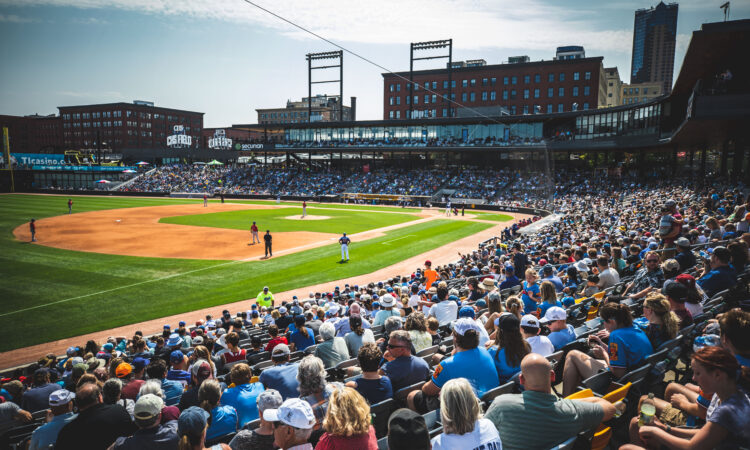
In St. Paul’s Lowertown, the St. Paul Saints inaugurated a new ballpark in 2015. Its fixed seating capacity is 7,210, which is 1,326 more than the old stadium in the Midway. CHS Field drew big crowds out of the blocks, including some fans who bought tickets to sit on the grass or stand along railings just beyond outfield play. On some great weather days, it wasn’t unusual to see crowds that exceeded 8,000.
The number of games the Saints play each season has increased since they opened CHS Field. The club had 50 home games a season when the Saints were playing independent baseball. Beginning with the 2021 season, the Saints are now the Triple-A affiliate for the Minnesota Twins. In 2024, the Saints attendance was 457,012 with 75 home games.
A few minutes away via I-94, Allianz Field opened in 2019 in St. Paul’s Midway neighborhood. The Minnesota United FC professional men’s soccer team is popular in the Twin Cities market, so fans often fill the facility that seats about 19,600 people.
As Minnesota’s capital city, St. Paul has a considerable amount of land devoted to state government buildings, and government agencies also lease substantial office spaces. The presence of government workers helps to support St. Paul restaurants and other businesses.
However, after the pandemic eased, many government workers didn’t return to downtown St. Paul. Years after Covid vaccines became available, some workers returned for a few days a week. That reality dealt a harsh blow to the city’s economy.
It has meant that St. Paul’s ability to attract visitors became even more paramount.
Reams of studies exist in which economists conclude that there is a limited economic benefit to a community hosting a sports stadium. It’s evidence that’s cited when a city or state is asked to subsidize the building or renovation of a sports stadium with tax dollars.
Often the same studies will cite a “substitution effect,” meaning that if people didn’t spend their money at a game, then they would spend the money on other forms of entertainment in their community.
That argument overlooks some key considerations. There is an economic benefit to St. Paul if a Woodbury family goes to Grand Casino Arena for a Wild hockey game, if a Blaine couple goes to Allianz Field for a Minnesota United FC soccer match, or if a group of friends from Minneapolis goes to CHS Field to watch a Saints baseball game.
If those facilities didn’t exist, people wouldn’t be traveling to St. Paul for a sports entertainment experience. The “substitution effect” economic argument is sound when considering the breadth of the Twin Cities metro area. But it ignores the fact that some St. Paul visitors are spending money in St. Paul establishments beyond the sports venues. In addition, the job base in St. Paul is expanded because people are working within the St. Paul-based sports facilities.
Economic infrastructure for St. Paul
In reality, the three facilities—doubling as sports and event venues—are a big part of the economic infrastructure of St. Paul. Unlike a public grade school or high school, these facilities go well beyond serving the needs of people who live within the boundaries of St. Paul.
That’s especially the case during the month of March. This year, people from every region of Minnesota came to Grand Casino Arena to watch the Minnesota State High School Boys Hockey Tournament. Early this month, the Saint Paul Downtown Alliance announced that downtown leaders expected nearly 1 million people would visit downtown St. Paul during March.
The estimate was based on the number of events scheduled as well as Placer.ai data, which showed that 937,800 people visited downtown St. Paul last March. The visitors were coming downtown for sports, arts, entertainment, and cultural events.
March is also a key month for St. Paul’s new mayor, Kaohly Her. She’s seeking support from her former legislative colleagues for St. Paul initiatives.
The city of St. Paul owns Grand Casino Arena, RiverCentre, and Roy Wilkins Auditorium. During the 2025 Minnesota legislative session, lawmakers didn’t support a $395 million state funding request to upgrade and renovate these facilities. The total cost of renovations and improvements was listed as $769 million.
Mayor Her reduced the total project cost from former Mayor Melvin Carter’s proposal and she negotiated with the leadership of the Minnesota Wild.
The amount that Her wants from state lawmakers was essentially cut in half. She’s seeking $200 million from the state of Minnesota. Her’s total project cost is $600 million—$450 million for Grand Casino Arena and $150 million for the RiverCentre and Roy Wilkins Auditorium.
Specifically for Grand Casino Arena, Her would use $125 million from the state, $162.5 million from the Minnesota Wild, and $162.5 million from the city, which it generates by extending the half-cent sales tax.
The Wild play 41 home games a year in Grand Casino Arena, but Wild owner Craig Leipold noted that it’s booked 150 days a year with events and entertainment.
It’s not hard, in the Twin Cities, to find people who don’t want a dime of their tax dollars to support buildings that house professional sports teams. They certainly have a right to their opinion.
Gathering spaces beyond sports venues
But decision-makers need to consider all of the factors at play when it comes to sports venues. St. Paul owns Grand Casino Arena, a place where people congregate for sports, concerts, and other activities. I recall reporting on the 2008 Republican National Convention when it was held in the St. Paul arena. (That was the year when U.S. Sen. John McCain was the presidential nominee and he threw a Hail Mary pass and chose Sarah Palin to be his running mate.)
Because the arena is nearly 26 years old, it’s doubtful that it could attract another national political convention in its current state. As technology has evolved, the infrastructure and systems in a large arena need to be upgraded. Leipold has made the case that the Wild’s renovation would extend beyond aesthetics and address some of these major infrastructure issues.
When assessing who pays what for facilities that house professional sports teams, it makes sense to acknowledge the role of these venues as community assets that benefit multiple constituencies. Whether the spaces are used for sports or festivals, they also are rare locations in which people set aside their partisan views, escape from everyday life, and connect with the people around them.
CHS Field also is owned by the city of St. Paul and Saints baseball management is soliciting support for an improvement project.
Tom Whaley, Saints’ executive vice president for business affairs, said the Saints would like to secure $8 million in bonding funds for an $18 million project. In the coming days, the Saints are expected to meet with city leaders to discuss financial contributions from the city and baseball club.
The Saints project involves relocating visitor player facilities and installing a large Ferris wheel, which would be used during games and as a downtown St. Paul attraction.
“The private/public partnership we established when the ballpark was developed in 2013-2014 has worked really well,” Whaley said. “We would like to extend that so that we are able to maintain the ballpark in a first-class manner and sustain our relationship with Major League Baseball as the AAA home for the Minnesota Twins.”
In addition, Whaley said, “we are all-in on doing our part to invest in the vibrancy of downtown.”
The Saints’ ability to attract baseball fans and successfully host other activities was reinforced earlier this month. That’s when CHS Inc. extended its naming rights partnership with the St. Paul Saints.
In 2015, I recall talking with then-CEO Carl Casale about why CHS chose to partner with a baseball franchise. Casale enjoyed baseball, but he made the corporate commitment because the Inver Grove Heights-based agribusiness wanted to elevate its profile in the Twin Cities. Casale wanted to use CHS Field as a means of attracting more employee prospects to the cooperative.
In announcing the naming rights extension, current CEO Jay Debertin noted that “our presence at CHS Field helps us build brand awareness and community engagement.” He also stressed that CHS and the Saints “share a common belief in the power of collaboration to strengthen communities.”
You’ll see that at a Saints game when fans laugh together about the on-field antics between innings, stand together for the “Star-Spangled Banner,” or pay tribute to a Minnesotan’s achievements.