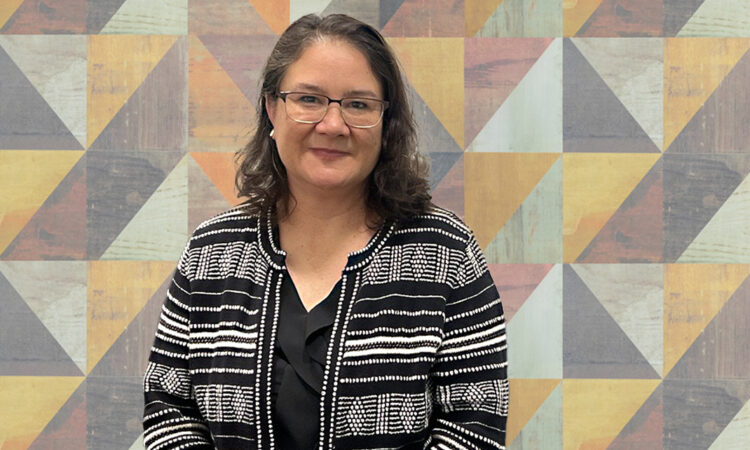
First Take: Latino Economic Development Center’s Alma Flores
Many conversations about entrepreneurship these days tend to focus on high-stakes tech businesses angling for million-dollar valuations – developers trying to build the next Facebook, chatbot, or other tech platform. What’s often overlooked are the stories of scores of “micro-entrepreneurs” running restaurants, corner stores, beauty salons, and other small neighborhood businesses that make up the fabric of American communities.
Alma Flores, the newly installed executive director of the St. Paul-based Latino Economic Development Center, sees a clear opportunity to advocate for the latter group, which is often composed of entrepreneurs of color. “The Latino community is very entrepreneurial,” she notes. “There are a lot of corridors in Minneapolis where you’re always going to find a Mexican restaurant or a Latino grocer.”
In the ‘90s, Flores was among the first to receive a bachelor’s degree in Chicano/Chicana studies from the University of California, Los Angeles. She went on to get her master’s in city planning at MIT.
Incorporated in 2003, LEDC is a certified Community Development Financial Institution that, among several other initiatives, makes small loans to a range of entrepreneurs. Notably, the organization played an important part in the development of the Lake Street neighborhood in Minneapolis. Flores sees opportunity to bring a similar model to other parts of town. In an interview with TCB, Flores talks through her approach to entrepreneurship and leadership.
The following interview has been edited and condensed for clarity.
You’re originally from Los Angeles and spent time in economic development roles in Massachusetts and Oregon. How’d you end up in Minnesota?
My family moved here for my husband’s job teaching at Carleton College. But Minnesota’s not foreign to me; my daughter attended Carleton and graduated two years ago, so we were already visiting often. LEDC is also near and dear to my heart, and it’s known nationally. [In the late oughts] when I was working on the board of a community development corporation in Portland, Oregon, we learned about Mercado Central that LEDC had established on Lake Street. At the time, we actually flew out to Minnesota to tour the site and meet with LEDC leadership. We also toured the Midtown Global Market. I’ll never forget it.
You’re also familiar with Neighborhood Development Center.
I have founder Mihailo Temali’s book: The Community Economic Development Handbook. That was my Bible in grad school, and I’ve used it as a reference throughout my career.
What are some lessons you’ve learned from your time on the coasts?
Oregon was a little late to the game to anti-displacement efforts for major infrastructure projects, like light rail. These projects can displace communities, and local entrepreneurs don’t always benefit. I’m hopeful other cities can take some lessons from that.
Minnesota’s Latino population has been growing; as of the 2020 Census, Latino residents made up 6.5% of the state’s total population, up from just 2.9% two decades ago. What would you say are some of the biggest needs facing Latino Minnesotans now?
To start, the systems aren’t set up with them in mind. There are lots of obstacles when someone is looking to get a permit from the city, or to rebuild a building. Those are barriers for everyone, of course, but they’re exacerbated when you compound them with language barriers and cultural barriers. I think that’s one huge need that isn’t necessarily being addressed fully. If you look at the demographics of city halls and other government agencies, they don’t always match the demographics of the community. It makes a difference when you see someone on the other side of the counter that looks like you and speaks your language. There’s a connection. That might not solve all your problems, but at least there’s one person who can be a liaison for you and help you navigate. It’s something that any immigrant population faces.
LEDC has played a big role in the development of Lake Street, which was hit hard in the wake of unrest after George Floyd’s murder. What role can your organization play in the corridor today?
One of the most important roles that we can play there is as a provider of technical assistance for entrepreneurs. We can also provide micro-loans for small businesses, which, as you said, did struggle through the unrest. Some are still just barely coming out of the pandemic. We can provide some leverage for folks who may otherwise not have access to banking services. And we’re not just there wearing the typical banker hat; we’re there to build relationships
Are there any other corridors in the Twin Cities where you see potential for LEDC’s involvement?
We’re located on the East Side of St. Paul, where there’s been a lot of disinvestment. I think we can bring the same energy we brought to Lake Street to this neighborhood. We see opportunity in areas like Payne and Seventh, and Dayton’s Bluff. That’s right in our backyard. But we’re also serving all of Minnesota. We have a presence in Rochester and Woodbury. And we know Faribault has a large Latino community. Cannon Falls, too. We will go where we’re asked to, but we also proactively go to some of these communities to meet the need. Plus, with our agriculture division, we’re poised to help Latino farmers all over the state.