Ballard’s Michaud Serves as a Role Model for Gay Attorneys
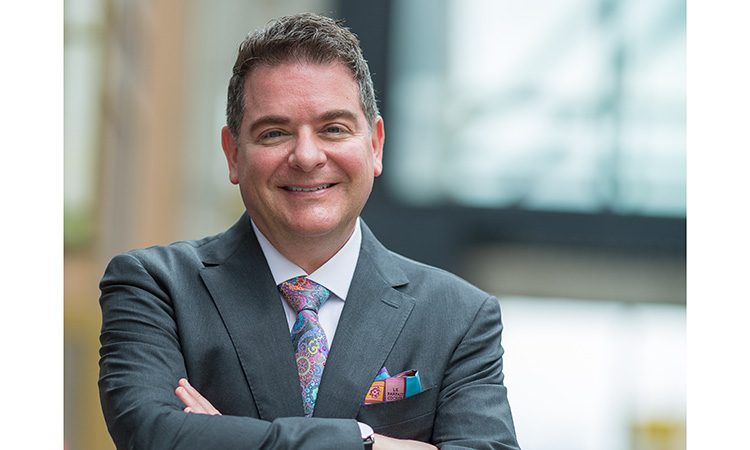
It’s been about 25 years since Peter Michaud told his fellow Lindquist & Vennum attorneys in Minneapolis that he was gay.
“I was the first openly gay partner at Lindquist,” Michaud said in an interview with Twin Cities Business. “I’m sure there were others in other firms, but that was something that mattered to me. I didn’t want my work life and my home life to be separate.”
Michaud was a pioneer at his firm long before the letters DEI came to stand for diversity, equity, and inclusion. “When I did come out, I was very pleased by how everyone responded,” he said. “It just was a non-issue, which is what you want.”
During Pride Month in 2024, it bears noting that Michaud is an LGBTQ trailblazer within the national legal community. He’s in the first year of a three-year term as chair of Ballard Spahr, a national law firm with $484 million in revenue last year.
Michaud appears to be the first openly gay person to hold the top leadership post among the nation’s largest law firms.
Lindquist & Vennum merged into Ballard Spahr, a firm founded in Philadelphia, in January 2018. Less than five years after that combination, the firm selected Michaud to lead the law firm with 15 offices around the country.
After serving as chair-elect for 18 months, he took the helm of the firm in January and divides his time between Minneapolis and Philadelphia.
In a conference room in the IDS Center where Ballard has its Minneapolis office, Michaud said that he made history in two ways when he was elected the firm’s chair. He was somewhat amused by how the news media covered his selection.
“If you look back and Google when I was announced as the next chair, most of the articles seized upon the fact that I was openly gay and that was the headline,” he said. “I thought the more interesting story was the fact that in 139 years I was the first chair elected who was not based in Philadelphia.”
Then he quickly recognized that he was serving as a role model. He started receiving email messages from gay college and law school students. They shared that his ascension within Ballard’s leadership structure gave them hope about their career prospects, while some said they were still worried about being openly gay in the workforce.
Michaud could relate to that latter sentiment. As a young lawyer, he feared that being gay could thwart his opportunities to work with some clients.
“In the business world, while I came out within the firm, I was much more careful with clients,” he recalled. “I didn’t know how they would react. And it was a little awkward if they’d say, ‘Do you want to bring your wife to dinner?’ or whatever.”
Minnesota didn’t begin issuing same-sex marriage licenses until 2013, so Michaud’s decision to come out to his colleagues was done in a very different time in the nation’s cultural life. “I was worried, but I’m not anymore,” he said. “That comes maybe with age where you get to a point where you stop worrying so much about what other people think of you. But I think as a young attorney who is moving up the ladder, it was always in the front of my mind.”
Now 55 years old, Michaud, and his husband, Tom, make their Minnesota home in a Minnetonka condominium, and they also have an apartment in Philadelphia. They’ve been a couple since 1992.
Both men planned to retire from work at 55, and then the Ballard chair opportunity surfaced for Michaud. “We sat down over a martini,” Michaud said. “I’m like, ‘Do I do this or not?’ He’s like, ‘I’ll support you. As long as I get to retire, you can do what you want.’ ’’
Michaud marked his 55th birthday the month before he officially became chair in January. “I love what I’m doing,” he said, including serving as a success story for young gay people. “It helps people to be able to look up and see someone who they can relate to, in whatever manner that is,” he said.
Smaller Minneapolis footprint
Michaud was a member of the Lindquist & Vennum Management Committee when it decided the firm should merge with Ballard Spahr.
A private equity and mergers & acquisitions attorney, Michaud thought a combination would benefit his group practice and the entire Minneapolis-based firm.
“We didn’t have the geographic footprint that would allow us to gain [some] new clients,” he said. “The other thing was just depth in practices. We had a lot of talented people, but there were only so many attorneys we could attract to a Minneapolis law firm.”
On Jan. 2, 2018, the two firms issued a news release that announced the merger. “With more than 110 lawyers, the Minneapolis office is Ballard Spahr’s largest outside of Philadelphia,” the news release said.
As of mid-May in 2024, the Minneapolis office had 61 attorneys, according to Ballard Spahr spokesman Will Ashenmacher. Total employee headcount in Minneapolis adds up to 104 people, when you include administrative business professionals, paralegals, and other staff. Minneapolis is Ballard Spahr’s third-largest office, behind Philadelphia and Washington, D.C.
Why has there been such a substantial decline in the number of attorneys in Minneapolis?
“We had several retirements over the years of Lindquist partners,” Michaud said. “We have had some attorneys move to other offices or other locations” within Ballard Spahr.
Also, Lindquist’s family law group moved to the Barnes & Thornburg law office.
“It is a smaller footprint, and I would love to change that,” Michaud said. “I’m very focused on growth. Karla Vehrs [Minneapolis office managing partner] and I talk a lot about really doing what we can in 2024 to make sure that people understand that we are interested in growth here in the Twin Cities.”
The firm’s departments are litigation, real estate, intellectual property, finance, and business and transactions. “I’d love to grow all five of those areas,” Michaud said. “The strongest practice here continues to be mergers & acquisitions and we’ve seen the least number of departures from that group.”
Minneapolis-based attorney Barb Rummel is co-leader of Ballard’s mergers and acquisitions group. She also serves on the firm’s elected board of directors.
“In Minneapolis, we have this amazing group of talented female partners who were part of Lindquist and whose practices have just skyrocketed being part of the Ballard platform,” Michaud said. In addition to Vehrs and Rummel, he cited two other women attorneys. They are Maggie Tatton, practice co-leader of the firm’s private equity group, and April Hamlin, co-leader of the firm’s environmental, social and governance team and agribusiness team.
Ballard’s business strategy
At mid-year Ballard Spahr employed 1,195 people, including 591 attorneys, in its offices across the United States.
Like most law firms, Michaud is focused on growing firm revenue. It can occur through adding attorneys to existing practice groups, expanding the firm’s substantive practice areas, or broadening the firm’s geographic footprint with additional offices.
Michaud is open to all of those approaches. But he emphasizes that growth is driven by meeting the evolving needs of clients and new attorney hires need to fit within Ballard’s culture that values collaboration among colleagues.
Ballard Spahr is pursuing a business strategy that Michaud outlined in a 45-minute address during the firm’s annual meeting in late January in Scottsdale, Arizona.
“Incomparable client service was No. 1,” Michaud said. He supports a “reinvigorated business focus” on how best to serve clients while recognizing that both clients and the firm need to use limited resources wisely.
In striving for operational excellence within the firm, he wants attorneys to take a second look at how they work with the firm’s professional staff, including those in marketing, communications, finance, and library science. “I’m trying to convince our attorneys that we need to work better and listen to the advice of our professional staff,” Michaud said.
He wants to strengthen Ballard’s reputation, so it’s viewed as “a destination firm for top talent.”
Michaud said he doesn’t have numerical goals for expanding Ballard’s population of attorneys. He’s interested in finding attorneys who enjoy working with other attorneys within their own office as well as other Ballard offices in different parts of the country. “If you have sharp elbows and what we call a silo practice—you just kind of work on your own—you don’t do as well at Ballard,” he said.
Michaud is proud of the fact that women, people of color, and LGBTQ people hold leadership roles within the firm. “Leadership positions are great,” he said. “But if you have an attorney who is excited about what he or she is doing each day with our clients, to me that’s what helps their job be fulfilling and rewarding and makes them loyal.” He noted that it’s incumbent on the firm to ensure the attorneys “are given quality work and challenging work.”
Overcoming leadership barriers
Michaud didn’t know any attorneys when he enrolled in the University of Minnesota Law School in 1994.
He grew up on the East Side of St. Paul and attended public schools. “I came from a large Italian Catholic family,” he said. “It was such a huge part of my upbringing, having a close family. We got together every Sunday for dinner at my grandpa and grandma’s.”
His mother’s family was Italian, and his father was French-Canadian. “We all belonged to the same Catholic parish in St. Paul,” he said, which was St. Ambrose, then located off of Payne Avenue.
Michaud’s father, Harold, worked as a lithographer at Brown & Bigelow and his mother, Jackie, was a stay-at-home mom, who would waitress a few nights a week to bring some extra money into the household.
Michaud enjoyed learning, and ultimately became the first person in his extended family to earn a four-year college degree. One of his aunts, RoseMary Enslin, who lived a block from Michaud’s family home, was a big advocate of education. Michaud said she was “like my second mom” and worked as an assistant to the St. Paul Public Schools superintendent.
Michaud’s parents and aunt and uncle co-signed loans, so he could attend Hamline University. While earning his degree in international management, he worked at Walden Books at Rosedale. Following graduation, he worked at Walden full-time until he decided to take the LSAT and go to law school.
“When I went to law school, I liked the thought of being a lawyer,” Michaud said. “I didn’t know any lawyers personally.” He laughs when he thinks about the fact that his perception of lawyers was what he picked up by watching the T.V. show “L.A. Law.”
But Michaud had a serious problem that could block his ability to be a successful lawyer. “I was terrified of public speaking,” he said. “I had a real bad speech impediment as a child, and I had to go to a therapist for many years.”
Even though he completed his speech therapy by middle school, he absolutely didn’t want to be a litigator after he got his law degree. He kept thinking: “I don’t want to be in a courtroom and have to stand up in front of a jury.”
He discovered the perfect legal niche for his skills in 1996 after he was hired to be a summer associate at Lindquist & Vennum. Within his first week on the job, he met some of Lindquist’s mergers and acquisitions attorneys and they invited him to work on a deal with them.
“This is it,” he remembers thinking. “This is how I can use my law degree in a way that’s not being in the courtroom.” Instead of the adversarial nature of litigation, he said he liked the “idea of working with the other side to achieve a common goal.”
Michaud was hired by Lindquist out of law school, and it’s where he built a robust M&A and private equity practice. He also rose within the ranks of the firm’s leadership. He was elected to one of the coveted seats on Lindquist’s Management Committee.
Michaud gave up his practice to channel his energy to his firm’s chair responsibilities, but he continues to do pro bono work. He also has won the battle with his public speaking demons by employing strategies that work best for him.
In his new job as chair, he wants to promote a “culture of innovation,” which includes embracing technology and altering work procedures that can be done more efficiently. While the chair sets the strategic direction and vision for the firm, Michaud does so by meeting with key clients and constantly talking with his firm’s attorneys.
In a meeting with some lawyer associates, he joked about his new role. “The two things I find hardest are public speaking and having to mingle in a party setting,” he said. Then he quipped to the associates that those activities have become “No. 1 and 2 of my job requirements.”