Uptown Fights for its Future
Small business owners in Uptown are banding together in effort to create an Uptown Business Improvement District—much like the Minneapolis Downtown Improvement District— that would allow them to raise funds for capital improvements, security, and other initiatives to revive the troubled neighborhood.
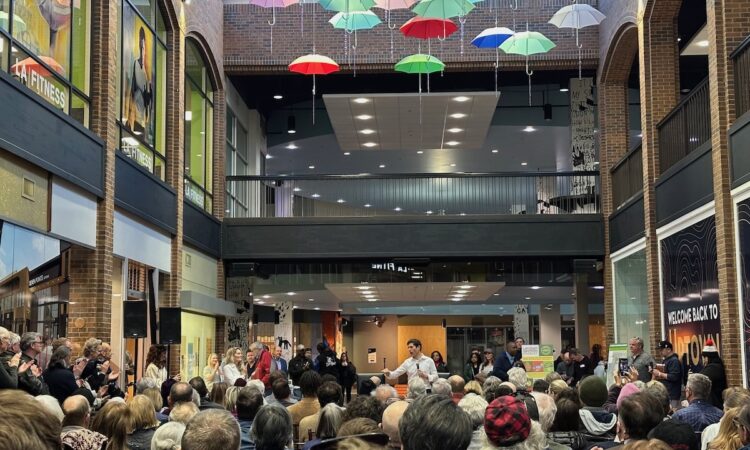
Business owners and concerned residents packed the common area of the largely vacant Seven Points shopping center at Lake and Hennepin on Monday night for a meeting organized by the Uptown Association. The group announced an Uptown Farmers Market that will run every Thursday, June 12 to September 25, on the Girard Avenue Plaza outside Seven Points. They also declared a grassroots effort to recruit 30 to 40 businesses within a two-block radius in the heart of Uptown. Andrea Corbin, president of the Uptown Association board of directors, outlined a plan to bring the LynLake, Lowry, and Uptown areas together as one Business Improvement District, a designation that comes with the ability to levy taxes for economic improvement. The group hopes to secure signatures of the necessary 25% of businesses in the area to move forward with the designation by August, Corbin said.
Minneapolis Mayor Jacob Frey addressed the group, promising “buds of progress” in Uptown this year, while warning the friendly crowd, “it’s not going to be everything you want all at once.”
Frey opened his remarks by explaining the “perfect storm” that has stymied the once-vibrant commercial hub in South Minneapolis, starting with the pandemic and the murder of George Floyd, followed by the 2021 fatal shooting of Winston Smith, which sent Uptown into an even deeper tailspin. Add to that a multi-year road construction project along Hennepin Avenue, which Frey owned, but described as imperative.
“Uptown has experienced some of the most difficult circumstances and has been the slowest to come back of any neighborhood in Minneapolis. I just want to acknowledge the truth,” the mayor said. “I also want to let you know that I have a whole lot of hope.”
Safety and parking were the two issues those in attendance named as essential for an Uptown revival.
“The two are very related: People don’t feel safe in Uptown and don’t want to park three blocks away like I had to today for the meeting,” said Ashok Dhariwal, owner of YogaFit Studios. Traffic at YogaFit’s Uptown location is 60% slower than the studio in Northeast Minneapolis, which has a similar demographic, Dhariwal said.
Frey pointed to the city’s improving safety record, including a sharp decline in homicides and an uptick in new Minneapolis police officers. One concrete measure Frey offered on Monday was a move by the city to temporarily shut off meters along 27th and 28th streets from Hennepin to Girard Avenue to allow free parking. This experiment will commence sometime in April, he said, and the city plans to evaluate the impact.
Corbin, the Uptown Association board president, said the key to Uptown overcoming its Catch-22 of not enough foot traffic to attract new businesses and not enough businesses to draw crowds, is to coordinate efforts. Her goal is to bring in 30 to 40 businesses within a concentrated two block radius at Lake and Hennepin, where a vast number of storefronts sit empty—ghosts of an era when Uptown boasted upscale retail like Apple and Arc’teryx, as well as longtime locals like Kitchen Window and Roam.
Corbin, who opened her own Uptown shop, the Flower Bar, two years ago at 27th and Lyndale, described an organized volunteer effort to identify potential businesses for Uptown and work with leasing agents to offer them favorable terms.
But even free rent might not be enough, Corbin acknowledged, noting that she’s talked to some business owners who say opening in Uptown is still too risky. YogaFit’s Dhariwal agreed: “There is still a cost to run a business, even with free rent. Even if you can get 30 to 40 businesses to come to Uptown, there will be 30 to 40 established businesses that will leave as soon as our leases are up.”
A few Uptown landlords attended the Monday meeting, but were not among the speakers.
“We need to talk about other incentives—helping with build-outs, special financing,” Corbin said. “It’s only going to happen if we work together.”