Tom Pohlad on Spending, Winning, and the Future of the Twins
On Nov. 10, 2001, the StarTribune published an op-ed article by a member of the Pohlad family. It concerned a recent decision by Major League Baseball to remove two financially struggling teams from the league, one of which was assumed to be the Twins. The op-ed was a ringing defense of a family and a patriarch who had owned the team for 17 years, through the highs of two World Series and the lows of failed efforts to escape the plasticized Metrodome. The article is quaint, almost endearing, save for how the rhetoric feels so eerily applicable today.
“People say we are unwilling to spend money to get good players,” the author wrote. “If you recall in 1994, a stable time for baseball, my family paid Kirby Puckett the highest salary Major League Baseball had ever seen. Now in an unstable time, there is no money to spend; the organization does not make enough revenue to field the kind of team you want, and no owners pay salaries out of their own pocket. We are a baseball team stuck in a rundown football stadium.”
The piece closed with a banger: “We have tried to make things right for the people of Minnesota and now we will make things right for our family.”
The Twins survived and eventually got that new ballpark, but they still struggle to win or make money. Twenty-five seasons later, they remain a franchise navigating ire between the family that owns them and the fans that want to love them. “I admit my family has not always made the best decisions,” Pohlad wrote. “We have always had good intentions, though.”
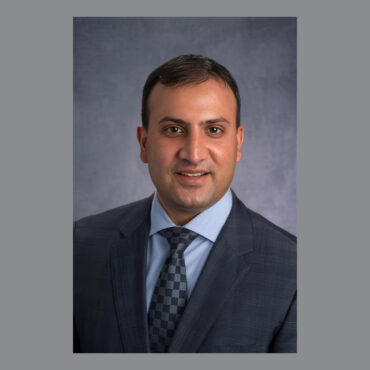
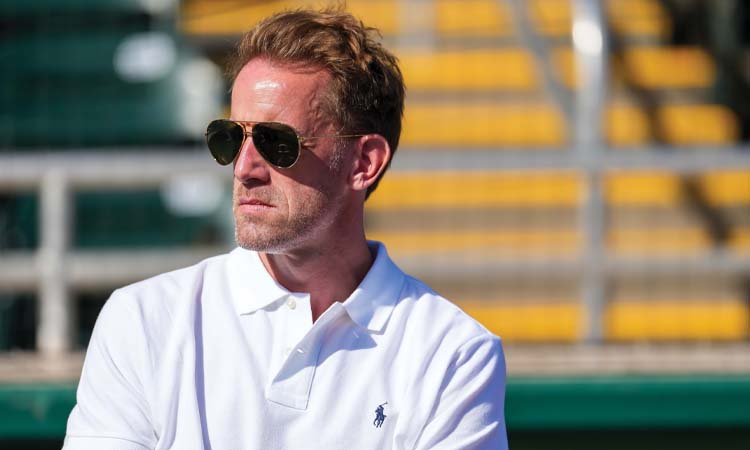
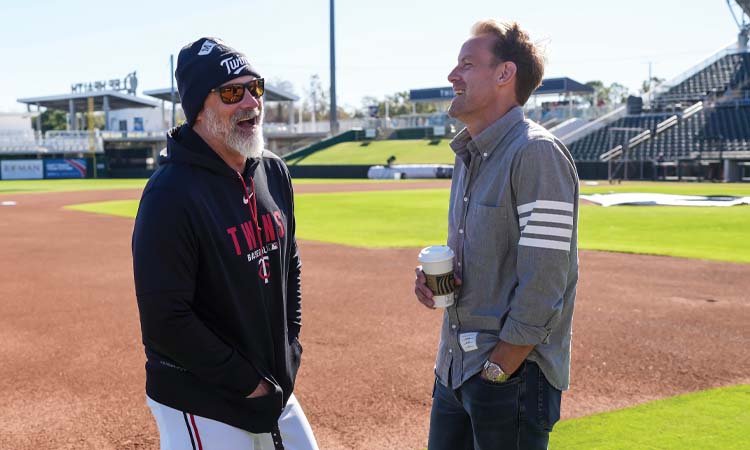
Tom Pohlad, 46, sits, legs crossed, in the owners’ box at Hammond Stadium in Fort Myers. It’s an unseasonably warm February day in southwest Florida, though he looks cool and collected in white slacks turned up at the ankles, a gray polo, white lace-ups, and no socks. His auburn hair, the identical shade of his tan, is combed back. Tall, with a patrician air, Pohlad evokes his uncle Jim, whom he just replaced as the team’s official ownership representative with Major League Baseball.
He wrote those words as a student at Boston College, 17 years after his grandfather, Carl, bought the Twins. Tom may not have foreseen that 25 Decembers later he would be the focus of a hastily called press conference in the home clubhouse at Target Field. He had, until that week, been chairman of the family’s corporate holdings: PaR Systems, Northmarq, United Properties, among others. He looked a little shell-shocked; after all, it was his younger brother Joe who had made the Twins his life’s work.
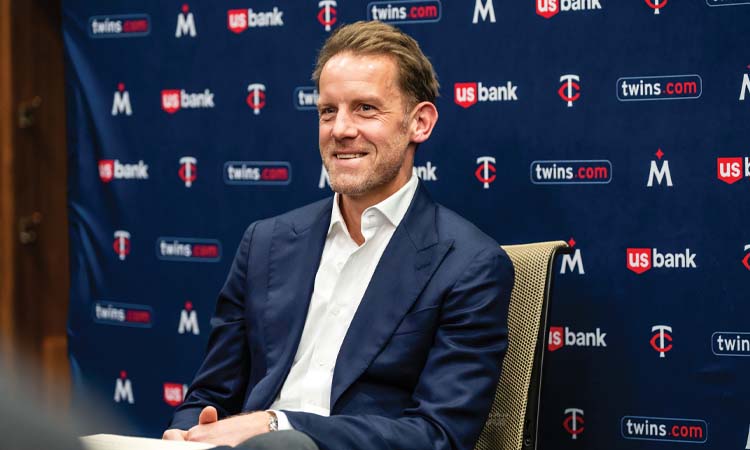
The motivation for swapping Tom for Joe wasn’t stated, but the timing alone—in December MLB approved the sale of roughly a third of the team (according to media reports) to limited partners—offered clues that the two events were not unrelated. Three years earlier, Joe had been introduced to the media: he was to transition into his uncle Jim’s role. Joe had been part of the org since 2007, and many observers expected him to be named team president eventually. Soft-spoken and affable like his uncle, he seemed set to stay the course. But there were problems behind the scenes.
The team had accumulated over $400 million in debt, mostly during the Covid years, when it declined to furlough staff who had little to do while revenues were nil or slightly north of nil. In 2023, the team won its first playoff series since 2002, but it was followed by retrenchment—a “right sizing” of the payroll is how Joe put it—and a PR disaster that arguably engendered two successive dismal seasons.
After 2024, it was announced that president of baseball operations Derek Falvey would succeed Dave St. Peter as president, perhaps because that winter the family announced its intention to sell the team. The Pohlads later changed course, announcing they would seek out minority investors to pay off the debt. Those transactions closed just before Tom’s ascendancy.
The Twins are “my sole focus,” he told TCB in an exclusive interview. “I left my role at Pohlad Cos. I think that’s what’s required right now. I want to be an active owner. I am not just looking to sit in the owners’ box and hope and pray. I want to roll my sleeves up and do my part.”
A new look
Fans should expect a change in tempo. “Tom and Joe are completely different people, with different visions,” says an associate who knows both men. “Tom is more aggressive and assertive than Joe. I expect him to have an outsized presence relative to the [distance with which] the Pohlads have operated the team.”
Family businesses are emotionally complicated organisms, and Tom Pohlad acknowledged to the media in December that supplanting his brother had created strain that the family might not have taken on under different circumstances. It would be naïve not to assume the new board is setting a strategic vision for the franchise.
“Everything is on the table. After the first board meeting it became evident that is the fact.”
—Craig Leipold, Wild owner/Twins investor
Tom had led the investor search, creating a bond of trust with the new partners. “We were focused on bringing a capital infusion to pay down the debt and stabilize the organization,” he recalls. “But equally important was who we were partnering with. We wanted true alignment on what’s going to drive success. We ended up with three partners who bring a lot of experience that is going to help us be successful.”
One of those investors is Minnesota Wild owner Craig Leipold. “Tom’s a very smart guy,” Leipold told TCB. “He is looking for advice and ideas. Everything is on the table. After the first board meeting it became evident that is the fact.”
In early February, just as management was about to leave for spring training, Pohlad announced Falvey would be leaving his job of nine years. Pohlad says he felt he needed to run and be the face of the team’s business operations, which had been handed to Falvey just 10 months earlier.
It’s perhaps easier to critique the work of your predecessors, but Pohlad makes no bones about the situation the team finds itself in: “It’s been a rough two or three years for Twins baseball. A lot of things have created headwinds in the world and the community, but we also haven’t run as good an organization as we would have hoped. The failure to communicate through those challenges created a vacuum with our fans. The sale process called into question our family’s commitment. We have to . . . prove that we’re committed and competent in building out a championship caliber organization.”
Though Pohlad may one day hire an executive to lead business operations, he plans to operate as CEO through at least the 2026 season. “I want to play the role I’m playing right now. I want to play an active role. I believe I should be the face of the organization’s leadership. I’m finding a lot of value in being heavily involved and learning our business. In the short to medium term, that’s going to pay dividends for us. It earns me trust here and will help me know what to look for when we begin that search.”
Pohlad suggests it was perhaps less than optimal to place executives who lacked control of financial strategy as the public face of those choices over a period of decades.
Leipold learned a similar lesson when he owned the Nashville Predators NHL team from 1997 to 2007, before he bought the Wild in 2008. “My decisions now versus Nashville are focused much more on how the community views things,” he says. “Every decision we make, we talk about how it will be viewed by fans, community, and media. You have to think about image, you have to be involved, and let people know you are involved.
“I can’t outsource earning back the trust of our fans, players, staff, and the community at large.”
—Tom Pohlad
“I go to all the games, we’re active in the Chamber, and so are the Pohlads,” Leipold continues. “They are a quiet family, but they make an impact. They may want to be more public about what they are doing.”
Pohlad concurs: “I can’t outsource earning back the trust of our fans, players, staff, and the community at large.”
As the face of the business, he will inevitably face criticism—from fans, sportswriters, and clients. “I’ve lived with it for 40-some years. It comes with the territory. Is it fun to see family members or your last name spoken about in the manner we have been spoken about? It is hard.”
The payroll conundrum
The most consistent critique of the Twins, from Carl Pohlad’s era to today is they don’t miss an opportunity to save a buck. Despite Tom Pohlad’s December statement that the Twins have not had positive cash flow since Covid (and more of a break-even operation in the early Target Field era, 2010–2019), fans and media continue to insist that the family is profiting from the team, and if they are not doing it through black ink, they are doing it through accounting gimmicks.
Another narrative is that because of the family’s immense wealth, the Twins should not be concerned with breaking even but should go for broke signing players, as is the case with big-spending New York Mets owner Steve Cohen or the LA Dodgers. (That the Pohlads had leveraged the business by nearly a third is apparently insufficient evidence of their commitment.)
“We can’t compete with the Steve Cohens of the world,” Pohlad says. “They are unicorns, and it’s an unfair example. [With the] majority of sports teams, the disparity in what they spend is a function of market size and the revenues they generate, not the owner’s wealth. There is a belief in the fan base that owners are putting their own money in every year, but by and large that is not true.
(It is tough to verify team finances. This March, CNBC estimated the Twins are the fourth least valuable team in MLB, at $1.65 billion. CNBC said the team ranked 18th of 30 MLB teams in revenue, with 2025 receipts of $352 million and EBITDA of $20 million, down from $356 million and $41 million in 2024. So it is conceivable that all earnings were consumed by debt service. CNBC said 12% of the team was leveraged—it’s unclear if that’s current.)
“I think we’ve got to be disciplined about when we make investments,” Pohlad continues. “There are going to be times when it makes sense to go for it, but when you do that, you’ve got to believe there’s going to be a return, and that will be greater success on the field, which will drive fan engagement and drive revenue so you can spend more money. But there are times you have to be realistic about where the team is at or the organization and say ‘Is this the best year to go all-in, and if we do, are we sacrificing the long term?’ ”
“If always being competitive comes at the cost of truly being able to compete for a world championship, then I have to question that approach.”
—Tom Pohlad, Twins CEO
Pohlad says his primary goal is sustainable success, not peaks and valleys. “Winning the World Series once [in the future will not] solve the revenue issue. Being consistently competitive solves the revenue issue,” he says. “Fans believing ownership is committed to competitiveness creates loyalty that drives revenue.”
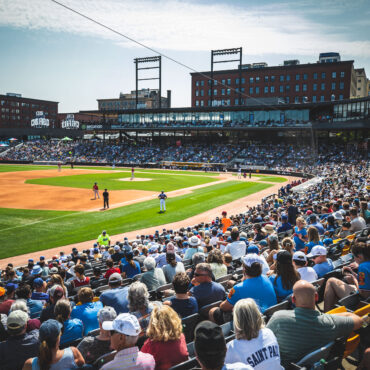
Pohlad is focused right now on revenue, and attendance remains an MLB team’s primary revenue stream. Recently announced season-long beer and ice cream promotions are tactical: “I am pushing our organization to get creative on how we bring people back to the ballpark. I want people to go on the journey with us. Help us build this together. It’s not going to happen in one season. [I asked] if they’re going to come on the journey, what can we do as an olive branch—$2 beer or free ice cream? There are plenty of teams across the league that don’t have a great record for winning, [yet] draw 2 million fans. So we are interested in what are those teams doing to drive fan engagement and [saying] let’s do a better job with that as well.”
Still, he is quick to reaffirm, “At the end of the day people want us to win.”
Which brings him to the most prominent sore point: 2023. “If we go back to 2023, we unfortunately made a decision not to invest in the team, and on paper there was some rationale because of the debt and revenue not growing,” he recalls, which led to “right-sizing” the payroll after that playoff run. “Hindsight being 20/20, what we failed to take into consideration was the long-term impact of what it signaled to the fan base and its potential impact on revenue in 2024 up to today. You can’t place a value on what we’ve lost as a result of that decision; it was the wrong decision.”
There is a certain mindset sports owners need to adopt, Craig Leipold says. (His Wild are currently valued at about where the Twins are.) “You have to believe the asset will be going up and up and up, so you can’t look at yearly swings in profitability as make-or-break.” He says, based on his conversations with the Pohlads, they get this. “People don’t think the Pohlads are committed or willing to spend, but it’s not true.”
Early innings
Tom Pohlad says he would like to shift the culture at One Twins Way. “I think culture plays a role in how the organization handles moments of adversity. We have depth of talent. And we have a new culture this year that I think is going to make us more resilient.”
Though he had no role in his hire, he sees new manager Derek Shelton as emblematic of said culture. “ ‘Shelty’ has a different mindset than previous managers,” says Pohlad. “He is intense and he wants to win, but he’s a clubhouse guy who believes in communication and accountability. We lucked out with him. He and I are aligned in how we think about things. Many of the same things he’s trying to instill in the clubhouse, I’m trying to instill in the organization. We’ve got to manage everything within our control.”
He believes his training at Pohlad Cos. prepares him for the unforgiving role. “I don’t think sports is so unique that all the things that work running the other family businesses we have don’t apply here.”
A new landscape
There has been lot of discourse about market imbalances in the economics of baseball, the sudden loss of broadcast revenue due to the collapse of the regional sports network model, and in Minneapolis, the downtown headwinds since Covid. Leipold points to the NHL, which established a salary cap and floor, which mostly equalized spending among markets.
“The difference between NHL payrolls 10 years ago ranged from $25 million to $80 million. All the high-payroll teams were in the playoffs,” he recalls. “When we implemented a hard cap and floor, within two to three years every team became competitive. Only two or three are not competitive this season. [A cap] enables smaller-market teams to compete. Attendance goes up, [TV] ratings go up. And the next year, players get 50% of our revenue so they earn more. Eighty percent of our teams [spend to] the cap. Certainly [MLB’s next] collective bargaining agreement will have a major impact on whether teams are profitable.”
Pohlad promises he will not use these factors as a crutch. “We have enough work in front of us within our control that worrying about the economic system is not my first concern. Big picture, do I think there are other systems that would give markets like us a better chance,” he asks, without answering. “But I don’t think our system right now precludes the Twins from being successful.”
What does success look like? “I think we thought we owed it to the fans to always be competitive,” he says, alluding to the question of whether teams must go through winning droughts to achieve full-throated success.
“If always being competitive comes at the cost of truly being able to compete for a world championship, then I have to question that approach. Also, what is competitive? Is it getting to the postseason? That’s been our [philosophy]. My definition is: “Let’s build a team that can truly compete in the postseason, rather than, ‘let’s see if we get lucky.’ ”
There has been speculation the Pohlads are short-timers now, that the minority investor recruitment was a prelude to a full sale. Pohlad shakes his head at the idea. “We’re long-term owners,” he says. “There’s a perception that we’re waiting for financial reform to happen in Major League Baseball and then we’re going to sell the team. That’s simply not true. We have unfinished business, and that’s to bring a championship to the city.”
If he has the right stuff to finish the job his grandfather started, there may not be a need for the Pohlads to write any more op-eds. At least not about baseball.