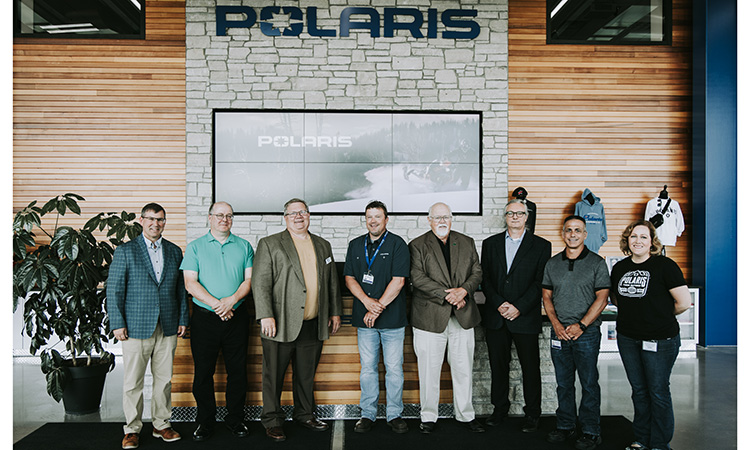
Polaris Rolls Out New Intern Program for High School Graduates
High school graduates in northern Minnesota can dive into a career in manufacturing while taking college classes, thanks to a new partnership between Medina-based Polaris Inc. and Bemidji State University.
The Polaris Manufacturing Operations Development Program allows students to receive 30 college credits while earning a living at the Polaris manufacturing facility in Roseau, Minnesota. The 19-month covers tuition at the university and housing for 15 recent high school graduates. The program starts Aug. 19.
Over five semesters, interns will start the day working in the Roseau facility and attend online classes at Bemidji State in the afternoon.
The program helps students who otherwise might not afford tuition costs, but it also eases the demand for educated employees as manufacturing advances and becomes more automated, said Dan Voss, transfer partnership coordinator at Bemidji State University. Manufacturers like Polaris need well-trained employees in a variety of areas to continue being competitive in the industry.
“We know that workforce demands are changing. This is a great example of how BSU is responding—changing what we do so that high school graduates who want or need to go directly into the workforce can still achieve their college dreams,” BSU president John L. Hoffman said in a news release issued last month.
The program emerged after Polaris Roseau’s Lean operations manager Anthony Lindgren noticed the amount of young people in the region choosing to not attend college, Voss said. It’s a group the company hopes to tap into to fill a growing need need for educated workers.
“Addressing the growing demand for technical labor skills in modern manufacturing, the 19-month program is designed to propel student careers and elevate business operations,” Lindgren said in a statement.
Many young people in northern Minnesota cannot afford a college education, and first-generation students question the value of going to college over jumping into the workforce, Voss said. This partnership creates a pathway for students to try both routes and decide what they want to do.
“We see a lot of students today who are wondering, ‘Should I go to school? Should I go to work?’ Voss said. “This is kind of the best of both worlds.”
The interns will complete 10 college-level courses over five semesters, from easily transferable general education requirements to manufacturing courses covering the hands-on work at Polaris, Voss said.
But even the general education courses are tailored to the interns’ experience – rather than enrolling in an introductory biology course, for example, students will take an environmental studies class to understand the context and policies of the daily soil and water samples Polaris tests to mitigate pollution, Voss said.
The educational side of the internship will also emphasize leadership beyond standard management training, he said.
“One of the things that we’re constantly looking at is teaching students how to look at a process, and how do you make this process as efficient as possible?” Voss said.
In teaching quality assurance processes and focusing on problem-solving, Bemidji State works to “create tomorrow’s leaders” in the manufacturing world by learning about leadership in team environments, not just management, he said.
Students will earn a Certificate of Operations Development after completing the internship, and can use the college credits to continue pursuing an education while continuing on at Polaris – the company will give returning interns an additional $5,000 per year to continue their education, according to the company.
“[Polaris is] providing them with direct career experience, and even when they’re done, they can continue working there, they can leave – it’s totally up to them,” Voss said.