Minnesota Women of Color Increase Board Representation
When Sun Country Airlines decided in January to green-light a $1.5 billion merger deal with Allegiant, a majority of Sun Country’s board seats were held by women.
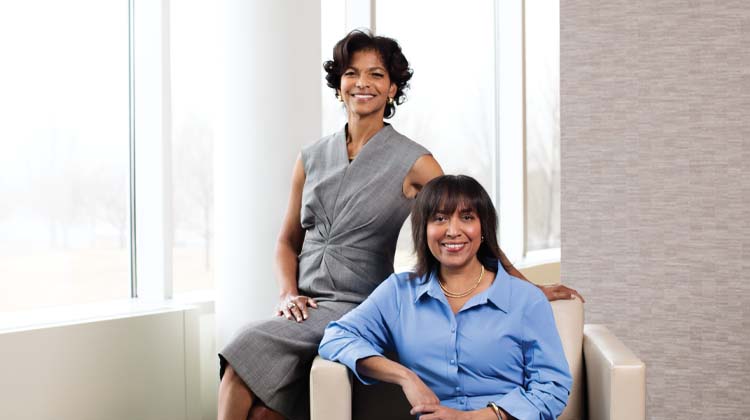
Gail Peterson, a former executive at General Mills and Ecolab, is among the women on the Minneapolis-based carrier’s board. A Black woman, Peterson also is one of the few Minnesota women of color who serve on public company boards in the United States.
“By the time you’re on a board, the power to ask really good questions and be curious is important,” Peterson says. A board is most effective, she adds, when it represents differences in business expertise, as well as gender, race, ethnicity, and other factors.
“Diverse teams make better decisions, and they are more innovative or better with handling complex problems,” Peterson says. She cites considerable research that has explored the diversity-effectiveness connection, which has been studied by prominent organizations that include McKinsey & Co. and Stanford University.
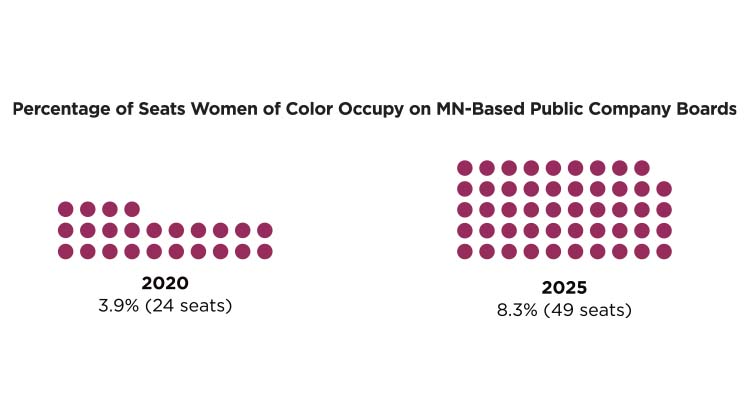
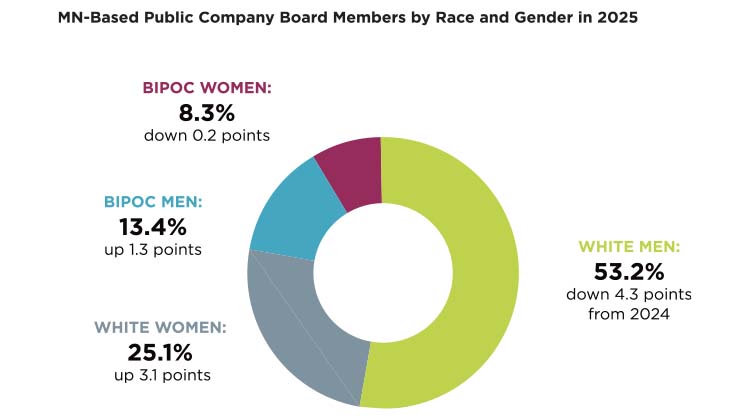
Women of color hold the smallest share of public company board seats—after white men, white women, and BIPOC men—in Minnesota and the United States. But they’ve more than doubled their portion of seats in Minnesota since 2020 to 8.3% in 2025 and they’ve made measurable progress at the national level.
“Diverse teams make better decisions, and they are more innovative or better with handling complex problems.”
—Gail Peterson, former General Mills and Ecolab executive and Sun Country Airlines board member
Twin Cities Business explored what it takes for women of color to secure board seats by interviewing diverse women currently serving on boards. TCB also examined the impact of a board readiness program created by Women Corporate Directors in 2020 to help BIPOC women executives become public company board members.
Clearing hurdles
Kim Nelson retired in 2018 after a three-decade career at General Mills, which included service as president of its snacks division from 2004 to 2010. Now Nelson devotes her time to corporate board work. In mid-March, she was preparing to fly to London for a board meeting for Tate & Lyle, a maker of specialty ingredients for sustainable food and drinks. Nelson is the senior independent director for the Tate & Lyle board, which she joined in 2019. Nelson also serves on the boards of Colgate-Palmolive Co. and Cummins Inc.
Since 2020, Nelson has been the driving force behind the board readiness program that’s an initiative of the Minnesota Chapter of Women Corporate Directors (WCD). After George Floyd’s killing, Nelson says, she thought about how she could increase opportunities for people of color. She decided to leverage her experience and connections in the corporate world.
“We know there are many qualified women of color in our market,” says Nelson, who is Black. She wanted to help diverse women business executives increase their numbers on corporate boards.
“I listened to Kim present the concept and vision. I wanted to make a difference,” says Kate Kelly, a former banking executive. Kelly, who is white, joined Nelson’s board readiness planning committee in 2020 because she thought the new program would achieve tangible results in the aftermath of George Floyd’s death.
Under Nelson’s leadership, the WCD Minnesota Chapter developed a seven-part program, which includes how to build a strong board biography, position oneself as a board candidate, build a network for board seats, connect with recruiters, and interview for board seats.
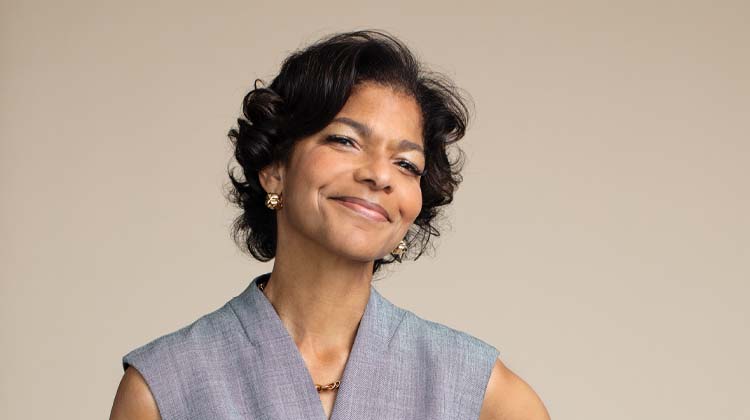
“Opportunities were being left on the table by having boards that were all white male CEOs who knew each other vs. having boards that brought in people with different skill sets,” Nelson says.
“Whether it’s management teams or board teams, the more alike people are, the more likely you end up at groupthink,” she says. “The more different people are, the more you might have some different thoughts as you weigh risks and evaluate opportunities and make capital allocation and strategy decisions.”
By late 2020, the board readiness program was designed, and the first cohort of women of color completed it by mid-2021. For the first three years of the program, the WCD sessions were conducted exclusively for women of color. About 20 to 25 women are selected for the program each year. “We’re doing nothing more than what we wish had been in place when we were all looking for our first board,” Nelson says.
Read more from this issue

Nelson and Kelly emphasize that the women who complete the WCD program are veteran business executives who are qualified to serve on a corporate board. The readiness program is tailored to help them market themselves and make the right connections so they can be seriously considered for board service.
“Whether it’s management teams or board teams, the more alike people are, the more likely you end up at groupthink.”
—Kim Nelson, former General Mills executive and member of three corporate boards
After targeting women of color, Nelson says the program is now open to BIPOC and white women. That switch was made in year four because there is still a relatively small population of women of color who have the business credentials to serve on a public company board.
The sixth cohort is now taking part in the program. Since it was launched, Nelson says that 25 women of color from the program have landed seats on public company boards, private business boards, or nonprofit boards, including large health care systems. In addition, five white women who completed the WCD program have secured board seats.
Progress for women of color
A variety of factors help to explain the increase in women of color on corporate boards.
In 2018, the California legislature passed a bill that required that public companies headquartered in the state have at least one woman board director by the end of 2019 and three by 2021.
“That sent shock waves,” Nelson says. “That was the beginning of a much more demand-oriented approach to board diversification.” In response, she says, “you started to see some of the proxy advisors also urging board diversity.” Proxy advisors are third-party firms that provide recommendations to institutional investors, including on governance and director elections.
George Floyd’s killing in 2020 provided another inflection point that prompted the corporate sector to closely look at the portion of board seats held by people of color, Nelson says.
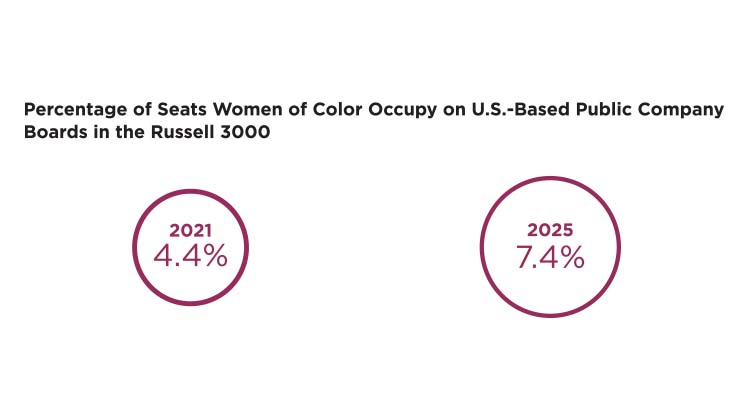
BIPOC women and men made representation gains during the Floyd racial reckoning period. By the second quarter of 2025, people of color held 18.7% of board seats in the Russell 3000, which includes the 3,000 largest public companies in the United States. Women of color held 7.4% of those board seats.
Equilar collected U.S. company data for the 2025 Gender Diversity Index Report issued by the 50/50 Women on Boards nonprofit. It said the high point for women of color on Russell 3000 boards was 7.7% in the second quarter of 2024. Board seats for BIPOC women dropped marginally from 2024 to 2025. It’s still unclear whether the portion of seats held by women of color will continue to decline or whether that was a statistical blip.
But there are new factors that could influence how some public companies and proxy advisors view board diversity.
In 2022, a California court ruled that the state’s gender mandate was unconstitutional and that state government could not dictate corporate board makeups. That was a major setback for women’s advocates who thought California’s law could serve as a model for other U.S. states.
In addition, since President Trump took office in January 2025, Trump and his administration have decried diversity, equity, and inclusion efforts inside and outside the federal government.
“The pause in board diversity gains should serve as a critical reminder to business leaders, investors, and policymakers that representation must also be paired with inclusion and engagement to drive lasting change,” David Chun, founder and CEO of Equilar, said in the report.
“Stalled progress means missed opportunities and risks treating diversity as a check-the-box exercise rather than a strategic advantage,” Chun said. “Even in this environment, it is encouraging to see many companies doubling down and renewing their strategies to build truly inclusive leadership to reshape company culture, mitigate risk, and spark innovation.”
No ‘ticket’ for diverse women
Veteran BIPOC women executives make the case that there are solid business reasons to include a diverse range of people on corporate boards.
Peterson’s many career accomplishments placed her in a strong position to meet board qualification thresholds. A product of the public schools in Louisville, Kentucky, Peterson was valedictorian of her high school graduating class, which helped her secure major scholarships to attend Princeton University. She joined General Mills after earning a bachelor’s degree in psychology. Seeing her potential, General Mills paid her tuition to earn an MBA from Harvard Business School. After distinguishing herself in marketing at General Mills, she joined Ecolab, where she served as chief marketing officer before leaving in 2024.
While Peterson’s Harvard MBA program and executive trajectory are similar to that of some white men who serve on corporate boards, she says a governing body benefits when people bring different experiences to their board service.
“A woman moves through the world differently than a man,” Peterson says. “A person who has an accent moves through the world differently than a person who doesn’t. When you have that [diversity], people see problems and opportunities very differently and ask questions very differently.”
Whether a board is dealing with executive succession planning, capital allocation, or business strategy, Peterson says, “the root of all of those things is asking good questions.” She maintains that the best scenario for governing a public company is with people who use different lenses to view board issues.
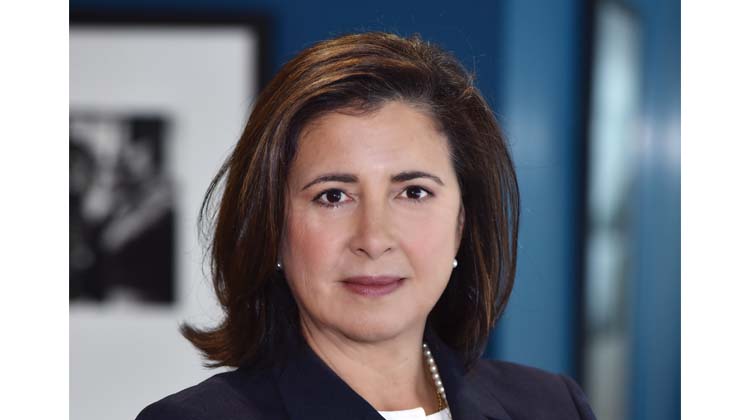
Silvia Perez is president of the 3M Co. commercial branding and transportation division, which generates about $2.6 billion in revenue per year. A native of Uruguay, Perez began her 3M career there in 1994. She moved to Minnesota in 1997 and has had a series of leadership roles at 3M, which included pharmaceuticals, infection prevention, food safety, and drug delivery.
When NASDAQ-traded Utah-based Merit Medical Systems was looking for a new director, Perez’s health care leadership experience was a strong match. The health care technology company chose Perez in 2024 to join its board.
“Having had that health care experience at a Fortune 100 company was highly valued by the board,” Perez says. “Being an active executive was important to them, and also that I was coming from a company that is highly recognized for its innovation culture.” Her international experience also was a strength for her board candidacy.
The fact that she was a woman and a Latina were pluses. “Those were not decision factors,” Perez says.
“A board goes through different needs as the company evolves,” she says. “You have to be the right person, and you have to have the right experiences. There’s no [board] ticket that comes with just being a woman or woman of color.”
The only one on the board
Lorinda Burgess was vice president of finance and CFO for the Americas Region of Medtronic in 2021 when she was chosen for a public company board seat in Illinois. Stepan Co., a chemical manufacturer, characterized her as “a seasoned finance professional who brings broad operational and strategic experience to our board.”
Two years later, Burgess was selected for another public company board seat. This time it was for AngioDynamics, a medical technology company based in Latham, New York. In a 2023 news release, the company noted her management, financial, and global operations experience. The announcement also praised “her ability to shape and execute transformative strategies that drive growth and remarkable profitability.”
Like Peterson and Perez, Burgess completed the WCD board readiness program. Burgess, a Black woman, lives in Minnesota, but travels for her board work. For Minnesota women who want to serve on a public company board, Burgess says many women need to embrace competing for seats in a national marketplace.
In addition to finding a company that’s the right fit, Burgess advises, “you have to do what you feel you can be 100% committed to.” Beyond traveling to board meetings, she says that new board members should expect to spend time on board work between meetings. “It’s a huge fiduciary commitment you make to be on a board,” she says.
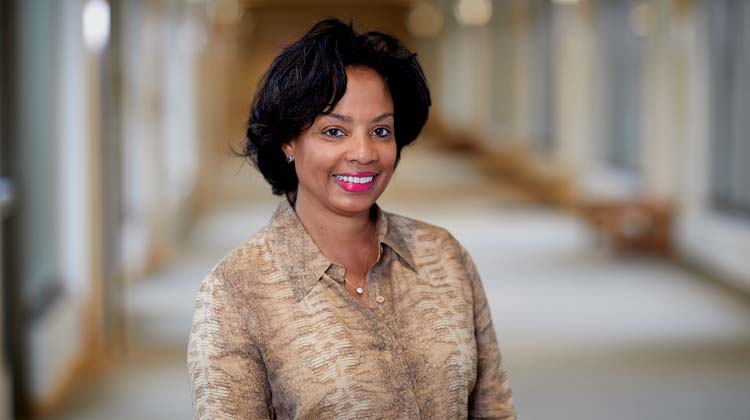
BIPOC women who seek public board seats also should be prepared to be the only woman of color on a given board. That’s the case for Burgess on the Stepan and AngioDynamics boards. While she’s the only woman of color, she says that the two boards also have men of color, other women, and board members who represent different industries and locations. As global companies, she says, “they went out and tried to find the best people to fit those board needs. I think both of them have done a nice job.”
Burgess isn’t someone who worries about being the only person in a room with a specific identity. “Since I started college at 17, [I am] frequently the only woman of color,” Burgess says. “So you get over that uncomfortableness very early in the game.” She’s taught her two daughters that lesson.
“I look at it as an opportunity,” she says. “You are showing people a different point of view than what they typically may have. By having that opportunity to be in that room, you can defuse a lot of those biases and stereotypes by how you show up.”
Buy-in from Minnesota CEOs
In November, the Minnesota Chapter of Women Corporate Directors held a joint event at the Minneapolis Club with the Minnesota Business Partnership. It was the third time the organizations got together in the fall to focus on excellence in the boardroom and kick off nominations for the board readiness program.
“We wanted to engage with CEOs in thinking about the senior women in their organizations, that board service would be a natural next step for their development,” Nelson says.
When the two groups gather each November, Nelson says, “we’ll have a panel of CEOs talking about their observations, about how different voices at the table enhance their ability to make great decisions in the boardroom.”
But she emphasizes that the WCD program’s connection with CEOs isn’t simply a once-a-year occurrence. “Our strategy, for the past three years, has been to deepen our connection with the Twin Cities employer community because we think this is mutually beneficial,” she says.
Typically, each of the seven board readiness sessions is hosted by a different private sector employer. Often the CEO will speak to the program participants.
“CEO Brian Sikes, at Cargill, spoke to the group,” Nelson says. So have Thrivent CEO Terry Rasmussen, Best Buy CEO Corie Barry, General Mills CEO Jeff Harmening, former Target CEO Brian Cornell, and Melodie Rose, president of the Fredrikson law firm.
“It enhances the quality and the experience of the program for our attendees,” Nelson says. “But it also provides that platform for the CEO to talk to this generation, this room full of very accomplished women, about how they think about diversity in the boardroom.”
New networking playbook
Many experienced women executives have excelled in academics and are accustomed to getting several good job offers. But landing a board seat is new territory. Before a woman serves on a board, Peterson says, she needs to persuade recruiters and corporate board members that she has the capacity to move from being an operator of a business to being a governor of the corporation.
Before she can make her way to a final interview, she needs to attract the attention of those creating board candidate slates. “The biggest avenue that you have to getting on a future board is the network that you create,” Burgess says. “You just can’t rely on recruiters, because recruiters have a vast number of candidates.”
She advises candidates to think broadly when networking for board seats, and notes the women who’ve completed the board readiness program are included in many such networks.
3M’s Perez says that she heard about the Women Corporate Directors program from Kelly, who has served on the program’s committee since its inception. After a Children’s Theatre Co. board meeting, Perez told Kelly she wanted to serve on a corporate board. Kelly linked her to WCD training. “One of the gifts that I got from CTC is a very broad network, and in this case, Kate Kelly,” Perez says.
“You have to have the experience, the credentials, and the knowledge,” Perez notes, “but your connections and your network are your most important asset.”
By the Numbers: Women of Color on Public Company Boards
In recent years, women of color have made measurable gains in the portion of seats they hold on public corporate boards.
Sources: Minnesota Census of Women in Corporate Leadership by St. Catherine University; 2025 Gender Diversity Index Report by 50/50 Women on Boards