Is There a Higher Power at 40,000 Feet?
Bill Wilson, who co-founded Alcoholics Anonymous in 1935, often told audiences about his personal journey to sobriety, including how important it was for him to help other alcoholics to stay sober himself. As AA membership expanded throughout the 1940s, Wilson, a natural leader and inspiring speaker, avoided emphasizing the religious roots underlying his organization. According to Ernest Kurtz, author of Not-God, A History of Alcoholics Anonymous, Wilson finally took the risk of exposing his own religious conversion at an AA national convention in 1955:
“My depression [back in 1935] deepened unbearably and finally it seemed to me as though I were at the bottom of the pit. I still gagged badly on the notion of a Power greater than myself, but finally, just for the moment, the last vestige of my proud obstinacy was crushed. All at once I found myself crying out, ‘If there is a God, let him show Himself! I am ready to do anything, anything!’
“Suddenly the room lit up with a great white light. I was caught up into an ecstasy … I was a free man! … there was a wonderful feeling of Presence, and I thought to myself, ‘So this is the God of the preachers!’ ”
Wilson’s epiphany, immortalized in the Twelve Steps of AA, has helped over 2 million alcoholics achieve sobriety as “active members of AA,” according to AA’s website. Alcoholics Anonymous group meetings and sponsorship programs are ubiquitous around the globe, and are generally acknowledged as a positive group support treatment for substance abuse. But some people object to its religious undertones, in particular its Protestant messaging. A recent alcoholic pilot’s successful case against his employer illuminates the conflict.
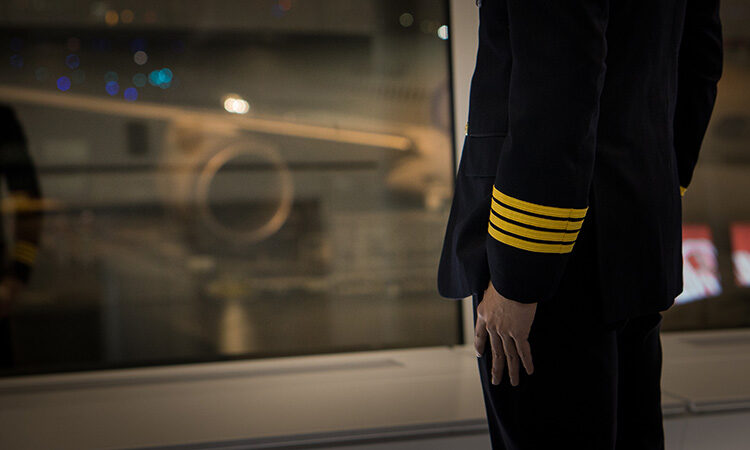
United Airlines Captain David Disbrow, a Buddhist, was a 30-year employee when he entered an alcohol treatment program in 2018.
When he acknowledged his addiction, Disbrow lost his FAA medical certification to fly, and thus his job. Reinstatement under FAA rules requires commercial pilots to attend the FAA’s HIMS program (Human Intervention Motivational Study), an occupational substance abuse treatment program for commercial pilots.
Disbrow balked at a HIMS rule: mandatory attendance at a weekly AA meeting. Instead, he wanted to attend an alternative support group, the Buddhist-inspired program Refuge Recovery. United refused, and Disbrow engaged the Equal Employment Opportunity Commission (EEOC) to fight on his behalf.
Disbrow won the fight. Under a consent decree, United agreed in November to pay him $305,000 in back pay.
The airline made a formal admission that pilots seeking alternative sobriety treatment based on “sincerely held religious beliefs” must be accommodated.
Title VII of the Civil Rights Act of 1964 prohibits religious discrimination in employment, including religious harassment, and it requires workplace accommodation of religious beliefs and practices unless the accommodation would create an undue hardship on the employer.
According to the EEOC’s Compliance Manual on Religious Discrimination, “Religion includes not only traditional, organized religions such as Christianity, Judaism, Islam, Hinduism, Sikhism, and Buddhism, but also religious beliefs that are new, uncommon, not part of a formal church or sect, only subscribed to by a small number of people, or that seem illogical or unreasonable to others.” A belief is, according to the EEOC, “religious for Title VII purposes if it is ‘religious’ in the person’s own scheme of things, i.e., it is a sincere and meaningful belief that occupied a place in the life of a possessor parallel to that filled by God.”
The burden for employers to vet alternative rehab programs such as Refuge Recovery is considerable, but likely not a hardship under Title VII.
On its website, Refuge Recovery describes addiction as “a kind of hell, like being a hungry ghost, wandering through life in a constant craving and suffering.” Addicts who join its program are “not asked to believe anything, only to trust the process and do the hard work of recovery.” In contrast, AA dictates that its members, “make a decision to turn our will and our lives over to the care of God as we understand God.”
For people who choose to fly, the notion of an inebriated pilot is terrifying. The “gold standard” HIMS relicensing program had a required AA component for several decades. Now, because of a federal agency’s ruling, pilots may seek a different “path of awakening,” as the Buddhists put it, to getting sober and back in the cockpit.
Linda L. Holstein is a writer, trial lawyer, and veteran employment law attorney based in Minneapolis and Chicago. Holstein also mediates employment and business law disputes (holsteinmediation.com).