Grand Casino Arena Name Will Light Up Xcel Energy Center
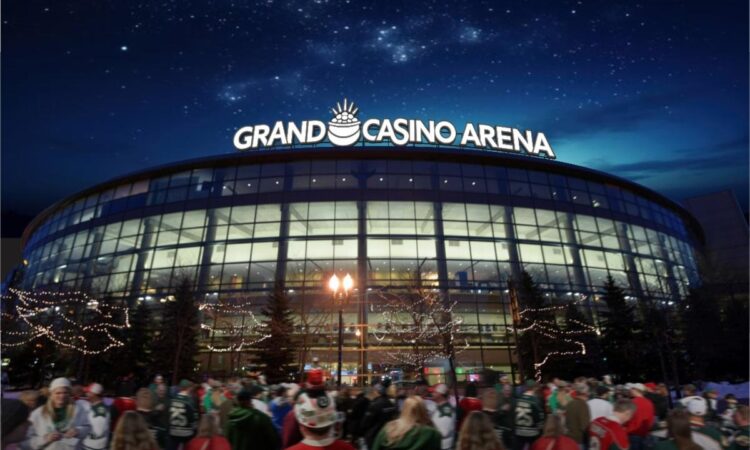
Xcel Energy Center—the St. Paul home for the Minnesota Wild and a popular concert venue—soon will become Grand Casino Arena.
A 14-year naming rights deal was announced Monday by Minnesota Sports & Entertainment, the center’s operator, and Grand Casino Mille Lacs and Grand Casino Hinckley, which are owned by the Mille Lacs Band of Ojibwe.
Minnesota Wild owner Craig Leipold is the majority owner and principal investor in Minnesota Sports & Entertainment. 2025 is a pivotal year for Leipold. He wants to sign a new contract with Wild superstar Kirill Kaprizov. He wants to build some traction on a financing plan to renovate the arena. He also wanted to nail down a new naming rights deal to succeed the one that was in place for 25 years with Xcel Energy.
After the Minnesota Legislature concluded its special session on June 10 without providing any funding to renovate the arena, Leipold closed out June by unveiling the naming rights deal.
“Grand Casino Arena will serve as the anchor of a dynamic entertainment district that transforms downtown St. Paul,” Leipold said in a Monday news release. “The Mille Lacs Band of Ojibwe has been a strong supporter of and investor in this city. We are thrilled for their partnership and support of the arena.”
Leipold now knows what revenue will flow from the naming rights partnership, however, those financial details weren’t disclosed to the public. The switch to the new name takes effect Sept. 3.
Before the Minnesota Wild drop the puck for their home season opener in the fall, interior and exterior signage will be replaced to showcase the new name of Grand Casino Arena.
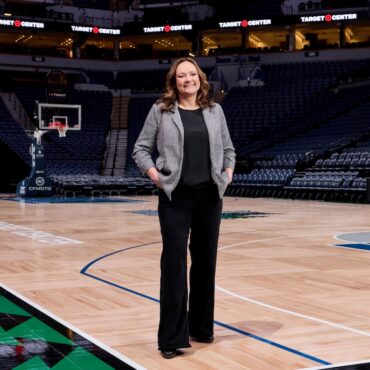
“This is more than a name change—it’s a signal of where we’re headed as a business,” Ronda Weizenegger, CEO of Grand Casino, said in a Monday statement. “Grand Casino Arena represents the strength of tribal enterprise, and our ongoing investment in Minnesota’s future. We’re proud to partner with the Minnesota Wild to bring this vision to life.”
Twenty-five years ago, the Minnesota Wild played in their new arena for their inaugural season of 2000-2001. Xcel Energy also was a new business. It was the product of a merger between Minneapolis-based Northern States Power and Denver-based New Century Energies. The naming deal elevated the Xcel Energy name.
Grand Casino is in a different situation because it’s already a known brand in Minnesota. However, the Mille Lacs Band sees business growth stemming from the naming deal.
“This partnership is a dream,” Jeff LaFrance, head of marketing for Grand Casino, said in a Monday statement. “Grand Casino Arena gives us an incredible platform to engage fans, tell our story in bold new ways, and bring the Grand Casino experience to downtown St. Paul. From digital activations to in-arena surprises, we’re building something unforgettable.”
Arena upgrades, signing Kaprizov
The arena is owned by the city of St. Paul. In mid-March, St. Paul Mayor Melvin Carter unveiled a $769 million project budget to cover renovations for Xcel Energy Center and the adjacent Roy Wilkins Auditorium and Saint Paul RiverCentre. Carter sought $394.6 million from the state of Minnesota.
As the legislative session proceeded, Carter and Leipold reduced their request for state funds and decided to focus first on arena improvements. But they still came up empty-handed from the evenly divided Legislature of 101 Democrats and 100 Republicans.
The Xcel Energy Center complex is an economic driver that brings more than 1.7 million visitors to downtown St. Paul on an annual basis, according to Minnesota Sports & Entertainment.
Leipold is a leader in efforts to revitalize downtown St. Paul. In a June 2 panel discussion, Ecolab CEO Christophe Beck said that he, Leipold, and Securian Financial CEO Chris Hilger view it as a civic responsibility to bring more economic life to downtown St. Paul.
“We’ve become such close friends,” Beck said of the trio of business leaders. “It’s this friendship, this relationship, the trust, the commitment,” he said, which drives their common work.
Meanwhile, for Leipold and ardent Wild fans, securing a new contract with Kaprizov is job No. 1.
July 1 is the first day that Kaprizov and the Wild could sign a contract. For a certain time frame, the Wild can exclusively bargain with Kaprizov.
Based on what Kaprizov said to the media at the conclusion of the 2024-2025 season, many Wild observers contend that Kaprizov would like to remain with the Minnesota Wild. Now, speculation has shifted to what type of contract duration would most appeal to Kaprizov.
“We will be competitive on money, and nobody can offer him eight years [in duration] but us,” Leipold said in a TCB interview earlier this year. “When you are re-signing a player, you can do it for eight years. If you go to the open market, [a team] can only do seven years.”
The open question is whether some of the best players in the National Hockey League will want to lock in long-term contracts or choose medium-term contracts and take a chance on how high team salary caps will go in the coming years.