Gains for Women Executive Officers Are ‘Marginal at Best’
Released this week in the April/May issue of Twin Cities Business, the 2023 Minnesota Census of Women in Corporate Leadership urged directors of every publicly traded company in Minnesota to take a hard look at their executive officer teams and do more to boost women’s representation. “Progress does not just happen on its own,” said the report’s authors. “Board members, especially women board members, can assist by requiring CEOs to set goals and enact policy changes to turn wishful thinking into action.”
Every year, St. Catherine University produces the report that analyzes women’s representation in C-suites and on boards of directors at Minnesota’s publicly traded companies– currently, a pool of 73. In 2023, the percentage of women on boards of directors reached 30% compared to 28.2% in 2022, while the number of women serving as executive officers has stayed more or less unchanged at around 23%.
The report’s authors—St. Kates professors Diane Fittipaldi, associate professor of business administration, and Anupama Pasricha, interim dean of the business school—credited the 1.8% bump in women board directors to two things: an increase in the number of board seats (from eight seats to 8.9) and a 2023 Nasdaq ruling that requires companies traded on the exchange to disclose board diversity annually and have at least one diverse board member. By 2026, the latter requirement will get bumped to two diverse board members.
Although the small bump in women board directors underscores the importance of baby steps, according to the report, gender parity remains out of reach, and the work to install more women board members and CEOs is far from complete. “It feels strange to celebrate women getting the equal representation they’ve previously been denied,” Fittipaldi and Pasricha wrote.
Further emphasizing the lack of progress in women’s representation, the Census noted that Minnesota falls below the national benchmark in many categories, according to McKinsey & Co. (Women in Workplace, 2023).
For instance, women make up 23.1% of executive officers in Minnesota, compared to the national average of 28%. In 2023, Minnesota had 12 BIPOC women executive officers, one more than in 2022. That’s 2.5% of executives, compared to McKinsey’s benchmark of 6%.
The Census pointed to apathy among male executives as a key barrier, with 74% of men interviewed stating that they were either unconcerned about the issue or did not see a compelling reason to get involved, according to Research by Catalyst (2022). The same percentage of men feared the loss of their status if women were to achieve equality. “Until or unless these fears and attitudes are alleviated, parity within the ranks of executive officers will be unattainable,” said the report’s authors.
New this year, the report included the best practices of the companies with a strong representation of women across the pipeline. Adapted from the 2023 McKinsey & Co. Survey, Minnesota’s top-performing companies employed methods such as career development programs with targeted content for women, employee resource groups for women, and regular audits of DEI policies and programs. Their best practices also included training that intersected across many sectors, including relationship building, employee wellbeing, fostering DEI, and cultivating a growth mindset.
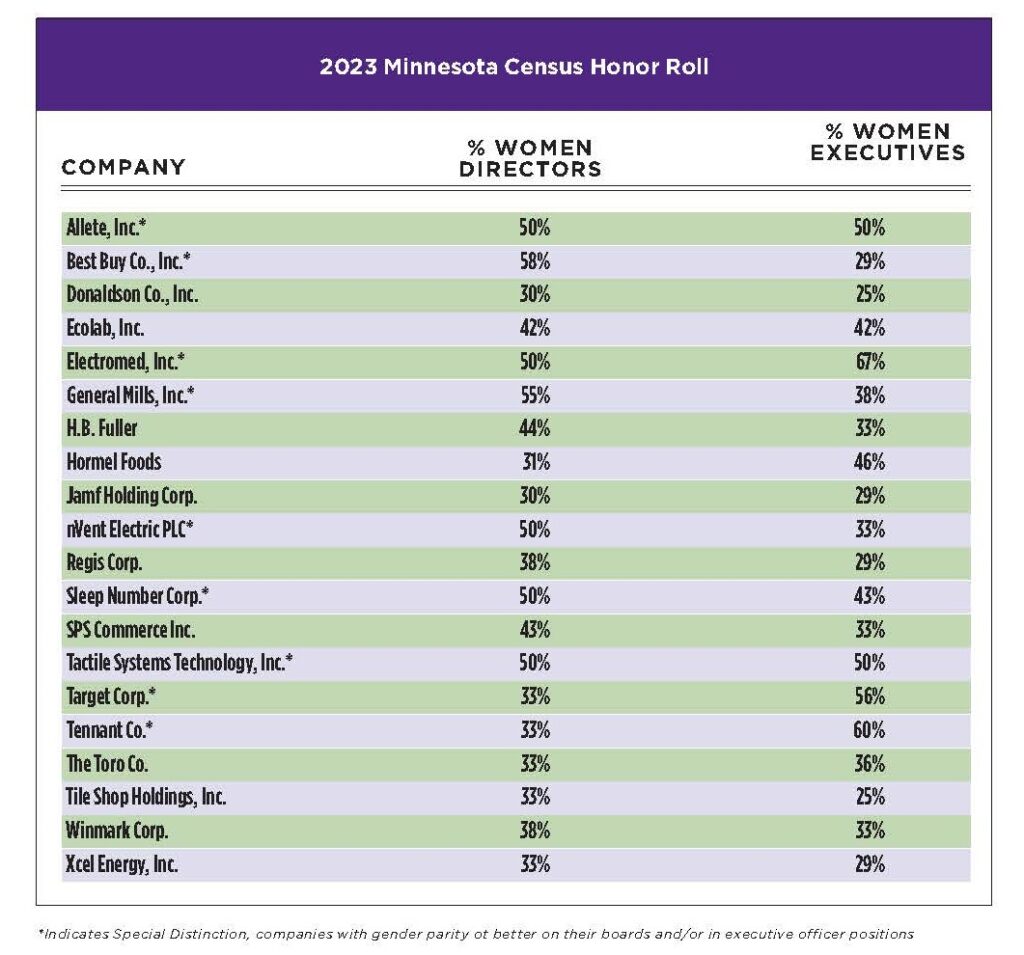
This year, the Census set the “honor roll” benchmark at 30% women on boards and 23% for women executive officers. Special distinction is awarded to companies with gender parity on their board, among their executive officers, or both.
Of the 73 companies, 20 companies qualified for honor roll status, three fewer than last year. Notably, Allete, Electromed, and Tactile Systems Technology have reached gender parity on both their boards and among their executive officer teams. This bumped special distinction up to nine companies.
Honor Roll companies will be recognized at TCB‘s Women in Leadership event on April 16. The program will also include an overview of key findings from the Census.