Fedor: Lacking Strong Leadership Ties—Minnesota’s Progress Will Be Stunted
For those who crave new leadership, your wishes have been granted. In Minnesota, half of the state’s biggest employers have new CEOs since 2021. The same pattern holds true for foundations, nonprofits, and colleges and universities. We are awash in a tide of new leadership.
But there’s a huge problem: Many of these organizational leaders don’t know each other and it takes collective action to tackle many of the state’s biggest problems.
Case in point: On Nov. 19, the Minnesota Chamber Foundation released a report with disturbing statistics. It disclosed that Minnesota’s real GDP per capita annual growth rate, from 2019 to 2024, was a paltry 1.0%. That placed Minnesota 38th in the nation.
Another cause for alarm is the size of Minnesota’s workforce. The Chamber reported that Minnesota’s total civilian labor force annual growth rate, from 2019 to 2024, was a minuscule 0.2%. That earned Minnesota a 40th ranking in the United States.
The Chamber closed out its report by identifying major factors that are “holding us back” as a state. The high cost and availability of housing and child care are major issues. So is the fact that Minnesota’s cost of living is higher than what people are paying in neighboring states. In addition, Minnesota is losing young talent—“a net loss of about 8,300 college-age students to other states each year,” according to the report.
If Minnesota wants to reverse these trends, it will require law changes that foster more robust business growth. It also will require the development of intelligent, workable solutions devised by private, public, and nonprofit leaders focused on making Minnesota a place where young people and middle-income families want to live and can afford to live.
Right now, Minnesota is struggling. Minnesota’s net domestic migration, between 2020 and 2024, was a minus 47,900. That negative number pushed Minnesota to the bottom one-fifth of U.S. states, with a ranking of 41.
So, who should solve these problems? If they want to have good schools, safe communities, and plentiful well-paying jobs in Minnesota, then all 201 Minnesota legislators should ask themselves what they can do to support private business growth. Those questions should be posed by citizens to candidates from both major parties who want to hold statewide office.
But the problems that have surfaced in communities across Minnesota will take more than governmental interventions and policy changes. The brainpower and resources of Minnesota’s business and nonprofit leaders also must be deployed.
Lars Leafblad, long involved in Minnesota’s civic spaces, reported in his Nov. 2 newsletter that there has been a breathtaking turnover in leadership in all three sectors.
Leafblad, co-founder and partner for the St. Paul-based Ballinger|Leafblad search firm, documented the leadership transition that’s occurred among Minnesota’s largest employers and civic leaders from the nonprofit world.
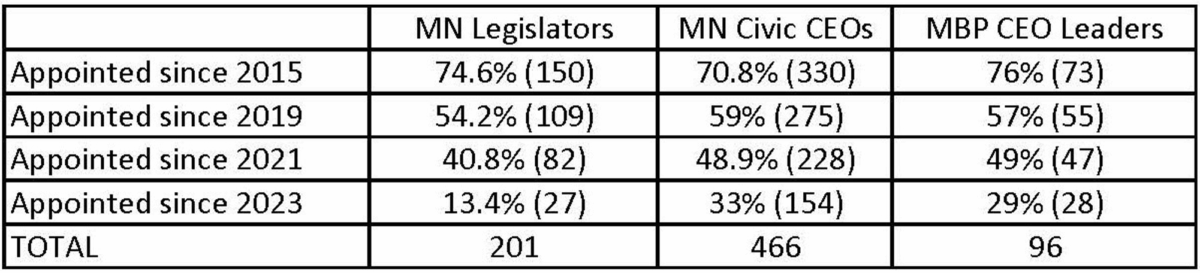
Ballinger|Leafblad’s research showed 49% of the top leaders of Minnesota’s major employers assumed their positions since 2021. The consulting firm generated that percentage by looking at the start dates of the 96 current members of the Minnesota Business Partnership. Most members are CEOs of large for-profit companies, but the membership also includes other key employers, such as the University of Minnesota and the University of St. Thomas and Thrivent, which is a not-for-profit membership organization.
The consulting firm also looked at turnover among civic leaders, who are the heads of foundations, nonprofits, member associations, higher education institutions, and other organizations. Among the 466 civic leaders in the study, the consulting firm found that 228 people, 48.9%, began their jobs since 2021.
In his newsletter, Leafblad also referred to research about Minnesota legislators that was done by Blois Olson, founder of Fluence Media and Fluence Advisory, and Paul T. Anderson of Fluence Advisory. They found that 82 of the 201 legislators, or 40.8%, had assumed their positions since 2021.
“Over the last five years, we’ve experienced a perfect storm of events that have left a wake of division and disconnection across our state: a global pandemic, the murder of George Floyd, political violence, mass shootings, and seismic generational retirements and turnover in our elected, civic, and corporate leaders,” Leafblad wrote in his newsletter.
“Each variable alone could have dramatically impeded Minnesota’s long-heralded ability to find compromise and common ground on a foundation of trust to move us forward together,” Leafblad wrote. “In the wake of this collective disruption, we need to invest in building trust across generations, geography, sectors, cultural identities, and political ideologies in Minnesota.”
Leafblad’s insights made me think about stories I wrote in 2025 about business leaders’ involvement in civic engagement.
One of those stories was published in June with the headline “Relationships Among MSP’s Corporate Leaders Fuel Civic Engagement.”
This story was based on a Harvard Club of Minnesota panel that I moderated at the Minneapolis Club. The panelists were Christophe Beck, chairman and CEO of Ecolab; Bill George, former Medtronic CEO and executive fellow at the Harvard Business School; and Tim Welsh, former vice chair of consumer and business banking at U.S. Bank and president of Chicago-based CCC Intelligent Solutions, Inc.
All three of them talked about the importance of business executives forming relationships with each other as well as leaders in the public and nonprofit spheres. They emphasized the need for all three sectors to be involved in addressing major issues.
Beck warned the audience that other states and countries are recruiting Minnesota businesses and leaders to move to their locations.
“We have everything we need to win,” Beck said. “So, if we get organized, if we trust each other, if we do [things] the right way, there is zero doubt in my mind that we will get to the right place.”
At the same event, Welsh recalled how the Itasca Project had served as the “dining room table” where “people from government, business, and nonprofits have come together to get to know each other.” In June, Welsh didn’t know that the Itasca Project would sunset operations within a few months.
But he referenced the major leadership transition that was taking place among all three sectors.
“Unless we as a community are intentionally in the process of relationship building and relationship renewal, we can’t get anything done civically because we won’t know each other,” Welsh said.
The Itasca Project was one vehicle for relationship building, devising solutions to complicated problems, and marshaling resources to make Minnesota a better place for people along all rungs of the economic ladder.
People who are strangers and those who’ve merely shaken hands with a new leader don’t have the capacity to be effective community leaders.
In 2026, veteran leaders and new leaders need to prioritize relationship building with people who could become allies in addressing economic and social problems.
Some of this work can be done in one-on-one breakfasts or lunches. Other progress can be made when one leader invites six or eight people to join him or her in conversation.
Considering the demise of the Itasca Project, key leaders should examine whether a new civic organization should be created. Or, whether the greatest progress could be made by expanding the roles of existing organizations or being more intentional about building action coalitions.
Minnesotans must face some stark realities.
In our state, we’ve had a massive turnover in top leaders. More energy must be devoted to building relationships among the new leaders and with veteran leaders. Failure to build the relationships would lead to Minnesota continuing to lag other states for workers and economic growth.